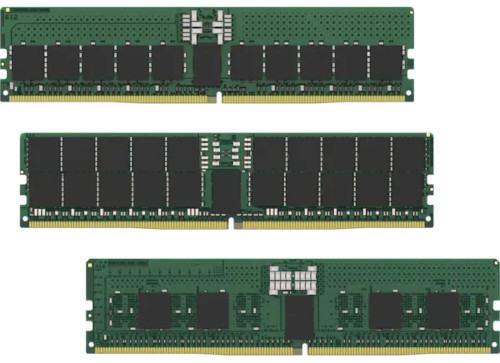
These modules have 32 internal banks, increasing efficiency by allowing more pages to be opened simultaneously. While DDR4 reaches a maximum of 3200 MT/s, DDR5 starts at 4800 MT/s (a 50% increase in bandwidth according to the JEDEC industry standard) and has planned standard speeds reaching 8800 MT/s. The modules feature integrated error correction code (ECC), which corrects bit errors on the DRAM chip and improves reliability.
These memory modules also feature post-packaging hard/soft repair and sideband access with I3C/I2C. With a typical supply voltage of 1.1V, DDR5 memory modules consume 20% less power than equivalent DDR4 components. These modules have a typical drain-out stage voltage of 1.1V and a typical peak-to-peak voltage of 1.8V. DDR5 SDRAM memory modules are UL 94 V-0 class, RoHS compliant, and operate in a temperature range of 0 to 95°C. These modules meet the needs of high-performance systems for edge computing, artificial intelligence (AI), gaming consoles, industrial applications, content creation workstations, as well as servers and data centers.