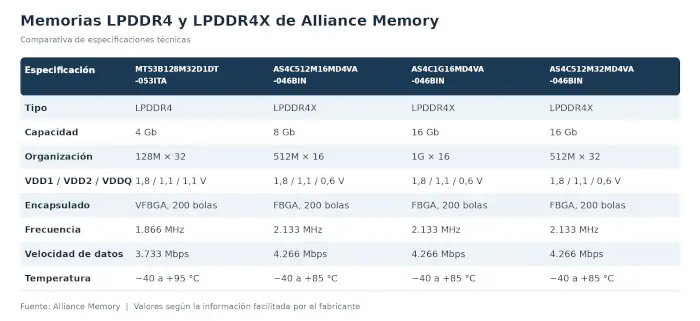
The new memory modules are available in VFBGA and 200-ball FBGA packages and offer clock speeds up to 2,133 MHz, with transfer speeds up to 4,266 Mbps. This family is geared towards portable electronic equipment, industrial systems, and connected devices that require a combination of memory capacity, performance, and low power consumption.
LPDDR4X memories with voltages up to 0.6V
The new LPDDR4X devices operate at a VDDQ voltage of 0.6V, reducing energy consumption and extending the battery life of devices powered by batteries. Intended applications include smartphones, tablets, smart speakers, wearables, video surveillance systems, and communications equipment. They can also be used in computing platforms and IoT devices incorporating artificial intelligence and 5G connectivity.
Capacities of 4, 8 and 16 GB
The range includes four models with different capacities and internal configurations. The 8 GB AS4C512M16MD4VA-046BIN, and the 16 GB AS4C1G16MD4VA-046BIN and AS4C512M32MD4VA-046BIN, reach frequencies of 2,133 MHz and speeds of 4,266 Mbps. Meanwhile, the 4 GB MT53B128M32D1DT-053ITA memory offers a frequency of 1,866 MHz and a transfer speed of 3,733 Mbps.
LPDDR4X memory supports operating temperatures from −40 to +85 °C, while the LPDDR4 model extends the upper limit to +95 °C.
Synchronous operation and energy management
The 8GB and one of the 16GB versions have one 16-bit channel, while the other two models have two 16-bit channels. Each channel has eight internal banks per memory array. The devices offer fully synchronous operation, programmable read and write burst lengths of 16 and 32 bits, dynamic selection, and configurable output intensity.
In addition, they integrate a temperature sensor that controls the self-refresh frequency to adapt the memory's operation to the thermal conditions.
Compatibility and availability
According to Alliance Memory, the new memories can be used as pin-compatible alternatives to numerous existing solutions, eliminating the need for board redesigns and new certification processes in compatible applications. The devices are available in both sample and production quantities, with an announced delivery time of eight weeks. The manufacturer also indicates a three-year supply continuity period.