
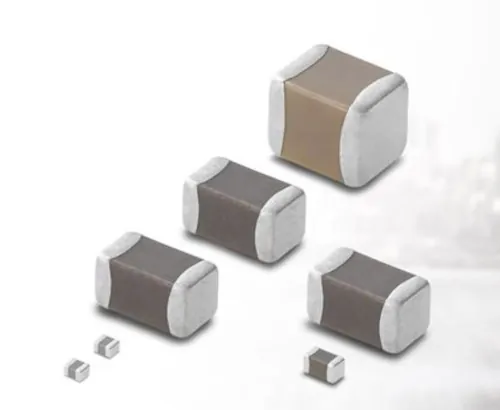
Five components in the GCM series have a nominal voltage of 2.5–4 Vdc and are intended for integrated circuit (IC) peripheral circuits in advanced driver assistance systems (ADAS) and autonomous driving (AD) applications. The two remaining MLCCs have a nominal voltage of 25 Vdc for on-board vehicle power line applications.
In recent years, as ADAS and AD technologies have advanced, the number and performance levels of systems installed in vehicles have steadily increased. As a result, the demand for low-voltage, higher-capacity MLCCs used around integrated circuits to ensure stable operation has grown. Furthermore, as the number of MLCCs mounted on printed circuit boards (PCBs) increases, space constraints become the critical factor restricting design. Simultaneously, for medium-voltage MLCCs used in automotive power lines, there is a growing demand for both miniaturization and increased capacity to improve power density and assembly efficiency. These needs are particularly pronounced in ADAS and AD systems, where both the peripheral circuitry of the integrated circuits and the power lines are subject to significant voltage fluctuations, necessitating increased capacity and reduced component size. Leveraging its proprietary ceramic materials, along with particle refinement and uniformity technologies, Murata introduces seven automotive MLCCs that achieve the world's highest capacity relative to nominal voltage and size.
For low-voltage MLCCs, Murata has expanded its product range with a capacity of 100 µF or higher, reaching 100 µF in the 1206 size (3.2 mm × 1.6 mm), which was previously only available in the larger 1210 size (3.2 mm × 2.5 mm). This reduces the printed circuit board (PCB) mounting area by approximately 36%. Furthermore, in the smallest automotive MLCC size, 0.201 inches (0.6 mm × 0.3 mm), the capacity has been increased from the usual 1–2.2 µF. In the case of medium-voltage rated MLCCs, Murata has achieved a capacitance of 1 µF in the 0.402 inch (1.0 mm × 0.5 mm) size, which was previously only achievable in the larger 0.603 inch (1.6 mm × 0.8 mm) size, reducing the mounting area on the PCB by approximately 61%.
By combining this product range, Murata addresses a wide variety of challenges in the automotive market, including the increased capacitance requirements around integrated circuits, the severe space limitations on printed circuit boards, and the stabilization of power lines, thus contributing to the stable operation of complete systems and greater design flexibility. Furthermore, reducing the number of MLCCs required allows for less PCB material usage and lower energy consumption during manufacturing, helping to reduce environmental impact.
In the low-voltage range, the GCM035D70E225ME02, with a nominal voltage of 2.5 Vdc, is available in size 0201 (0.6 mm × 0.3 mm) and offers a capacitance of 2.2 µF, the highest capacitance in the world for its voltage class and size. The GCM31CD70E107ME36 model, size 1206 (3.2 mm × 1.6 mm), has a nominal voltage of 2.5 Vdc and offers 100 µF, the highest capacitance in its class worldwide.
The GCM035D70G225MEC2 has a nominal voltage of 4 Vdc, is available in the 0.6 mm × 0.3 mm (0201) size, and offers 2.2 µF, also the highest capacitance in this category worldwide. The GCM31CD70G107ME36 has a nominal voltage of 4 Vdc, is available in the 1206 inch size (3.2 mm × 1.6 mm), and offers 100 µF, which is the highest capacitance in the world for this nominal voltage and size. The GCM32ED70G227MEC4 has a nominal voltage of 4 Vdc, is available in the 1210 size (3.2 mm × 2.5 mm) and offers 220 µF, the world's largest capacitance in this class.
The medium voltage range includes two products designed for power line applications. The GCM155D71E105KE36 has a voltage rating of 25 Vdc, is available in a 0.402-inch (1.0 mm × 0.5 mm) size, and offers 1 µF, which is the world's highest capacitance for this voltage rating and size. Also rated at 25 Vdc, the GCM31CC71E226ME36 is available in a 1206-inch (3.2 mm × 1.6 mm) size and offers 22 µF, which is also the world's highest capacitance in its class.
Learn more