Well, some people might do that. But do they actually take a wrench, consult the connector's datasheet, and adjust the torque to the specified strength? The truth is, it's not necessary.
However, what happens when the environment is far from ideal? What if it's not a living room or an office, but, for example, a rocket that will experience high g-forces during takeoff, or an industrial press monitoring wear in an Industry 4.0 facility where constant vibrations are a fundamental part of operation? In these cases, everything changes, and the connector, being the most vulnerable element, must be as reliable as possible, especially in critical applications that cannot tolerate failure.
Besides ensuring signal integrity and maintaining the physical connection, applications in harsh environments demand robust connectors for another reason. In an IT application, such as in a data center, equipment is likely to be installed by a qualified electronics technician. In an industrial or defense application, it might be a machine operator or personnel who disconnect and reconnect equipment as part of their maintenance work. Somewhere in the operating manual (who knows where, but it doesn't matter) there will be instructions like: “reduce torque to X Newtons”; “use the correct tools”; or simply “handle with care.” But how many operators in this situation actually consult the manual?
 Finally, we should consider Design for Manufacture (DFM). Will the connector have to withstand a large number of matings, and is there a way to simplify or accelerate the assembly process through careful connector selection? A very common problem is that design engineers only think about the connector's intended use and not how the connectors fit together. An important lesson is to always consider the production process.
For these reasons, manufacturers have developed products specifically designed to overcome these challenges. Two examples from Harwin are the M300 connectors and the recently introduced Kona family.
M300 connectors offer reliable performance in harsh environments such as aerospace, defense, and industrial applications. These compact connectors deliver up to 10A per contact, making them lightweight and robust solutions proven under extreme conditions. These 3mm pitch PCB connectors feature stainless steel screw locks to ensure the terminations are unaffected by vibration and shock.
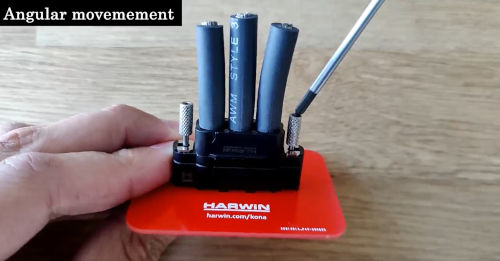
Want to know how robust these connectors are? Click here to watch a video of this author subjecting an M300 connector (Figure 1) to a hammer drill in a way that is not recommended in the technical specifications, but which demonstrates the durability of these devices. There's a bit of humor involved, but the point is clear.
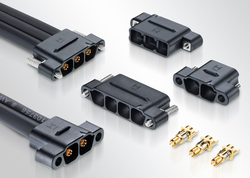 With their 8.5mm pitch and individually covered connections, the Kona family of connectors allows designers to establish high current levels for maximum power under extreme conditions, enabling systems to handle up to 60A and 3000V per contact. These high-quality connectors are available with 2, 3, or 4 pins in a compact, single-row configuration.
Vibration and shock resistance are built into the design, as the six-terminal copper-beryllium alloy contacts ensure good electrical continuity and spring strength. Their tough, robust housings protect the connections from impacts and other physical damage. The male connectors are designed for insertion into a printed circuit board, with board clamps that provide additional protection against pulling. The female wire housings feature screw closures. Female wire contacts are also supplied, allowing 8AWG wires to be soldered before assembly with the housing. As this assembly video, the robust housing facilitates blind wiring, and the socket head cap screws accept socket head screwdrivers that can be used at an angle, further simplifying blind wiring.
Let's now look at a couple of practical application examples.
A three-pin M300 connector can be used to connect a panel-mounted potentiometer. Panels are often assembled using a modular construction method and are connected by hand during final assembly on the production line. The enclosure, printed circuit boards, and components such as power supplies and sensors are also interconnected by hand, so having a robust connector like the M300, especially if supplied as part of the wiring system, will help prevent damage during production.
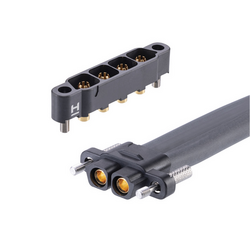 Another example would be DC/DC converters, which often rely on basic terminal blocks. In high-reliability applications, these might not be sufficient, and a four-way Kona connector or even two two-way Kona connectors would be more appropriate.
In both examples, if a basic connector were used, any accident on the premises, or worse, something that happens in the environment during operation, could cause an assembly or piece of equipment costing thousands of euros to be completely out of service.
At this point, the humble connector that design engineers often leave until last (if they even think about it at all) is actually quite vulnerable due to its mechanical and electrical function, as it's the only component routinely handled by people with varying levels of training and skill. By being proactive and risk-averse, the designer can increase product reliability and become a lifelong friend to production and maintenance personnel.
Author: Robert Webber, Director of Applications in Europe, Powell Electronics