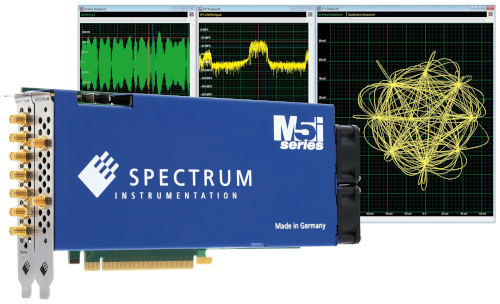
To achieve this transmission speed, they utilize 16-lane PCIe Gen3 technology. This allows acquired data to be sent to the PC's memory for storage, or to the CPU and GPU for custom signal processing and analysis. The cards also incorporate front-end circuitry with a bandwidth exceeding 3 GHz and up to 16 GB (8 GSamples) of onboard memory.
With 12-bit resolution, these digitizers offer 16 times the resolution of many digital oscilloscopes, which typically use 8-bit analog-to-digital converters. This additional resolution enables measurements with improved signal-to-noise ratio (SNR) and greater accuracy and precision. It also allows users to capture and characterize the subtlest signal details, which are often missed by lower-resolution devices.
The cards are designed to handle a wide variety of signals, such as those found in communications, semiconductor testing, spectroscopy, optical systems, and quantum physics. The front-end circuitry has a bandwidth of over 3 GHz, with programmable full-scale ranges from ±200 mV to ±2.5 V along with variable offset. Acquisitions can be performed in single-shot or multi-record waveform mode. Multi-recording divides the onboard memory into segments and allows for the acquisition of numerous events, even at very high trigger rates. It is ideal for situations such as serial bus testing or with devices that use stimulus-response processes, like those found in LIDAR and RADAR systems. For added flexibility, the onboard memory can be used as a ring buffer, functioning much like a conventional oscilloscope, or as a FIFO buffer for continuous data transmission to the PC environment.
To help capture even the most elusive signals, a range of triggering modes are available for use on the channel or external trigger inputs. These modes include conventional edge triggering, along with more sophisticated methods such as Window, Reset, Logical OR/AND, Software, and Delay. Triggering is fast and accurate, and waveform data is stored along with the corresponding trigger timestamp information. The front panel features SMA connectors for channel inputs, clock and trigger inputs and outputs, and four multifunction digital I/O lines. Additional clock and trigger connections allow the card to be synchronized with additional digitizers or other measurement devices. 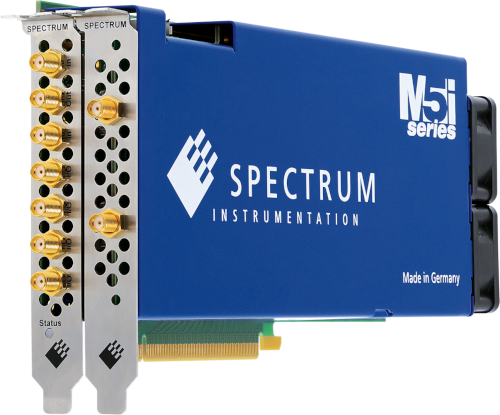 The cards can transform almost any PC into a powerful measurement tool simply by installing them in a suitable PCIe slot. This also opens the door to anyone wishing to utilize the latest CPU and GPU hardware for signal processing and analysis. The cards include all the necessary tools for use on a Windows or Linux PC. A software development kit (SDK) is supplied so the cards can be programmed in almost any popular language. This includes C, C++, C#, Delphi, VB.NET, J#, Python, Julia, Java, LabVIEW, and MATLAB. The SDK contains all the necessary driver libraries, as well as programming examples. Alternatively, for users who prefer not to write their own code, the company offers SBench 6 Professional. This powerful measurement software provides complete control of the card, along with a wealth of features for data visualization, analysis, storage, and documentation.
A key differentiating factor of all Spectrum Instrumentation PCIe cards is their ability to stream data directly to and from a CUDA GPU. This is made possible by the company's SCAPP (Spectrum's CUDA Access for Parallel Processing) package, available as a low-cost option. SCAPP includes the drivers for CUDA GPU support and allows users to develop their own processing routines. To ease the initial setup, the package includes working examples that can be modified and extended. It is ideal for users who need to perform data-intensive processing, such as continuous averaging for noise reduction or MPoint-FFTs for spectral analysis.
Another option available for the new cards is integrated summation averaging (option M5i.33xx-spavg). Averaging is a very useful tool for reducing unwanted signal noise. At the same time, it can improve measurement resolution beyond the standard 12-bit performance of digitizers, providing greater dynamic range and improved signal-to-noise ratio (SNR). This option utilizes the card's integrated FPGA (Field Programmable Gate Array) technology to average waveforms, even when sampled at a full 10 GS/s. The result is one of the fastest signal averaging solutions on the market, capable of averaging at an astonishing rate of up to 15 million events per second due to the extremely short dead time of less than 40 ns between events.
Like all Spectrum Instrumentation products, the new M5i.3350-x16 and M5i.3357-x16 cards come with a 5-year product warranty. They also include direct technical support from the engineering team and free software and firmware updates for the product's lifetime. The M5i.33xx series offers five different models, with one or two channels, allowing you to select sampling rates of 3.2, 6.4, or 10 GS/s, and bandwidths of 1, 2, or 3 GHz.