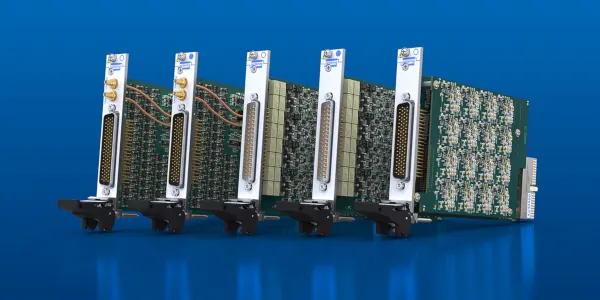
The new modules encompass multichannel waveform generation, precision digital-to-analog converter (DAC) outputs, and high-density thermocouple simulation, enabling engineers to simulate embedded controllers with realistic analog, sensor, and waveform conditions from compact, open-platform test systems. Designed to offer high channel density in a single PXI/PXIe slot, broad chassis compatibility, and full controller support, the modules help engineers create high-capacity automated test systems while reducing rack space, system complexity, and the risk of long-term obsolescence.
“Leveraging Pickering’s leading position in modular signal switching and sensor simulation, our expanding range of PXI/PXIe analog output instrumentation modules covers a broad spectrum of electronic test applications, from multi-channel waveform and function generation to precision DAC outputs and high-density thermocouple simulation,” said Stephen Jenkins, Product Manager for Simulation at Pickering. “Whether you’re developing a functional tester for the production line or a HIL test system, Pickering’s instrumentation offering delivers high channel density, reliable accuracy, and trusted long-term technical support.”.
The 41-770 PXI and 43-770 PXIe DAC modules provide up to four fully isolated analog output channels in a single 3U PXI/PXIe slot. Each channel can be independently programmed across multiple voltage and current ranges, with voltage outputs up to ±40 V and current outputs up to ±20 mA. The modules can also simulate open-circuit conditions, allowing engineers to reproduce real-world fault modes, such as faulty wiring or a sensor failure, for fault injection testing. A hardware interlock feature provides additional protection for the device under test and the entire test system.
The 41-625 PXI and 43-625 PXIe multichannel waveform generators provide up to 32 independent output channels in a single 3U PXI/PXIe slot. The modules support waveform generation from DC to 300 kHz, making them ideal for simulating real accelerometer signals and other multichannel stimulus conditions. Each channel can store waveforms in independent memory blocks, supporting sine waves, standard waveforms, or arbitrary waveforms defined by the customer, with instantaneous frequency adjustment controlled by software via direct digital synthesis (DDS). Trigger functions allow events from other instruments to initiate waveform generation or frequency sweeps.
The PXI 41-761A analog output/thermocouple simulator modules are a purpose-built solution for simulating thermocouple sensor outputs with accurate µV resolution and integrated fault insertion.
They provide independently isolated, two-wire, low-voltage outputs covering the output ranges of the most common thermocouple types, support multiple cold junction configurations, and accurately handle common-mode voltages for true sensor-level simulation. With up to 32 fully isolated channels per slot, no external switching or system expansion is required, delivering the industry's highest thermocouple simulation density in a single PXI slot.
“These new analog output modules offer a true simulation of the signal, not an approximation,” Jenkins added. “They are designed specifically for testing, rather than being general-purpose instruments adapted for this purpose. Each module is designed to accurately replicate the actual behavior of a sensor or signal for a specific simulation task—thermocouple, DAC, or arbitrary waveform—enabling more realistic and reliable automated testing than with general-purpose voltage sources or arbitrary waveform generators.”.
Designed for HIL simulation, functional testing, sensor simulation, production testing, and fault injection, these modules enable the application of software-controlled electrical stimuli to embedded controllers and devices under test (DUTs), eliminating the need for physical sensors, environmental chambers, or manual fault configurations. For slot-constrained PXI and PXIe systems, they consolidate signal generation, sensor simulation, switching, and interconnection into a single modular signal path architecture.
Drivers are available for both Windows and Linux operating systems, with a driver API that supports multiple programming languages, including C, Python, C#, MATLAB, Simulink, and LabVIEW, as well as a virtual front panel to simplify development and debugging. PXI and PXIe variants are available, including PXI modules that integrate into standard PXI chassis and Pickering's LXI/USB chassis, enabling engineers to create sustainable, long-life test architectures on open, industry-standard platforms.
All standard products manufactured by Pickering Interfaces include a three-year warranty and guaranteed long-term technical support.