

The 12-bit architecture offers certain advantages over the 8-bit structure, which, while sufficient for many oscilloscope applications, is not always ideal. Therefore, it is important to evaluate the specific advantages of a 12-bit structure and whether they are truly necessary.
This article describes the advantages of a 12-bit architecture, such as that incorporated in the new DHO4000 series oscilloscopes from RIGOL, and examines other important aspects. Since the 8-bit structure is often sufficient for many applications, the advantages and disadvantages of both architectures will also be presented.
Applications requiring higher resolution are typically related to measuring signals with a high dynamic range. This means that they may be signals with large amplitudes containing very small amplitude changes that also need to be measured. An example is the measurement of currents and voltages in power electronics.
Older 8-bit oscilloscopes allow the activation of a 12-bit High-Res mode for low-noise signal measurements. This mode is mathematically calculated on the oscilloscope after the signal is recorded. It uses oversampling, which generates an average value from the finer amplitude values, now displayed at a higher resolution. This averaging reduces noise components, allowing for the visualization of finer amplitude deviations. However, the architecture remains 8-bit (2⁸ = 256 values) if the data is saved to a CSV file. A second drawback is the significant reduction in bandwidth depending on the settling time. Furthermore, the noise level adapts to an 8-bit structure and also negatively impacts the measurement.
The RIGOL DHO4000 series offers the option of switching the instrument to a vertical scale from 1 mV/DIV to 100 µV/DIV. The minimum noise level (with a bandwidth limited to 20 MHz) in this range is less than 18 µArms (see Figure 1, at 1 mV/DIV). This allows for the measurement of even the smallest voltage and current signals (e.g., through a shunt with the appropriate impedance).
The RIGOL DHO1000 and DHO4000 series utilize a 12-bit architecture based on RIGOL's newly developed "Centaurus" ASIC chipset. This increases the number of vertical values from 256 levels to 2<sup>12</sup> = 4096 values, providing 16 times finer vertical resolution compared to an 8-bit architecture. No compromises, such as reduced bandwidth as in high-resolution mode, are necessary. In addition to improved vertical resolution, the DHO4000 series offers a very high real-time sampling rate of up to 4 GS/s and a maximum memory capacity of 500 Mpts. If the analysis requires a resolution of 4 GS/s, more than 100 ms can be recorded in this memory and displayed in high resolution using the zoom function. This results in an optimal combination of very high vertical and horizontal resolution. Furthermore, the large memory capacity allows for the visualization of a high number of signals in a single acquisition. One of the drawbacks of 12-bit resolution is that it creates significantly larger datasets than an 8-bit structure. This means that when selecting an oscilloscope, it's important to verify whether the application truly requires the high resolution and whether this will result in a larger data volume. The circuit set consists of two ASICs, one of which, the "θ-Centaurus," was developed for the analog input stage to provide the required bandwidth, 1 MΩ and 50 Ω impedances, very fast surge protection, and very low noise. This ASIC has a very high dynamic range of up to 97 dB and offers very high linearity with a THD (total harmonic distortion) of -55 dBc. This chip is also characterized by its very low noise level, which is essential for 12-bit resolution, a fundamental aspect of the 12-bit platform. If the noise level did not correspond to the higher number of bits, the increased noise would prevent the ADC from being more sensitive.
 The second chip, called "α-Centaurus," is a high-precision digital signal processor with a 12-bit ADC resolution and a sampling rate of up to 4 GS/s. Along with its resolution, this chip is also characterized by its very high temperature stability of
3.6 µV/°C and its very high synchronization (multi-chip timing) of different signals at 33 fs. Like the DS70000 series (5 GHz/20 GS/s), the DHO series uses the new UltraVision III platform. In many applications requiring very high resolution, the bandwidth is typically found in the lower range of the oscilloscope, where the effective number of bits is the same as that of the ADC, i.e., 12 bits. However, sometimes it is necessary to know the resolution up to the maximum bandwidth. This value is defined by the ENOB (effective number of bits) value, which is frequency-dependent. With the DHO4000 series, this value exceeds 8 bits across the entire bandwidth. This means that ENOB becomes important with higher bandwidths and higher resolution.
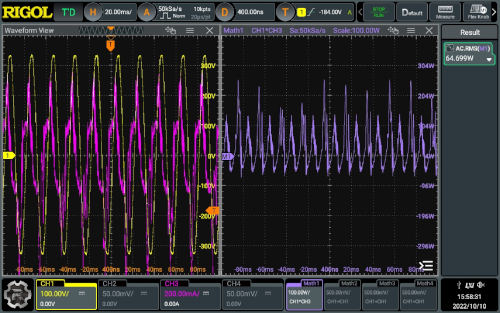
As mentioned earlier, the higher vertical resolution can be used to measure signals with a high dynamic range, which can occur in power measurements. However, it should be emphasized that the optimal use of the higher resolution is achieved when the signal can be displayed full screen. This means that when measuring, for example, current and voltage with channels 1 and 2, it is recommended to utilize the entire screen for the respective measurement. Nevertheless, due to the color-coded trace representation, these curves remain easy to recognize (see Figure 2).
In the power segment, even the smallest variations in the AC input grid can negatively affect various functions. To ensure the overall and complete functionality of devices, it is important to understand how these fluctuations are handled by the powered electronics; for example, fluctuations resulting from short voltage dips, noise, or the development of harmonics. An oscilloscope can acquire signals in these situations using a high-voltage differential probe and a current probe. The voltage and current waveforms are then measured with the oscilloscope. The accuracy and noise level of the probes must also be considered. Parameters such as those described below can be recorded and measured. While the measurement of the maximum/minimum values of the components of strong signals is very similar for 8-bit and
12-bit oscilloscopes, the advantage of a 12-bit oscilloscope lies in its ability to measure small signal deviations that would not be visible on an 8-bit oscilloscope. 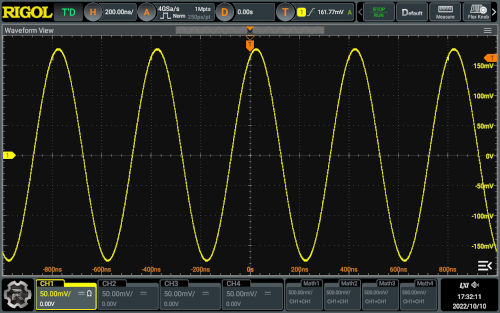 The vertical adjustment can be fine-tuned so that these very small components of the signal can be visualized with good resolution, and therefore can also be analyzed and measured with great accuracy (see Figure 3).
With an 8-bit structure, the theoretical resolution with 256 levels and a vertical representation of 8 V (1 V/DIV) is 31.25 mV. On a 12-bit oscilloscope, the number of steps is 4096, which corresponds to a resolution of 1.95 mV with the same vertical setting. This means that noise components and other deviations can now be measured in the step sections, something not possible with an 8-bit oscilloscope.
As with the 8-bit oscilloscope, the RIGOL DHO series integrates a High-Res mode that can be set to 14 or 16 bits for even greater signal clarity. This averaging technology is therefore superior to the 12-bit High-Res resolution of 8-bit oscilloscopes. The resulting lower bandwidth is displayed alongside the resolution on RIGOL DHO models.
The optional power analysis function can also be used for general measurements of the AC input of a switched-mode power supply. Specifically, it allows you to measure current and voltage values as active, apparent, and reactive power, as well as the crest factor. The mathematical function also allows you to display the results as a curve. At the output of a switched-mode power supply, power analysis can be used to analyze the output ripple in order to measure signal quality.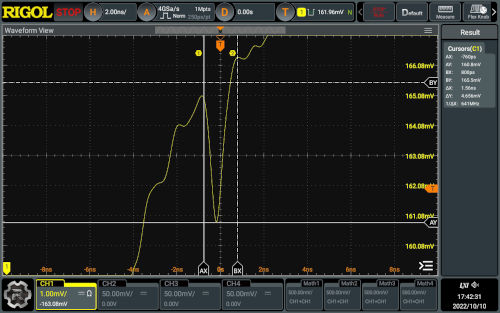 In signal analysis, and especially error analysis, it makes sense to focus not only on time analysis but also on frequency analysis, as this allows for a clear representation of, for example, unwanted nonlinearities or harmonics. The superior interference-free dynamic range of the 12-bit oscilloscope compared to the 8-bit oscilloscope also allows for frequency analysis across a wider dynamic range. Therefore, in frequency analysis, the noise level and amplitudes of internally generated interference are lower than those recorded with an 8-bit oscilloscope. As mentioned earlier, in addition to improving noise reduction, greater linearity is also achieved. The FFT can convert up to one million samples into a frequency spectrum, thus achieving very high frequency resolution. Similar to a spectrum analyzer, the spectrum can be defined by start and end frequencies or by a center and range. When the oscilloscope is set to 50 Ω, the vertical unit can also display dBm (a logarithmic representation with "m" standing for "mW").
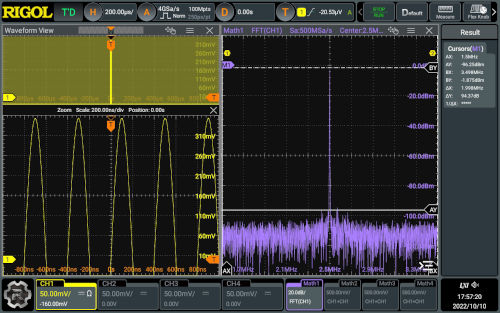 Figure 4 shows the frequency analysis of a 1 MHz sinusoidal wave.
Along with its higher vertical and significantly higher horizontal resolution, the oscilloscope offers the ability to take measurements using the new "UltraAcquire" function, which divides the memory into different segments, each of which integrates different types of triggers. This allows for a very high waveform capture rate of 1.5M waveforms/s. With this function, the user can decide how many triggers to record (up to the maximum number). The acquired signals can then be displayed in different types of representations (e.g., cascaded or with a three-dimensional perspective), making it easier to analyze rapidly changing signals that would otherwise be difficult to detect due to long blind times. This analysis can be used, among other things, for a transmission pulse that generates several much smaller echoes, and the dynamic range can be used again to measure the smallest echoes quite accurately or to visualize glitches much more quickly (see Figure 5).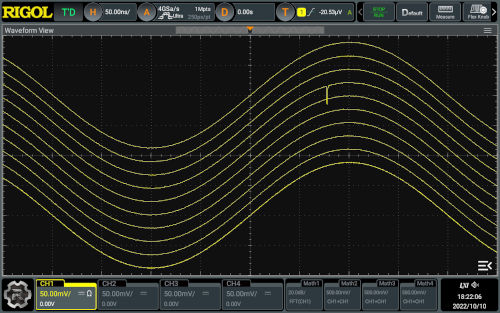
With the DHO1000 and DHO4000 series, RIGOL expands its extensive product range to meet a wider variety of applications. In addition to user-friendly operation via touchscreen, keyboard, or web interface, these oscilloscopes are characterized by their versatility across diverse fields, including R&D, education, and other industrial applications requiring very high horizontal or vertical resolution. Thanks to these high-resolution oscilloscopes, RIGOL positions itself in the market with an exceptionally attractive price-performance ratio, as well as very high levels of quality and versatility compared to other, more expensive equipment on the market.