

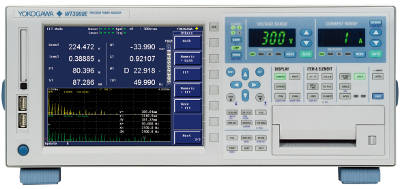
 Because power ranges are multiples of voltage and current ranges, the actual power measurement error due to an uncertainty of 0.03% of the range in a WT3000E is less than 0.01% of the range for a peak-value-based power meter.
These levels of accuracy are important for test devices such as solar inverters, which are already operating at overall efficiencies of 90 to 96%. Increasing efficiency, even by a few decimal places, is a difficult and important goal for manufacturers, and the WT3000E offers the necessary levels of accuracy.
The focus on sustainable and renewable energy has also highlighted the importance and necessity for manufacturers to comply with IEC standards during product development. The WT3000E provides the flexibility to mix 30 A and 2 A input current elements, allowing users to test their products' compliance with harmonics, flicker, and standby power standards in a single instrument.
Like other models in the WT3000 series, the WT3000E features a variety of alphanumeric and graphical display formats, including the ability to display the input signal as waveforms for easy analysis. It also offers high-speed data refresh, enabling users to quickly capture changing transient signals with high accuracy.
The WT3000E also includes two standard features previously only available as options: delta calculation and cycle-by-cycle analysis. The delta calculation function allows users to calculate individual phase voltages from the measured voltage line in a 3-wire/3-phase system—an important feature for determining phase voltage in applications such as motor testing where there are no neutral lines.
Cycle-by-cycle analysis provides users with a list of measurement parameters, such as voltage, current, and active power, for each cycle in a time series. Input frequencies from 0.1 Hz to 1000 Hz can be measured, and up to 3000 data items can be saved in CSV format. Furthermore, using Yokogawa's free WTViewerEfree software, users can graphically visualize the data per cycle—a unique method for capturing transient power fluctuations with high accuracy.
The guaranteed accuracy of Yokogawa instruments is verified through testing at the company's European Standardization Laboratory at its European headquarters in the Netherlands. This facility is the only industrial (i.e., non-governmental or non-national) organization in Europe to offer power calibration traceable to national and international standards at frequencies up to 100 kHz—a requirement for the higher harmonic measurements specified in quality standards such as ISO 9000.