

Peak has selected Testblox as the standard instrumentation platform for its new fixture-based test systems. According to the companies, two of Peak's major customers have already adopted this approach. The new architecture aims to reduce the size, complexity, and integration costs of automated test equipment (ATE), with an estimated 50% reduction in total hardware and integration costs.
The collaboration combines Peak Production Equipment's more than 40 years of experience in designing and manufacturing automated test equipment with Testblox's commercially available modular instrumentation standard (COTS). The Testblox platform uses credit card-sized modules designed to be installed directly within production test fixtures.
Unlike traditional rack-mounted instrumentation systems, this format allows for the integration of measurement and control functions in a compact space, eliminating the need to place external instruments alongside the test equipment. The catalog includes measurement, switching, power, communications, and input/output (I/O) modules from various manufacturers, all sharing standardized mechanical, electrical, and software interfaces.
Architecture with eight modules and direct connection to the device under test
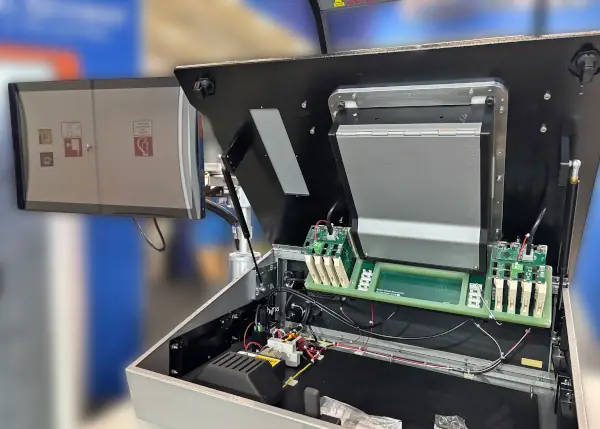
The new architecture developed by Peak incorporates eight Testblox instrumentation modules distributed across two backplanes.
Instead of connecting instruments to the device under test (DUT) using traditional cable assemblies, Peak utilizes a custom interface board that connects directly to the edge connectors of Testblox modules. This direct pin-to-pin connection system eliminates much of the individual wiring typically required between instrumentation and test fixtures. Furthermore, it allows for shorter signal paths, reduces the number of interconnections, and simplifies assembly, resulting in a compact and repeatable design that can be adapted to various functional testing applications.
Karl Miles, Sales and Marketing Director at Peak Group, explains that one of the main challenges when designing production test systems is integrating all the instruments within the tooling. According to Miles, using standardized modules and a dedicated interface board saves design and assembly time, as well as facilitating system maintenance and replication.
Estimated 50% reduction in hardware and integration costs
Peak anticipates that the new architecture will offer several advantages over conventional automated testing systems. Among the expected benefits are:
Estimated 50% reduction in total hardware and integration costs.
Shorter development time thanks to the use of standardized COTS instrumentation.
Faster assembly, due to reduced internal wiring.
Simplified debugging and commissioning, with fewer connections and shorter signal paths.
Software reuse across different testing systems.
Easier maintenance, through fault identification and quick module replacement.
Reducing cabling also decreases the presence of external connections that could become disconnected or damaged during operation.
A reusable and easy-to-maintain test architecture
Kyle Voosen, product manager at Pickering Interfaces, one of the founding partners of Testblox, emphasizes that the platform's objective is to standardize instrumentation so that integrators can concentrate their engineering resources on tooling design and the specific requirements of each application.
The eight-module system developed by Peak exemplifies the concept promoted by Testblox under the motto "The Fixture is the ATE," which proposes integrating the functions of automated test equipment directly into the fixture itself. Through this collaboration, Testblox and Peak Production Equipment aim to simplify the development, manufacturing, and maintenance of production functional test systems, using a compact, modular architecture that can be reused across different projects.