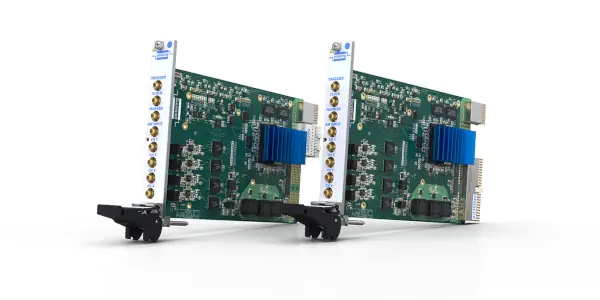
The modules offer up to four channels in a single 3U slot, with 16-bit resolution, a sampling rate of up to 250 MS/s per channel, and the ability to generate sinusoidal signals up to 40 MHz. Applications include avionics functional testing, verification of FADEC digital motor control systems, multi-channel sensor simulation, and the modernization of automated test equipment (ATE).
PXI and PXIe generators with up to four channels per slot
The new 41-621 and 43-621 families are available in two- and four-channel versions, compatible with the PXI and PXIe platforms, respectively. According to Pickering Interfaces, the four-channel models offer the highest channel density in PXI/PXIe format among arbitrary waveform generators operating above 20 MHz. Compared to comparable two-channel solutions, they allow for double the number of available channels per slot and reduce the chassis footprint. The manufacturer estimates that the four-channel version provides a cost advantage of approximately 40% per channel compared to competing solutions.
Tom Sarfi, head of Pickering's product line, points out that these modules allow for the reproduction of complex signals while keeping test systems compact and reducing integration costs.
16-bit resolution and 250 MS/s sampling rate
Each channel incorporates a 16-bit digital-to-analog converter (DAC) that operates at speeds of up to 250 million samples per second (250 MS/s). Key technical features include:
Up to four channels in a 3U slot.
16-bit resolution per channel.
Sampling rate up to 250 MS/s.
128 Msamples per channel memory for storing waveforms.
Output amplitude up to 20 Vpp into a high impedance load.
Generation of sinusoidal signals up to 40 MHz.
Compatibility with standard and arbitrary waveforms.
These features allow the reproduction of sensor signals and other electrical stimuli used in functional testing and electronic validation systems.
Advanced modulation and multi-channel synchronization
The generators incorporate various modulation and signal generation functions, including AM, FM, chirp, frequency-shift keying (FSK), phase-shift keying (PSK), and pulse-width modulation (PWM). They also allow for frequency sweeps to analyze the behavior of devices under test.
The channels can be synchronized and phase-aligned both within a single module and between multiple modules, facilitating the coordinated generation of signals in multi-channel test applications. This capability is particularly useful for sensor simulation and the validation of electronic systems that require multiple synchronized stimuli.
Compatibility with LabVIEW, Python, and C#
The new generators are available for PXI and PXIe platforms, while the PXI models can also be used in Pickering's modular LXI and LXI/USB chassis, with control via Ethernet or USB. Software support includes LabVIEW, Python, and C#, as well as a graphical control panel (soft front panel). This environment allows users to configure common waveforms, import custom signals, and program sweeps without having to develop all the control functions from scratch.
Three-year warranty and long-term support
The 41-621 PXI and 43-621 PXIe modules include a standard three-year warranty and Pickering Interfaces' long-term product support program. According to the company, this support typically extends for 15 to 20 years or more, a relevant feature for automated test systems that must remain operational for extended periods.
With this launch, Pickering expands its catalog of modular instrumentation for electronic testing, signal simulation and upgrading of existing ATE systems.