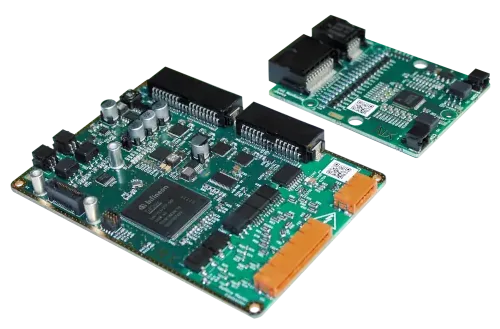
Designed for applications requiring high levels of functional safety and operational robustness,
its architecture is conceived for battery systems up to 1000 V, providing charge, discharge, and pre-charge control, and also enabling the management of peripherals such as heating, cooling, and fans.
The hardware is developed with automotive-grade components, prepared to meet ISO 26262 ASIL-D functional safety standards, and equipped with a hardware security module (EVITA HSM) to comply with cybersecurity requirements according to ISO 21434.
Key Technical Features
Architecture and Communications
Multiprotocol system with CAN-FD transceiver and partial networking capabilities to improve communication integrity.
Multi-master architecture allows parallelization of battery banks for larger systems.
Fault-tolerant network for communication between cell modules.
Battery Master Unit (BMC)
The central unit integrates multiple functionalities to ensure precise and safe battery management:
Full-bridge contactor controllers with Fast Drop-Out function to minimize mechanical wear and improve response to safety events.
Isolated voltage measurement up to 1000 V, isolated shunt current sensor, and dual-channel Hall sensor.
Insulation monitoring and HVIL signal generation for high-voltage system integrity monitoring.
Cell management and balancing.
Monitoring of 9s to 18s cells.
Passive balancing up to 300 mA per cell.
Support for multiple external temperature sensors (NTC) and optional aluminum cold plate swapping for additional cooling.
Integration and Calibration Tool: DeveLinkSTUDIO™
To facilitate system integration, parameterization, calibration, and diagnostics, NX Technologies offers DeveLinkSTUDIO™, a software platform that allows:
Calibration of sensors and modification of product parameters.
Continuous, high-frequency signal capture for detailed analysis.
Connectivity with multiple interfaces: USB, CAN, Ethernet, and UART/RS232.
Compatibility and Applications:
The NX Technologies BMS system is compatible with multiple battery chemistries and is designed for integration into advanced electric vehicle (EV) platforms, stationary energy storage systems, and industrial applications requiring high voltage, safety, and superior performance. These capabilities position it as a scalable and reliable solution for manufacturers seeking to accelerate the development of electrified solutions without compromising safety or efficiency.