
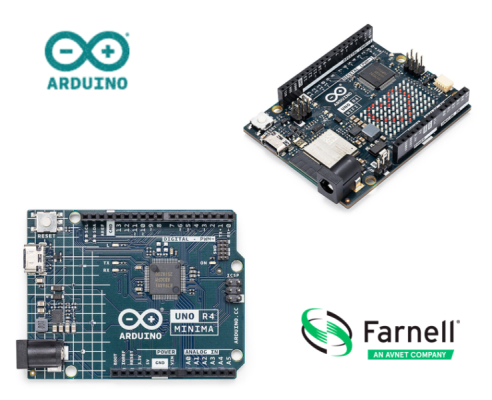
Building on the advanced features of the UNO series, the UNO R4 introduces a 32-bit architecture with many new functionalities for makers. The UNO R4 is equipped with the Renesas RA4M1 32-bit Cortex®-M4 processor, which significantly increases processing power, memory, and functionality. These improvements are fully backward compatible and do not compromise operation with existing shields and accessories.
The UNO R4 Minima offers high-end, powerful, and affordable technology for designers who want the power and speed of the latest microcontroller but don't need additional features. Onboard SWD pins allow for easy connection of third-party debug probes to ensure reliable system operation.
The UNO R4 Wi-Fi incorporates an Espressif ESP32-S3-mini coprocessor and offers Wi-Fi and Bluetooth connectivity, providing reliable internet access for IoT projects.
The main features shared by the new Arduino UNO R4 models include:
The Renesas RA4M1 processor (Arm Cortex®-M4) runs at 48 MHz, representing a 3x performance increase over the UNO R3.
SRAM has been expanded from 2 KB to 32 KB and flash memory from 32 KB to 256 KB to support more complex projects.
A 12-bit analog DAC
, along with an integrated operational amplifier
, a USB-C port
, and a maximum 24 V power supply voltage with an improved thermal design.
A CAN bus and an SPI port allow users to reduce wiring and perform tasks in parallel by connecting multiple shields.
An HID device is also included for emulating a mouse or keyboard.
In addition to the above, the UNO R4 Wi-Fi also includes:
· Bluetooth Low Energy/Wi-Fi
· A fully addressable 12x8 LED matrix
· Qwic I2C connector for external I2C connectivity
· RTC with support for a buffer battery
· Runtime error diagnostics
Romain Soreau, Head of Single Board Computing at Farnell, comments: “No matter where you are on the development ladder, from beginner to highly experienced professional, the new UNO R4 board offers makers and designers a substantial performance boost and, as a result, the power to realize new application possibilities.”
Keith Jackson, Arduino Marketing, states: “Expanding our portfolio available at Farnell greatly expands the availability of our products to the right people, and makes them available to them at the right time. Our partnership continues to strengthen for the benefit of designers and developers worldwide.”
Arduino is an open-source electronics platform based on easy-to-use hardware and software. Over the years, Arduino has been the brains behind thousands of projects, from everyday objects to complex scientific instruments. A global community of makers, including students, hobbyists, artists, programmers, and professionals, has gathered around this open-source platform. Their contributions add up to a vast repository of accessible knowledge that can be of great use to both beginners and experts.