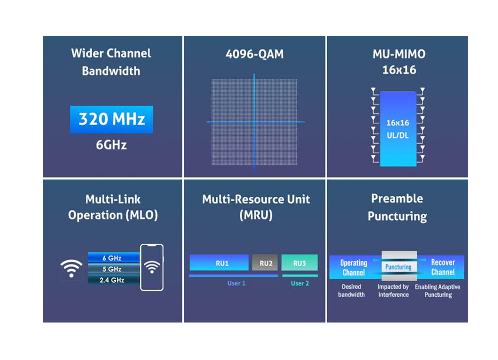


What are the key features that make this improvement possible?
• It can operate at the 6GHz frequency, which has significantly less traffic than lower WiFi frequencies like 2.4GHz or even 5GHz.
• It offers a bandwidth of up to 320MHz per channel. Therefore, we can fit much more data into each channel.
• It uses 4096-QAM modulation, compared to the 1024-QAM modulation of WiFi 6.
• It supports up to 16 simultaneous downlink and uplink data signals, known as 16x16 UL/DL MU-MIMO.
• It features MLO (Multi-Link Operation), allowing it to operate on all three WiFi frequencies available on the market (6GHz, 5GHz, and 2.4GHz).
• It includes Multi-Resource Unit (MRU) and Preambre Puncturing. This enables lower latency and faster communication.
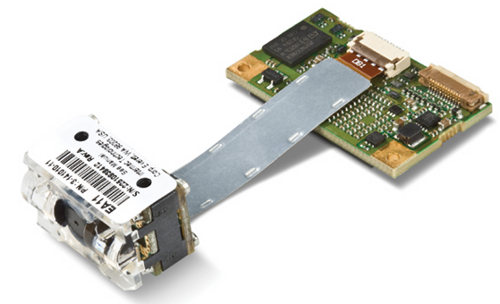
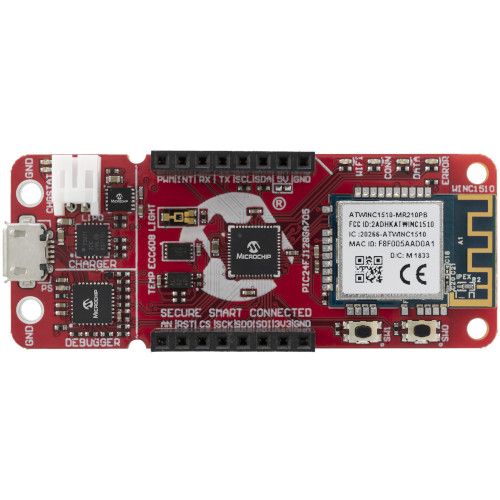
Here we have an example of the initial portfolio of WiFi 7 modules that Sparklan will release to the market.

Below is a comparison of the different WiFi technologies on the market, where we can see that there is a significant difference with the previous protocols.