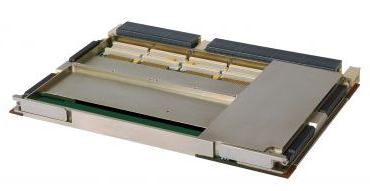


Utilizing the PC/104 form factor, with dimensions of 90mm x 96mm, an industry standard offering compatibility and expandability, the Sundance VCS-1 embedded module is optimized for machine vision, AI, and deep learning applications. Weighing 300g, it has a low typical power consumption of 15W and is compatible with a wide range of sensors and actuators.
At the heart of the Sundance VCS-1 is a Xilinx Zynq MPSoC, mounted on the PC/104 board using a System-on-Module (SoM). It incorporates a 64-bit quad-core ARM Cortex A53 processor, combining real-time control via graphics, video, and signal processing engines, as well as acceleration with an FPGA. This includes an ARM Mali 400 Graphics Processing Unit (GPU) for graphics acceleration, an ARM Cortex R5 Real-Time Processor (RPU) for handling real-time events, and an FPGA (Firmware-Based Gamma Array), a reprogrammable logic board, intended for hardware acceleration of AI algorithms used for image processing.
 The Sundance VCS-1 is characterized by its expandable I/O, available through the Sundance External Interface Card (SEIC), including multiple USB 3.0 interfaces for connecting various cameras and sensors, such as tracking cameras like the Intel RealSense T265 and Intel RealSense D435, depth-sensing cameras like the Stereo Labs Zed, and thermal cameras like the FLIR AX-8. It can also connect to most Arduino and Raspberry Pi-compatible actuators and sensors. Additional interfaces allow for PC simulation with an HDMI display, SATA storage, and Ethernet networking. An A/D converter is available for collecting data from external sensors, and a D/A converter for controlling servos, etc. A wide selection of I/O standards is directly implemented in the programmable logic to reduce latency between supported cameras, sensors, and servos.
Software support is available for precision robotics solutions, including the Morenia Melodic ROS robot platform (compatible with ROS and ROS2), the MQTT machine-to-machine connectivity protocol, the OpenCV real-time programming function library for machine vision, Xilinx AI solutions, and Python as a scripting language. It is also compatible with the Ubuntu operating system, the Xilinx SDSoC environment, the TULIPP STHEM toolkit, and the Xilinx DPU (Deep Learning Processing Unit) for convolutional neural networks.
The Sundance VCS-1 is available in a custom PC/104-Blade enclosure, designed to eliminate the need for fans and ensure a robust environment for building durable embedded applications for precision robotics.