




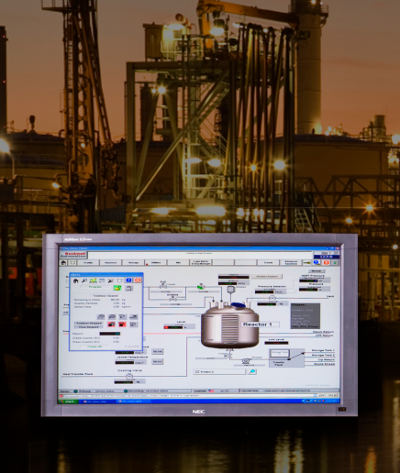
PlantPAx, version 2.0, builds on the success of the original PlantPAx system and adds new features to provide greater availability, device integration, asset management, design productivity, batch control and sequencing, and operational productivity. Furthermore, a redesigned program will help original equipment manufacturers (OEMs) and skid builders serving the process industries reduce their total cost of ownership and minimize their time to market, while simplifying the integration of their equipment into the user's process system.
The capabilities of the PlantPAx system, version 2.0, include:
High System Availability – Business continuity is critical for many process control applications and is a core discipline of the PlantPAx system. In particular, for 24/7 operating processes, the PlantPAx system focuses on system component redundancy and maintenance, helping to ensure that problems are detected and corrected without production interruption. New capabilities include EtherNet/IP network support for redundant systems and a device-level ring network topology that provides high EtherNet/IP network availability without any additional infrastructure costs. A new I/O line, based on ICS Triplex technology, adds redundant I/O capacity to the system. PlantPAx, version 2.0, also includes new diagnostic and troubleshooting capabilities to help operators and maintenance personnel identify and resolve the root cause of a problem before production is interrupted.
Device Integration and Asset Management – The PlantPAx system offers a wide range of connectivity options, including HART, Profibus-PA, and Fieldbus Foundation. PlantPAx version 2.0 expands these options to provide an even more scalable portfolio. Another significant addition is the integration of other devices and asset management features into the system, such as intelligent motor control centers, variable frequency drives (VFDs), condition monitoring, and power control components. VFDs, for example, are now displayed using icons and templates in the visualization layer and managed in the asset management layer to provide disaster recovery, automatic backup and restoration of VFD configurations, and change auditing.
Design Productivity – A focus on design productivity helps Rockwell Automation partners deliver a more consistent, modular solution to users faster and with fewer errors. A careful evaluation of typical distributed control system configuration workflows revealed several steps that can be simplified or accelerated. These include initial architecture sizing and design, the creation of reusable engineering template objects, and engineering and deployment tools for objects and diagnostics in the PlantPAx library.
Batch Control and Sequencing – The PlantPAx System, Version 2.0, covers the full spectrum of batch applications. At the most complex level, the new batch server software adds key capabilities such as intelligent recipes, enhanced user control of operating time, expanded data collection, and optimized reporting and material management. For simpler sequencing requirements, such as those found in OEM skid applications or startup sequences, the PlantPAx System, Version 2.0, provides an elegant alternative to traditional custom sequencing solutions. The new Logix batch and sequence manager is an S-88 compliant machine that offers simple setup and execution and minimizes the costly and risky design and maintenance aspects associated with custom code. This unit-scale sequencer also integrates easily into a higher-level batch strategy, helping to ensure that original equipment manufacturer solutions, such as CIP cleaning unit skids, are easily integrated into whole-plant production operations.
Operational Productivity – PlantPAx's approach to operational productivity is a three-tiered solution. At the most basic level, the Rockwell Automation data historian collects key process data either within the controller chassis or via a plant-level server. This data is then analyzed in an information and decision support portal. This portal provides relevant information about the production system based on the user's role. For example, maintenance personnel can benefit from reports displaying data such as motor run times or valve diagnostics, unlike the information needs of operations or quality control departments. Then, at the third level, the PlantPAx 2.0 system offers industry-leading optimization solutions. This optimization leverages advanced control techniques for single-loop or unit operations, or more advanced predictive modeling solutions for a plant area or an entire line.




