Now, MIT researchers and their colleagues—including one from the original RoboTuna team—have devised a novel approach to building deformable underwater robots, using simple, repeating substructures instead of unique components. The team has demonstrated the new system in two different example configurations: one as an eel and the other as a winged hydrofoil. The principle itself, however, allows for virtually unlimited variations in shape and scale, the researchers say.
The work is published in the journal Soft Robotics, in an article by MIT research assistant Alfonso Parra Rubio, professors Michael Triantafyllou and Neil Gershenfeld, and six other people.
Existing soft robotics approaches for marine applications are generally small-scale, while many useful real-world applications require meter-scale devices. The new modular system proposed by the researchers could easily be scaled up to those sizes and larger, without requiring the kind of retrofitting and redesign that would be necessary to scale up current systems.
"Scalability is a strong point for us," says Parra Rubio. Given the low density and high rigidity of the lattice-like pieces, called voxels, that make up their system, "we have more room to continue expanding," while most of the technologies currently used "are based on high-density materials that face drastic problems" when scaling up.
The individual voxels in the team's experimental proof-of-concept devices are mostly hollow structures formed from cast plastic pieces with narrow, complexly shaped struts. The box-like shapes support loads in one direction but are flexible in others—an unusual combination achieved by mixing rigid and flexible components in varying proportions.
“Treating soft robotics as opposed to hard robotics is a false dichotomy,” says Parra Rubio. “This is something in between, a new way of building things.” Gershenfeld, director of the MIT Center for Bits and Atoms, adds that “this is a third way that combines the best elements of both.”.
"The soft flexibility of the body surface allows us to apply flow control capable of reducing drag and improving propulsive efficiency, resulting in substantial fuel savings," says Triantafyllou, the Henry L. and Grace Doherty Professor of Ocean Science and Engineering, who was part of the RoboTuna team.
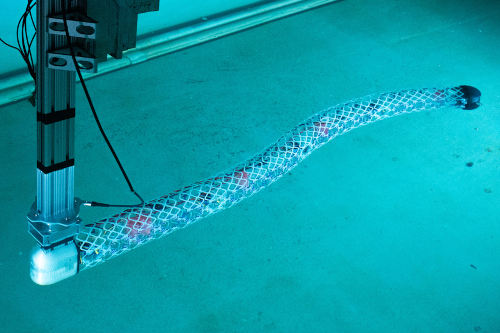
In one of the devices built by the team, voxels are linked end-to-end in a long row to form a one-meter-long, snake-like structure. The body is composed of four segments, each made up of five voxels, with an actuator in the center that can pull a wire attached to each of the two voxels on either side, contracting them and causing the structure to bend. The entire 20-unit structure is covered with a rib-like support structure and then with a tight-fitting, waterproof neoprene skin. The researchers deployed the structure in an MIT tow tank to demonstrate its effectiveness in water, and showed that it was indeed capable of generating enough forward thrust to propel itself with undulating movements.
"There have been many snake-like robots before," Gershenfeld says. "But they're usually made of custom-built components, unlike these simple building blocks that are scalable.".
For example, Parra Rubio says, a snake-like robot built by NASA was made up of thousands of unique parts, while in the case of this group's snake, "we showed that there are about 60 parts." And compared to the two years spent designing and building MIT's RoboTuna, this device was assembled in about two days, he says.
The other device they demonstrated is a wing-like shape, or hydrofoil, composed of an array of the same voxels but capable of changing its airfoil shape and thus controlling the lift-to-drag ratio and other wing properties. These wing shapes could be used for various purposes, from generating energy from waves to helping improve the efficiency of ship hulls—a pressing need, since maritime transport is a major source of carbon emissions.
Unlike a snake, the wing's shape is covered with a series of overlapping, scale-like tiles designed to press together and maintain a watertight seal even when the wing changes curvature. One potential application could be incorporating some kind of attachment into a ship's hull profile to reduce the formation of drag-inducing eddies and thus improve its overall efficiency—a possibility the team is exploring with collaborators in the naval sector.
Ultimately, the concept could be applied to a whale-like submersible, using its morphable body shape to generate propulsion. Such a vessel could avoid bad weather by staying below the surface, but without the noise and turbulence of conventional propulsion. The concept could also be applied to parts of other vessels, such as racing yachts, where having a keel or rudder that could curve smoothly during a turn instead of remaining straight could provide an added advantage. "Instead of being rigid or just having a fin, if it can curve like fish do, you can take the turn much more efficiently," says Gershenfeld.
The research team consisted of Dixia Fan, from Westlake University (China); Benjamin Jenett SM '15, PhD '20, from Discrete Lattice Industries; José del Águila Ferrandis, Amira Abdel-Rahman, and David Preiss, from MIT; and Filippos Tourlomousis, from the Demokritos Research Center in Greece. The work was supported by the U.S. Army Research Laboratory, the CBA Consortium, and the MIT Sea Grant Program.
David L. Chandler, MIT News Office


 Asparagus picking-1-w.jpg)