A significant portion of the market relies on PVC polymer, which is used in a variety of applications, including flooring, flexible hoses, and shoe soles. It is a versatile material used in the manufacture of flexible flooring for a wide range of environments, such as sports facilities, hospitals, and high-traffic areas.
In these environments, it is crucial to ensure that the floors are dissipative to prevent the buildup of static electricity, which can pose a risk to the safety and operation of sensitive equipment, such as in operating rooms or chip manufacturing rooms.
It is important to note that, due to the high quantities of doping agent required to achieve the desired conductive properties in PVC materials, Delta Tecnic does not use the typical masterbatch process. Instead, it manufactures compounds—homogeneous blends of polymer and additives designed to provide the necessary electrical properties to the final product.
Proper dispersion of conductive additives is essential to ensure optimal performance of the final material.
How do you give PVC materials their conductive properties?
Specifically, a variety of carbon-based additives are used to impart conductive properties to plastic materials. The molecular structure of these carbon derivatives is crucial: its long structure allows electrons to move along it, creating a network of carbon atoms within the plastic material.
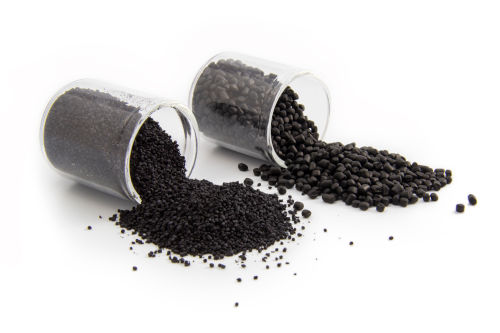
There are three main types of carbon-based dopants used by Delta Tecnic: carbon black, carbon nanotubes, and graphene. Each of these additives has unique characteristics and structures. Carbon black consists of finely divided carbon particles that form a dispersed network within the plastic. Carbon nanotubes have a duct-like structure, while graphene has a two-dimensional sheet-like structure.
These dopants have different effects on the electrical properties of the plastic material. For example, when using conductive carbon black, a higher concentration of the additive is required within the polymer mass to achieve the desired conductivity. This can range from 15% to 30% of the total weight of the plastic. In contrast, carbon nanotubes require a lower concentration, typically between 3% and 7%, while graphene can provide even higher conductivities with concentrations ranging from 2% to 5%.
It is important to note that the amount of additive used affects other properties of the plastic, such as impact resistance and attractiveness. The more additive added, the greater the impact on these properties. This can be crucial in the manufacture of finished parts that require a certain level of mechanical strength or that are exposed to specific environmental conditions. Therefore, finding the right balance between electrical conductivity and other material properties is essential in the product development process.
Metallic Fibers: A New Approach to Electrical Dissipation and Conductivity.
Very recently, the manufacture of masterbatches that allow the passage of electrical energy through very small-diameter metallic fibers has begun. These fibers are manufactured as masterbatches that can be applied during the injection molding of parts or even in the fabrication of compounds for subsequent processing.
The ability to achieve the passage of electrical current with these metallic fibers opens a new dimension in the manufacture of conductive compounds without the limitation of the black color that only classic carbon-based dopants allowed.
These metallic fibers, introduced into plastic parts, can achieve very interesting conductivity values and offer the possibility of achieving high electromagnetic shielding, at a time when reducing the weight of parts and simplifying their manufacturing is imperative.