



Semiconductors

- Details
- Category: Integrated Circuits
Industrial automation is in an era of transformation, due to the increased operational efficiency enabled by AI, the convergence of IT and OT systems to eliminate data silos, and the need for distributed control, as flexible manufacturing demands solutions that can adapt over time.

- Details
- Category: Integrated Circuits
Currently available rotary position encoders and sensors provide an absolute measurement range of a single revolution, or 360°. Systems requiring a multi-rotation measurement range typically incorporate bulky mechanical solutions or a backup power supply to track movement during power outages. ADI's innovative new ADMT4000 is the market's first single-chip multi-rotation position sensor with an absolute measurement range of 46 revolutions (16,560 degrees) and an accuracy of 0.25 degrees. This new sensor is poised to revolutionize actuator design by eliminating the need for linear transducers, bulky gear reduction mechanisms, or the need for continuous power supply. The ADMT4000 significantly streamlines the actuator and drive design process, enabling reductions in the size, weight, and cost of the final equipment.
This new product has broad market appeal, and the target audience within the industrial sector includes manufacturers of industrial actuators and drives, industrial encoders, and manufacturers of industrial automation equipment, including robots, cobots, and humanoids. Other markets of interest include manufacturers of sensors and actuators for the automotive industry, manufacturers of aerospace and defense end-effector equipment, and manufacturers of medical equipment such as surgical robots, scanners, and dental chairs.
This technical article explains the operating principle.
- Details
- Category: Design
Analog Devices' precision signal chain μModule® solutions provide system designers with an integrated, compact, and highly customizable solution that simplifies design, improves performance, and saves valuable development time.1 This approach offers a significant advantage to customers who can get to market faster with cutting-edge performance.
- Details
- Category: Design
From its beginnings as a military technology, radar has permeated most of the world's major sectors. radar technology has undergone remarkable evolution over the years. What began as a method for locating aircraft and ships has become a versatile tool impacting various aspects of modern life. Beyond its original applications in air and maritime navigation, radar is now found in fields such as automotive safety, healthcare, industrial operations, and even smart homes. In this article, we'll discuss the latest uses of radar in areas we don't typically associate with this technology.
In-cabin monitoring:
Radar is used in the automotive sector to achieve greater vehicle autonomy, but it has also found an application inside vehicles. Specifically, radar sensors are now being used to improve in-cabin monitoring systems.
In this context, radar sensors use electromagnetic waves to detect objects and movements inside the vehicle, providing real-time data about the surrounding environment. The use of this technology, along with sophisticated software and mapping algorithms, allows for the identification of passenger position and movement in order to monitor and protect them. For example, cabin monitoring can be used to ensure that airbags deploy correctly in the event of an accident, thus minimizing injuries. Furthermore, radar systems can monitor the driver's level of attention, detecting signs of drowsiness or distraction by observing head position and movement, and issue appropriate alerts to reduce the risk of accidents.

Image 1: Currently, radar is used for in-vehicle monitoring applications (source: Infineon)
One important application of radar in the passenger compartment is the child detection system. This system alerts drivers if a child has been left in the back seat, thus preventing the serious consequences of overheating in such situations. The advantages of radar technology in the passenger compartment are not limited to safety; comfort can also be improved thanks to features such as automatic adjustment of the climate control system based on the number of passengers and their location. This can include setting optimal temperatures in different areas of the vehicle, which has a positive impact on the overall driving experience.
Contactless Health Monitoring:
In the healthcare sector, radar technology offers a revolutionary method for monitoring vital signs without any physical contact. This method uses electromagnetic waves to detect micro-movements of the chest associated with heartbeats and lung expansion/contraction, transforming these movements into digital signals that can be analyzed to continuously monitor health parameters. Unlike traditional methods, which require physical contact with the body, radar health monitoring is non-intrusive, a significant advantage in various settings, both in hospitals and at home.
In today's society, where health awareness is higher than ever, contactless monitoring offers numerous advantages. For patients in intensive care, it minimizes the risk of infection and the discomfort associated with regular physical examinations. At home, it allows for continuous observation of elderly people or patients with chronic illnesses without causing them discomfort and respecting their privacy. One of the most important advances in this field is the development of radar-based sleep monitoring systems.
These systems can accurately measure sleep quality or breathing rate and even detect sleep apnea without the discomfort of wearable devices. This technology is especially useful for monitoring sleep patterns and detecting early symptoms of heart or respiratory disorders, so that individuals can receive the necessary treatment in a timely manner.
Industrial Applications
: In the industrial sector, radar technology has become an essential tool for improving safety and efficiency. Radar provides accurate, real-time data in demanding environments where dust, smoke, or extreme temperatures impair the performance of other types of sensors; therefore, it is extremely useful in a wide range of applications.
One of the main advantages of radar in industry is its contribution to workplace safety. For example, radar sensors can create invisible safety zones around dangerous machinery. When an unforeseen person or object enters these zones, the system can automatically shut down the equipment and prevent potential injuries. In manufacturing facilities and construction sites where interaction between heavy machinery and workers is a constant concern, these safety zones can greatly contribute to operator safety.
Furthermore, radar technology is essential for improving operational efficiency. In large ports or warehouses, radar systems can track goods and vehicles to optimize logistics and reduce loading and unloading times. This speeds up operations and minimizes the risk of accidents, as operators are more aware of their surroundings.

- Details
- Category: Design
A comprehensive overview of semiconductor system design requirements for an electric bicycle or scooter
The rise of electric bicycles and scooters is transforming urban mobility, offering a cleaner and more convenient alternative to traditional modes of transport. Charging systems, battery management, motor controllers, and controls are fundamental to the success and efficiency of these electric vehicles, as shown in Figure 1.

- Details
- Category: Integrated Circuits
Melexis introduces the MLX91235, a new current sensor that eliminates the need for a ferromagnetic core. The MLX91235 expands Melexis' product portfolio, enabling the measurement of larger currents flowing through external primary conductors such as PCB traces and busbars.

- Details
- Category: Integrated Circuits
Toshiba Electronics Europe GmbH (“Toshiba”) introduces a new series of gate driver ICs for three-phase brushless DC (BLDC) motors used in industrial and consumer applications. The TB67Z83xxFTG series (with 3.3 V regulator output) and TB67Z85xxFTG series (with 5.0 V regulator output), both consisting of four devices,
- Details
- Category: Integrated Circuits
Renesas Electronics Corporation today announced new AnalogPAK™ integrated circuits, including low-power, automotive-qualified devices along with the industry's first programmable 14-bit SAR (successive approximation register analog-to-digital converter) ADC.

- Details
- Category: Microcontrollers
Mecter introduces the new GD32G5 series of high-performance microcontrollers from GigaDevice. Based on the Arm® Cortex®-M33 core, the GD32G5 series of microcontrollers (MCUs) offers exceptional processing performance, a wide range of digital and analog interface features, and enhanced security capabilities.
- Details
- Category: Other Semiconductors
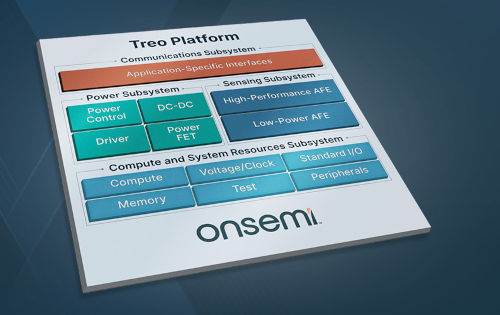
onsemi has introduced the Treo platform, an analog and mixed-signal platform built with Bipolar-CMOS-DMOS (BCD) process technology on an advanced 65nm node. This platform provides the foundation for a wide range of onsemi's power and sensing solutions, including high-performance, low-power sensing, high-efficiency power management, and purpose-built communication devices.

- Details
- Category: Design
Empower Semiconductor has introduced the Crescendo vertical power platform for artificial intelligence (AI) and high-performance computing (HPC) applications. Powered by Empower's proprietary FinFast™ technology, the Crescendo platform unlocks scalable, on-demand vertical power for power ranges exceeding 3,000 A, delivering an unprecedented combination of system efficiency, current density, and nanosecond transient response.

- Details
- Category: Integrated Circuits
Power Integrations has introduced a new member of its InnoMux™-2 family of single-stage, multi-output, independently regulated offline power supply integrated circuits. The new device incorporates the industry's first 1700V gallium nitride switch, manufactured using the company's proprietary PowiGaN™ technology.

Spanish electronics magazine. Printed for over 25 years.
Spain - Madrid - All rights reserved © Convertronic Professional Spanish Electronics Magazine.