With the rapid advances in very large-scale integrated (VLSI) circuit technology, the multifaceted discipline of signal processing applications emerged, spanning from telecommunications and audio systems to industrial automation and automotive electronics. To support these applications, significant research was required to develop a high-performance, discrete, linear, and accurate signal chain block. This article will illustrate how ADI's μModule precision signal chain solution leverages heterogeneous integration through system-in-package (SiP) technology to address this market need, providing system designers with an integrated, compact, and highly customizable solution that simplifies design, improves performance, and saves valuable development time. This approach offers a significant advantage to customers who want to get to market faster with cutting-edge technology.
What is μModule Precision Signal Chain Technology?
μModule Precision Signal Chain is a SiP technology that enables the integration of diverse circuitry while maintaining the highest level of performance. ADI's μModule Precision Signal Chain solutions aim to improve density in a smaller form factor by combining best-in-class devices, iPassives® technology, and advanced 2.5D/3D packaging technology, while maintaining intelligent and efficient system component management (see Figure 1) .¹ These μModule devices serve as reliable building blocks for the signal chain, enabling system designers to achieve higher levels of integration, faster time to market, increased speed performance, and reduced power consumption at an affordable price without the need for additional external circuit debugging or optimization.¹
Key Features and Benefits
The Power of Integration:
Precision signal chain μModule solutions represent a significant advancement in signal chain design by integrating multiple analog and digital components into a single module. This is made possible by utilizing ADI's iPassives technology with our superior signal conditioning ICs, which are encapsulated using SiP technology to create best-in-class performance and robustness μModule devices with exceptionally short development cycle times. Just as integrated circuits contain many transistors, integrated passives can contain many high-quality passive components packaged into a very small module .
A single device can now contain systems that were previously board-level solutions. By combining functions such as amplification, filtering, and analog-to-digital conversion, these modules eliminate the need to design complex signal chains using individual components. This significantly reduces interconnect parasitic effects (inductance, capacitance, and resistance). All these factors contribute to creating complete solutions with excellent out-of-the-box performance. Developed in short development cycles with significant cost savings, all in very compact packages,this integration not only reduces the physical footprint by offering complete solutions in space-efficient footprints, but also optimizes the performance and reliability of the signal chain. Passive components manufactured at the same time, under the same conditions, are more likely to be a good match for the integrated passives.

Figure 1. System in a Package.
This solution reduces design iterations by transferring the selection, optimization, and arrangement of components from the designer to the device. ADI produces highly customizable precision signal conditioning systems with superior performance made possible by our unique silicon manufacturing processes. Figure 2 illustrates the significant space reduction this solution offers. Furthermore, it can reduce the total cost of ownership and time to market for system designers.
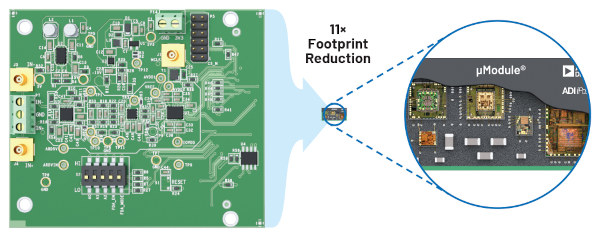
Figure 2. Reduction of the space occupied by the solution.
Unlocking Performance Potential:
Precision Signal Chain μModule solutions are engineered to deliver exceptional performance to meet customers' growing electronics demands, overcoming the limitations of front-end integrated circuit designs and manufacturing technologies.careful component selection, precise analog design techniques, and advanced design optimization, these modules ensure high signal integrity, low noise, and accurate signal processing. Whether capturing sensor data, amplifying signals, or converting between analog and digital domains, the Precision Signal Chain μModule solution unlocks the full potential of signal processing with uncompromising quality.
ADI's iPassives technology ensures a homogeneous mechanical environment. To achieve this, interconnected parasitic elements, such as trace resistance and inductance, are minimized, while the few that are present are highly predictable and can be reliably accounted for.2 Figure 3 shows the superior performance of the ADAQ4003 through different gains for various input frequencies.
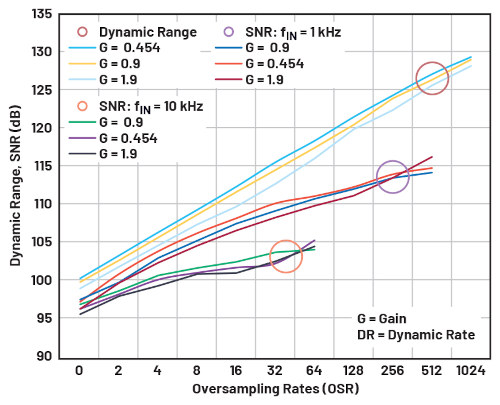
Figure 3. Performance of the ADAQ4003. Dynamic range of the ADAQ4003, with SNR versus oversampling rate (OSR) for various input frequencies.4
Personalization and flexibility
While offering integration, μModule precision signal chain solutions also provide system designers with flexibility in signal chain design. They are highly configurable, allowing users to tailor signal chain parameters and characteristics to their specific application requirements through intelligent partitioning of all components, as shown in Figure 4. With adjustable gain, bandwidth, filtering options, and other customizable features, these solutions offer a versatile platform that meets a wide range of design challenges.

Figure 4. Simplified block diagram of the source's unit of measurement.4
Lower total cost of ownership:
system over its lifetime. By their very nature, discrete devices invariably degrade their performance over operating temperature and circuit lifetime. A system built with a precision signal chain μModule solution has lower secondary costs because the passive components that affect performance and production during manufacturing are integrated into the μModule device. Figure 5 illustrates the reduction in secondary costs when a precision signal chain μModule solution is used instead of a discrete signal chain.
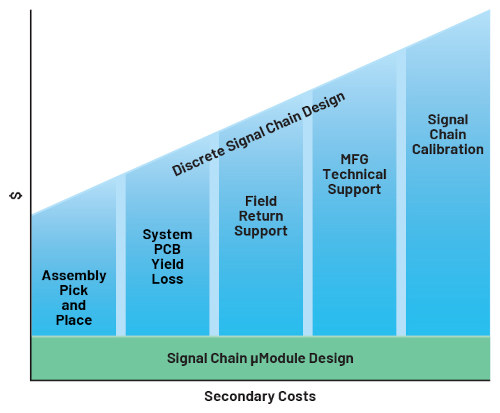
Figure 5. Secondary costs.
The limits reflected in the datasheet for a μModule signal chain cover the entire performance of the signal chain; therefore, they enable consistent performance and high manufacturing throughput, reducing the occurrence of performance issues on the manufacturing line and helping to minimize support costs and maximize manufacturing throughput.Furthermore
, since passive components are an integral part of all electronic subsystems, their integration into the substrate offers the potential for improved performance. This integration reduces temperature-dependent sources of error. Moreover, it eliminates the need to calibrate the signal chain for temperature during manufacturing, which is known to be time-consuming and expensive (see Figure 6). Minimizing the number of discrete components and interconnects on the printed circuit board also improves system reliability due to fewer solder joints, thus reducing support costs.
Ease of use and rapid prototyping:
The μModule precision signal chain solution simplifies the design process and significantly reduces development time. Design time is reduced because the cores are pre-engineered, manufactured, characterized, and tested. μModule precision signal chain solutions come with pre-configured signal chains and a wealth of support resources, such as evaluation boards and software development kits, resulting in good performance and a streamlined design phase.
Figure 7 shows a sample signal chain kit that exhibits the capabilities of the precision signal chain μModule solutions.
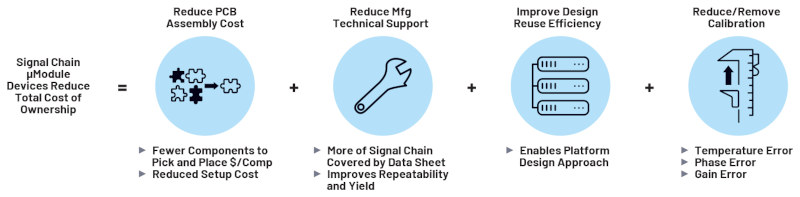
Figure 6. Reduction of total cost of ownership through precision signal chain μModule technology.
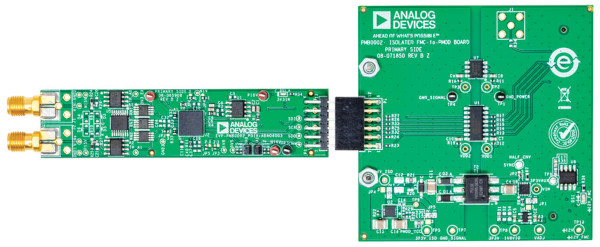
Figure 7. The ADSKPMB10-EV-FMCZ signal chain kit.
From a designer's perspective, ADI's iPassives technology can be seen as a flexible design tool for producing precision signal chain μModule solutions that enable the design of system solutions in exceptionally short development cycle times.² System designers can focus on system-level design and functionality rather than grappling with intricate circuit-level implementation. Rapid prototyping and system validation are simplified, allowing for aggressive timelines from system definition to parts delivery for innovative applications.
To meet diverse market demands, ADI provides an extensive portfolio of integrated and special-purpose converters to support a wide range of industries.
Applications across all industries
The precision signal chain μModule solutions provide a wide range of applications in numerous industries, spanning various domains such as the following:
Communications:
Most wireless communication products require digital, analog, and RF electronics to facilitate uninterrupted signal transmission and reception. Precision signal chain μModule solutions achieve this by improving the performance of transceivers, base stations, and network infrastructure. These solutions offer an effective way to mitigate electromagnetic interference caused by the digital counterparts of noise-sensitive RF electronics by separating the RF and digital circuitry.6
One example is the ADAQ8092 (Figure 8), a dual-channel SIP system that integrates three common signal processing and conditioning blocks to support a wide variety of demodulation and data acquisition applications. The device integrates all active and passive components into a complete signal chain, reducing the footprint by up to six times compared to a discrete solution. Built-in power supply decoupling capacitors improve power supply rejection performance, making it a robust DAQ solution. The ADAQ8092 operates on 3.3V to 5V digital and 1.8V analog power supplies. Digital outputs can be CMOS, double data rate CMOS, or double data rate LVDS.

Figure 8. Block diagram of the ADAQ8088.
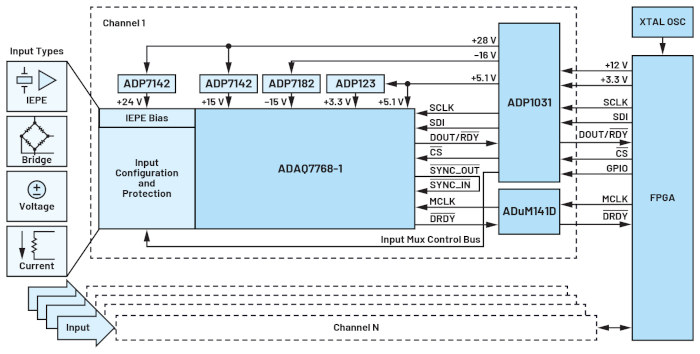
Figure 9. Typical application diagram of a channel-isolated DAQ system.
Industrial Automation
Focusing on industrial applications, recent advances in semiconductor technology are enabling innovative trends in three main directions: power density and energy efficiency, the ubiquity of digital power control, and safety.7
Precision signal chain
μmodule precision signal chain solutions enable precise signal processing for industrial automation systems, ensuring accurate measurement, control, and actuation.
Industrial communication networks drive smart and safe manufacturing scenarios by providing real-time communication between machines and control systems. The μModule precision signal chain solution enables the development of digital control systems along with innovative connectivity solutions to ensure human safety at all times.
System safety is essential to ensure the safety of people and protect the environment.7 Recent advances in new process options for semiconductor technologies ensure that compromises are not necessary to address the lack of communication speed, high power consumption, considerable size, and reliability issues of safety control systems.
Precision signal chain μModule solutions provide an integrated approach in terms of space savings, low power consumption, excellent reliability, and communication speed.
Industrial automation systems collect data from multiple sensor nodes and transmit it to a central condition monitoring system for analysis. Condition-based monitoring (CbM) is a preventive maintenance strategy that continuously monitors the condition of assets using various types of sensors. CbM can be used to establish trends, predict failures, estimate asset lifespan, and enhance safety in manufacturing plants.For
CbM applications, the ADAQ7768-1 supports a wide variety of input types, including IEPE sensors, resistive bridges, and voltage and current inputs, as illustrated in Figure 9. The ADAQ7768-1 also supports two device configuration methods. The user has the option to choose the configuration with which the device will operate by altering the registers through its SPI, or by using a simple hardware pin strapping method to configure the device to operate in various predefined modes.1
Solutions for testing in the automotive industry.
Innovation and optimization of precision signal chain μModule solutions provide robust interconnections and mechanical support, high reliability, and a compact and cost-effective product that helps meet the needs of the automotive industry.9 These solutions are used in applications such as infotainment systems, powertrain control, advanced driver assistance systems (ADAS), and improvements to vehicle safety, comfort, and performance.
Technological advances increase complexity, thus requiring new simulation and verification methods. To avoid impractical simulations, a digital twin can be used. A digital twin is a virtual representation of a real-world physical system.This method can help reduce costs, accelerate development cycles, or enable overall system optimization.
As an example from the automotive market, hardware-in-the-loop (HIL) is a digital twin technique used to test complex systems in real time, such as electronic control units (ECUs), power steering systems, suspension systems, battery management systems, or any other vehicle subsystem. ADI's broad portfolio of signal conditioning, data acquisition, signal generation, and isolation products enables it to offer optimized solutions for HIL simulators. Specifically, the ADAQ23878 with signal scaling reduces the number of components in the final system by combining multiple common signal processing and conditioning blocks into a single device, including a low-noise, fully differential ADC (FDA) controller, a stable reference buffer, and a high-speed, 18-bit, 15 MSPS successive approximation register (SAR) ADC.1

Figure 10. EVAL-ADAQ238 Assessment Plate
Conclusion:
The new dictate of IC technology is to streamline the development process using heterogeneous integration of SiP technology.10 The introduction of precision signal chain μModule solutions has transformed system designers' approach to signal chain design. This solution offers integration, high-performance capabilities, flexibility, and ease of use, while maintaining exceptional signal processing capabilities. As technology continues to advance, precision signal chain μModule solutions are positioned to play a crucial role in enabling innovative applications across various industries, contributing to the advancement of electronic systems.
Acknowledgments
We would like to thank Stuart Servis for his technical contributions to this article.
References
1 “µmodule Solutions for Precision Signal Chains.” Analog Devices, Inc.
2 Mark Murphy and Pat McGuinness. “Using Integrated Passives in Micromodule SIPs.” Analog Dialogue, vol. 52, no. 10, October 2018.
3 Man-Lung Sham, YC Chen, LW Leung, Jyh-Rong Lin, and Tom Chung. “Challenges and Opportunities in the System-in-Package (SiP) Business.” 2006 7th International Conference on Electronic Packaging Technology, August 2006.
4 Maithil Pachchigar. “µModule Data Acquisition Solution Eases Engineering Challenges for a Diverse Set of Precision Applications.” Analog Devices, Inc., November 2020.
5 Michael Scheffler and Gerhard Tröster. “Evaluating the Profitability of Integrated Passives.” Proceedings of the Conference on Design, Automation, and Testing in Europe, February 2000.
6 King L. Tai. “System-In-Package (SIP): Challenges and Opportunities.” Proceedings of the Conference on Design Automation in Asia and the South Pacific 2000, January 2000.
7 Domenico Arrigo, Claudio Adragna, Vincenzo Marano, Rachela Pozzi, Fulvio Pulicelli, and Francesco Pulvirenti. “The Next Era of Automation: How Semiconductor Technologies Are Changing Industrial Systems and Applications.” ESSCIRC 2022—IEEE 48th European Solid State Circuits Conference (ESSCIRC), September 2022.
8 “Condition-Based Monitoring.” Analog Devices, Inc.
9 Yangang Wang, Xiaoping Dai, Guoyou Liu, Daohui Li, and Steve Jones. “An Overview of Advanced Power Semiconductor Packaging for the Automotive System.” CIPS 2016; 9th International Conference on Integrated Power Electronics Systems, March 2016.
10 KM Brown. “System in Package: The Renaissance of the SIP.” Proceedings of the 2004 IEEE Conference on Custom Integrated Circuits.
About the author:
Lloben Paculanan is a product application engineer at Analog Devices in General Trias, Philippines. He joined ADI in 2000, where he worked in various hardware development, test, and application engineering roles. He has been working on the development, precision, and high-speed implementation of μModule solutions. He graduated from Cagayan Xavier Atheno University with a Bachelor of Science in Industrial Engineering and Technology, and from Enverga University with a Bachelor of Science in Computer Engineering.
About the author:
Regine Garcia joined Analog Devices in 2023 and is currently a product application engineer for the μModule precision signal chain solutions at ADI in General Trias, Philippines. She earned her bachelor's degree in electronic and communications engineering from Saint Louis University in Baguio City.