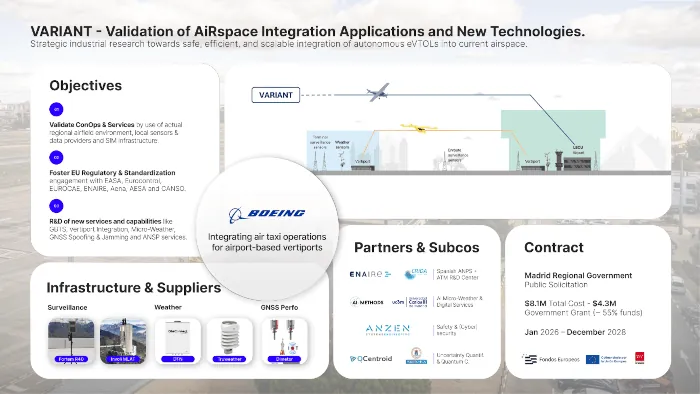
Led by Boeing Aerospace Spain, the consortium is made up of ANZEN Engineering, AI Methods and QCentroid Labs, and has the Carlos III University of Madrid (UC3M), ENAIRE, the Polytechnic University of Madrid (UPM) and CRIDA as subcontractors.
VARIANT focuses on Innovative Air Mobility (IAM), which encompasses electric vertical take-off vehicles (eVTOLs) operating at low altitudes in urban and suburban environments, and will validate operational concepts, ground systems and technologies through simulation, laboratory testing and high-fidelity simulation trials.
"The VARIANT program represents a critical step in preparing the airspace for the mobility of the future," said Eduardo Carrillo de Albornoz, general manager of Boeing Engineering and Technology Innovation Europe. "By validating aircraft and ground systems together, we will ensure that electric and autonomous vehicle operations are safely and efficiently integrated, delivering value to communities and enabling new modes of transportation.".
The goal of VARIANT is to develop new operating procedures and automated air traffic management services for vertiport operations. "At ANZEN Engineering, we are contributing our expertise in prevention, safety, and systems engineering to the VARIANT consortium," commented Pablo de la Cruz, CEO of ANZEN Engineering. "This project represents an excellent opportunity to validate the requirements, interfaces, and assurance frameworks necessary to integrate vertiport and Innovative Air Mobility (IAM) operations into the existing airspace system, with the level of rigor that future certifiable services will demand."
“Integrating electric and autonomous aircraft into shared urban airspace is, in essence, a highly complex computational challenge. QCentroid provides a systematic framework to assess how quantum and hybrid computing can significantly improve air traffic management, complementing our partners’ expertise in AI and prevention. VARIANT offers the necessary collaborative and preventative environment to generate and validate this evidence with the rigor this sector demands,” added Carlos Kuchkovsky, CEO of QCentroid.
“It is an honor to participate in the VARIANT project and contribute our expertise in AI-powered weather analysis,” said Aniel Jardines, CEO of AI Methods. “Our goal in this project is to provide high-resolution, real-time forecasts to support safe and efficient IAM and U-space operations.”.
VARIANT will contribute to improved ground traffic surveillance, local weather monitoring, resource management at vertiports, and GNSS signal spoofing detection services, in line with the strategic objective of SkyGrid, a Boeing subsidiary dedicated to digital airspace management by developing digital ground traffic management capabilities that facilitate autonomous aircraft operations in complex urban and suburban airspace. "The safety of autonomous aircraft operations depends on adequate situational awareness, resilience in positioning and timing, and intelligent management and integration of airport infrastructure," said Jia Xu, CEO of SkyGrid. "VARIANT accelerates the development and validation of these ground services for high-density, low-altitude environments."