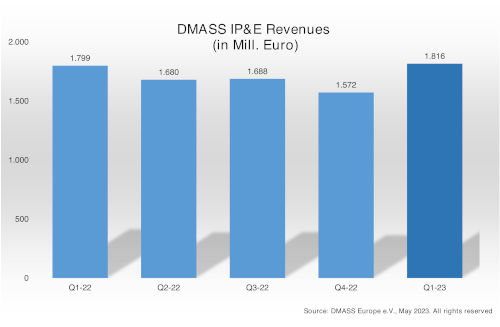
Hermann Reiter, President of DMASS, states: “After the fourth quarter of 2022, it was difficult to imagine that our market would return to growth, both year-on-year and sequentially, especially since the slowdown in orders had been visible for some months. The surprising revenue growth in Q1 cannot mask the reality of fairly full inventories in the channel. At the same time, we share the general optimism of the European sector that the slowdown will be short-lived. As our main business segments are not PCs or smartphones, but rather thriving segments such as automotive and industrial, we are confident that, after the inventory is absorbed, demand will return to dynamic growth.”
 Semiconductors (Q1):
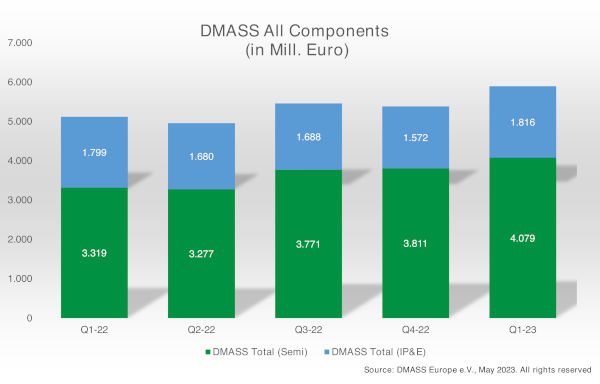
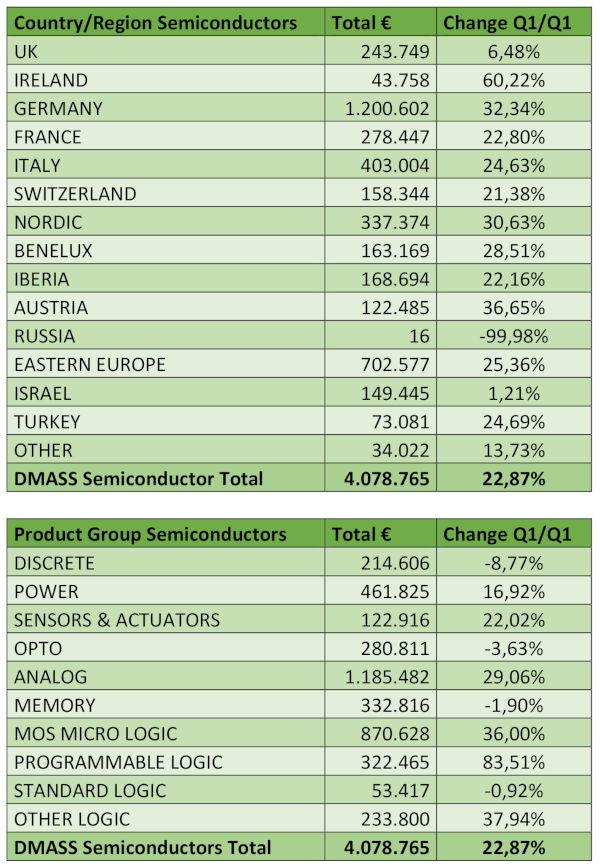
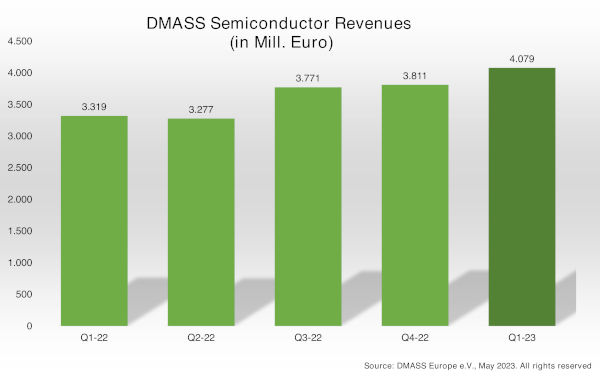
With a total of €4.08 billion, DMASS achieved the highest revenue ever recorded in the semiconductor sector. Growth occurred in all countries and regions, albeit at varying paces. Among the major countries, Germany recorded the largest increase. By product type, microcontrollers, programmable logic and other logic products (ASICs, ASSPs) registered the greatest growth, followed by analog products (see charts for more details).
Interconnect, passive, and electromechanical components (Q1):
The IP&E segment posted a surprising 15% sequential increase compared to Q4/22, but meager growth of 0.9% to €1,820 million compared to Q1/22. The distribution of growth by country was entirely different from that of semiconductors (primarily due to a different membership structure in IP&E). While passives declined by 2.3% (specialty passive components saw an increase), connectors and electromechanical components, as well as power supplies, remained positive (see charts for details).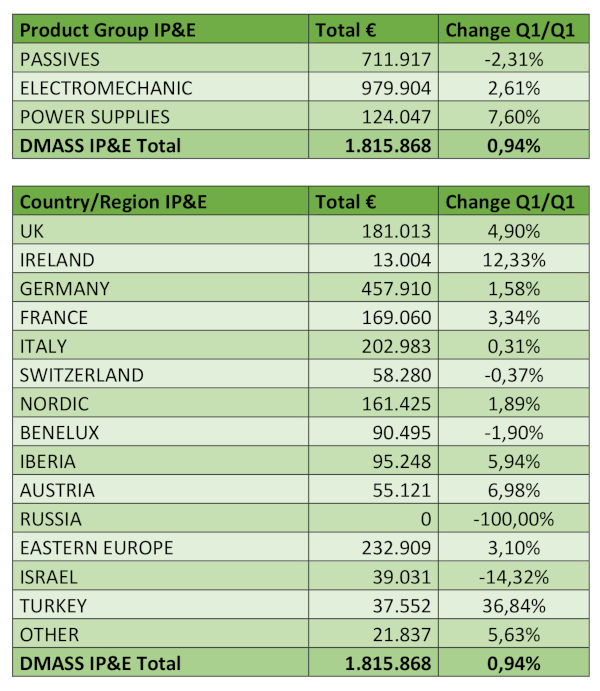
President Hermann Reiter states: "The growth curves for Semiconductors and IP&E have been quite different for some time, with IP&E growth peaking a few quarters earlier than that of Semiconductors. That's why we were pleasantly surprised by the first quarter. What's also clear is that specialty electronics on both sides continue to register growth peaks, which may indicate a shift away from standard technologies."
 However, the unique situation of the distribution sector, compared to a broader market experiencing steeper declines, makes predictions difficult, Reiter explains: "It's true that inventories have decreased, but not to the extent we feared. We would expect a slowdown by 2023, but at moderate levels, and we see considerable optimism from customers regarding the long-term prospects for the electronic components business in Europe."