




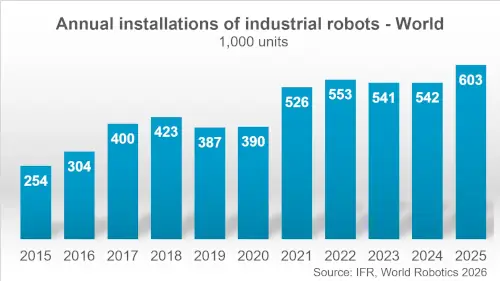
New installations also increased during the year. Factories incorporated more than 600,000 industrial robots, an 11% increase over the previous year.
Growth shows significant differences between regions. Asia accounts for a large share of new installations, while the Americas also registered increases during 2025. In Europe, on the other hand, several of the main markets reduced their installations.

China accounts for 59% of new installations
China remained the world's leading market for industrial robots in 2025. The country installed 354,000 units, up 20% from the previous year, and accounted for 59% of new installations worldwide.
Chinese manufacturers installed 195,000 units in their domestic market, a 15% increase. This accounted for 55% of all installations in China during the year.
Japan was the second largest Asian market, with 36,219 robots installed. This figure represents a year-on-year decrease of 19% and places the country as the third largest market worldwide for new installations, behind China and the United States.
South Korea added about 30,000 units, down 1% from 2024. Its annual installations have remained around 31,000 units since 2019.
India surpasses 10,000 installations
India installed nearly 10,500 industrial robots during 2025, 15% more than the previous year, and ranked as the sixth largest global market by volume of new installations.
Medium-term growth has been particularly significant. Between 2020 and 2025, annual installations of industrial robots in India increased at a compound annual growth rate (CAGR) of 27%.
Although its volume remains below that recorded by the five main global markets, these data show a sustained expansion of industrial automation in the country.
The United States becomes the second largest market in the world
The United States overtook Japan in 2025 and moved into second place worldwide in terms of the number of industrial robots installed.
The US market added approximately 38,500 units, a 12% increase over the previous year. This is the third-highest annual figure recorded in the country, according to IFR statistics.
In Mexico, installations decreased by 7%, falling below 5,200 units. This marks the third consecutive year of decline for the country.
Canada installed nearly 4,000 industrial robots, a 5% increase. Between 2020 and 2025, installations saw a compound annual growth rate of 9%.
Brazil increases facilities by 38%
Brazil recorded one of the largest increases in the Americas during 2025, with nearly 4,300 new industrial robots, 38% more than the previous year.
The automotive industry played a significant role in this trend. The sector installed approximately 2,100 units, representing a year-on-year increase of 212%.
IFR links this increase to investments made in the country by car manufacturers, including Chinese producers.

Decline in installations in key European markets
Germany continued to be the largest European market for industrial robotics and the fifth largest worldwide in 2025.
The country accounted for 41% of new installations in the European Union. However, its installations fell by 8% during the year, dropping below 25,000 units.
Between 2020 and 2025, German annual installations registered an average growth rate of 2%.
Italy, the second largest European market, installed approximately 7,800 robots, 11% less than the previous year.
France reached nearly 4,500 units, down 8%, while Spain registered around 4,300 installations, 15% less.
More than 600,000 robots installed in one year
Data from *World Robotics 2026* shows a global market marked by growth in Asia and America and by a more moderate evolution in Europe.
China continues to account for the largest volume of new installations, while the United States has moved into second place globally. India is also maintaining a growth trajectory, although its absolute figures are still lower than those of the major markets.
Meanwhile, the global stock of industrial robots has exceeded five million operational units, more than double what it was seven years earlier.
IFR forecasts 806,000 annual installations in 2029
IFR forecasts indicate that global installations could increase by 9% in 2026, reaching approximately 655,000 units.
By 2029, the organization estimates that around 806,000 industrial robots could be installed in a single year.
Factors that may influence this evolution include the relocation of certain manufacturing activities, demographic changes, labor shortages in some markets, and investments aimed at increasing production capacity.
These factors are further compounded by the technological evolution of the robotic systems themselves. Advances in artificial intelligence, computer vision, and sensors are expanding the tasks that robots can perform, while simplified programming and integration facilitate their incorporation into new industrial processes.







