With component supply chains gradually stabilizing and the first cost cuts, operators are now using data from real-world deployments to determine which humanoid use cases are commercially viable in the short term and which represent longer-term opportunities.
According to IDTechEx’s new report, “Humanoid Robots 2026–2036: Technologies, Markets and Opportunities,” the humanoid robot industry is entering an early stage of commercialization, with adoption initially planned for industrial settings before expanding into broader commercial and consumer markets.
IDTechEx forecasts that the global humanoid robot market will reach approximately US$29.5 billion by 2036, driven by increasing deployments in automotive manufacturing and logistics, along with continued advancements in component scalability and platform reliability.
Automotive Manufacturing: The First Scalable Market.
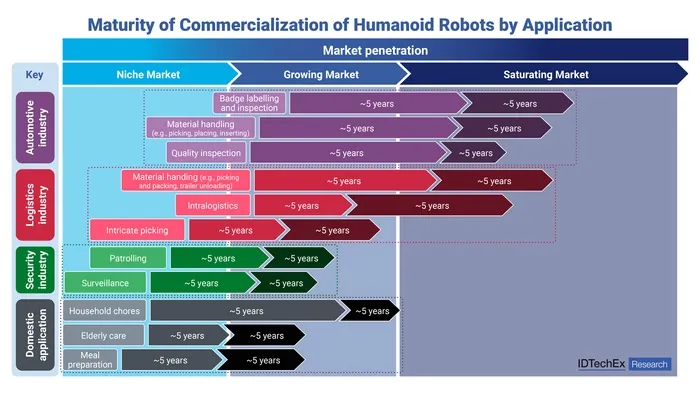
Automotive manufacturing is expected to be the first sector where humanoids scale in significant volumes. Compared to open environments, automotive plants offer controlled conditions, structured workflows, and a clearer ROI justification for repetitive and labor-intensive tasks. Early deployments focus on relatively simple but scalable tasks, such as material handling, inspection support, internal transport, and basic assembly assistance. As the market moves beyond proof-of-concept, commercialization is increasingly defined less by “general-purpose capability” and more by reliability, safety validation, maintainability, and predictable uptime.
A key factor is that many of the most active strategic investors and backers are the automotive OEMs themselves. Unlike traditional buyers of industrial automation, these OEMs have both the capital base and the long-term incentive to accelerate humanoid development, especially in the face of rising labor costs, limited workforce availability, and pressure to improve manufacturing flexibility.
Logistics and Warehousing: Scaling Potential with Automation Competition.
After automotive, logistics and warehousing are emerging as the second most important market segment. However, growth will depend on competition from existing automation technologies such as autonomous mobile robots (AMRs), automated guided vehicles (AGVs), and robotic arms, which already offer established cost-performance advantages.
Even so, humanoid robots are positioned as a flexible solution in environments where tasks are mixed or unpredictable and are performed around human workers. As hardware costs decrease and performance improves, humanoids could become commercially attractive for pick-and-place operations, package handling, and repetitive sorting, especially where fixed automation would require significant capital investment and infrastructure redesign.
Domestic Humanoids: A Long-Term Opportunity
. The domestic market remains a longer-term opportunity. Significant adoption is expected after 2030, once challenges related to safety, reliability, affordability, and true autonomy are addressed. Scalability to a domestic volume is likely to occur after 2035, when reliability, safety validation, and autonomy are adequate for unstructured home environments.
Component limitations will define the speed of commercial expansion.
Despite market momentum, humanoid robots still face engineering and manufacturing limitations. Battery energy density and thermal management remain critical constraints, while scaling high-precision components such as screws, bearings, and high-performance actuators is a challenge. Hand dexterity and tactile perception also remain key obstacles to expanding capabilities beyond basic industrial operations.