China accounted for approximately 66% of global NEV sales in 2025. However, its annual growth slowed to 24% due to a high comparative base, falling slightly below the global average.
In contrast, Western Europe recorded year-on-year growth of close to 30%, its best performance since 2022.
BYD surpasses Tesla to lead global BEV sales in 2025.
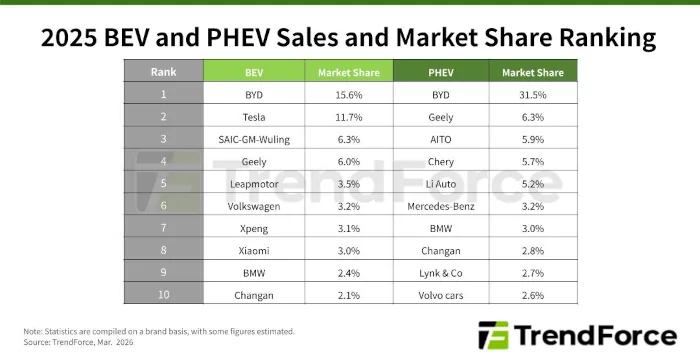
In the 2025 battery electric vehicle (BEV) rankings, BYD recorded approximately 25% year-on-year growth, overtaking Tesla to take the top spot.
Tesla experienced an estimated 9% year-on-year decline, reflecting limited momentum in its product lineup refresh. SAIC-GM-Wuling maintained its third position, while Geely climbed to fourth place thanks to strong demand for its Xingyuan model, priced below 100,000 yuan. Geely's market share increased from 3% to 6%.
Xiaomi also recorded rapid growth, doubling its share from 1% to 3%, which propelled it to eighth place. Although
Volkswagen achieved overall sales growth, continued weakness in China resulted in a drop in its ranking and market share. To reposition itself, the company launched the China-focused sub-brand ID.UNYX and deepened its collaboration with Xpeng. The jointly developed models will reach the market in the first quarter of 2026, marking a strategic realignment in China.
Geely rises to second place in the PHEV segment.
In the plug-in hybrid electric vehicle (PHEV) segment, BYD maintained its lead with approximately 31.5% market share in 2025. However, it recorded its first decline in both sales volume and share, while its group-level share stood at around 36%.
Geely advanced to second place with a 6.3% share, driven by its Galaxy range. Both BYD and Geely, as large automotive groups, benefit from strong cost control and advantages in resource integration.
In contrast, Li Auto, which had been runner-up in 2024, faced more intense competition in China and slower international expansion. Its 2025 sales fell by around 30%, dropping it to fifth place. The company is increasing investment in AI-powered vehicle technologies to regain competitiveness.
Key Regulatory Changes for 2026:
TrendForce highlights major policy changes in key markets in 2026:
China is shifting from fixed-amount incentive subsidies to price-based percentages, which could hurt cheaper models.
The US will stop offering federal subsidies for electric vehicles.
Germany has reinstated subsidies without country-of-origin restrictions, which could benefit electric vehicles manufactured in China.
A key turning point will come on July 1, when negotiations to renew the United States-Mexico-Canada Agreement (USMCA) reach a critical phase. The United States is expected to push for a revision of the terms. Should Washington ultimately opt for an aggressive withdrawal, cross-border logistics costs would increase significantly, disrupting current production efficiencies and weakening the long-term competitiveness of the North American automotive supply chain.
Impact of memory pricing on electric vehicles
Electric vehicles, due to their high degree of integration of intelligent systems, require large volumes of high-capacity, high-bandwidth memory. Therefore, the sector is particularly sensitive to price increases and volatility in memory supply.
However, memory represents only between 1% and 5% of a vehicle's total material cost. In a context of increasing competition in intelligent vehicle capabilities, manufacturers prioritize supply stability to ensure timely product launches and continuous feature updates.