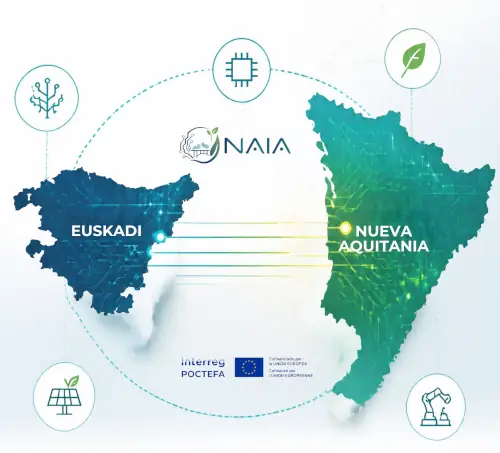
Supported by the Interreg POCTEFA 2021-2027 program and co-financed by the European Union, NAIA will develop a cross-border technology platform specializing in sustainable electronics over the next three years.
The infrastructure will connect companies, technology centers, universities, public administrations and training entities from both territories with the aim of sharing capabilities and infrastructure, developing joint projects and facilitating the transfer of knowledge to the business sector.
The project is led by AGUILA Technology and includes the participation of the GAIA Cluster, ESTIA Institute of Technology, the Basque Government—through the Department of Education and Don Bosco—and the Rectorate of the New Aquitaine Academic Region. During the 36-month duration of the project, the participating entities will work on the development and consolidation of the shared technological platform.
Three technological areas
The platform, called Common Space, will be structured around three technological areas:
Disruptive electronics: microelectronics, chips, and semiconductors.
Cognitive manufacturing: advanced robotics and intelligent manufacturing processes.
Connected intelligence: industrial automation and technologies related to smart industry.
In addition to facilitating access to technological infrastructure and equipment, the *Common Space* will make it possible to identify the capabilities, products, services and projects existing in the Basque Country and New Aquitaine.
The platform is designed to facilitate the location of technology partners, access to complementary capabilities, and the identification of potential joint projects between companies and knowledge centers in both regions.
Sustainable electronics and the circular economy
Among NAIA's objectives is the strengthening of local capacities related to the design, production, repair and recycling of electronic products.
The project also includes the development of new industrial activities and specialized professional profiles, as well as the incorporation of circular economy principles into the electronics sector.
Another of its lines of work will be the transfer of technology to companies, with special attention to SMEs and the development of the skills necessary to incorporate new technologies and processes.
Training and talent for the electronics industry
The development of specialized professionals is another area of focus for NAIA. The project will organize joint training activities between the Basque Country and New Aquitaine, including specialized workshops, shared programs, and student exchanges.
These initiatives will be geared towards adapting professional skills to the needs that the electronics industry may pose in the coming years, especially in areas such as microelectronics, semiconductors, robotics, automation and advanced manufacturing.
The project begins with a preliminary assessment conducted in both regions to identify existing capabilities, available infrastructure, and key needs in the industrial and educational sectors. This information will be used to define the cross-border collaboration model and the various planned actions.
With these lines of work, NAIA seeks to establish a stable structure of collaboration between Euskadi and New Aquitaine in advanced and sustainable electronics, connecting industrial, technological and educational capabilities of both territories.