The few memory companies that have commented on the recent market trends have attributed the rapid decline to a massive inventory adjustment being carried out by their customers. Furthermore, most expect this inventory adjustment period to continue at least until early 2023.
The following statements and data from some of the memory suppliers help to understand how quickly the market has changed in the last two months.
When Micron's fiscal third quarter ended in May, the company gave an early warning of the problems brewing in the memory market. Although fiscal third-quarter sales were solid, the company issued a sales forecast for the fourth quarter (ending in August) of -17%. Furthermore, Micron revised this figure to a sales decline of at least 21% for its fiscal quarter ending in August.
In its second-quarter conference call, leading NAND flash memory supplier Western Digital commented that the inventory adjustment underway is "definitely very, very sharp in the quarter we're in (3Q22)." Western Digital's outlook is for an 18% decline in company-wide sales this quarter. Since hard disk drives (HDDs) account for about half of the company's sales and are expected to show only a modest decline in the third quarter, IC Insights believes its NAND flash business is likely to see a drop of at least 20% this quarter.
- In early September, Kyung Kye-hyun, Samsung's co-CEO and head of its semiconductor unit, stated: "The second half of this year looks bad, and for now, next year doesn't appear to show a clear upward trend.".
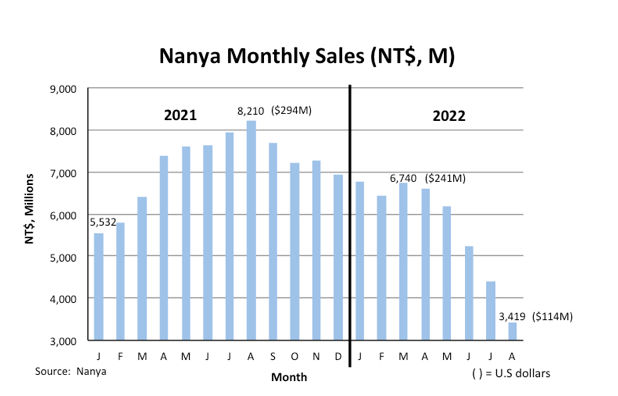
Nanya, based in Taiwan, is a relatively minor player in the global DRAM market, but its monthly sales data offers insight into how quickly the DRAM market can go from boom to bust. As shown in Figure 1, the company's DRAM sales in August 2022, expressed in US dollars, were 39% of what they were in August 2021 and down 53% from sales in March—just five months earlier!
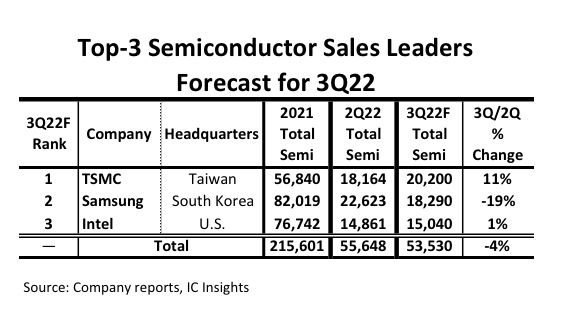
With the memory market currently in freefall, IC Insights expects foundry giant TSMC to overtake Samsung and take the top spot in semiconductor company sales rankings in Q3 2022 (Figure 2). As shown, Intel is expected to slip to third place in the rankings with Q3 2022 sales 26% lower than TSMC's. To illustrate how quickly TSMC has risen to the top, in 2021 it ranked as the world's third-largest semiconductor supplier, with sales 31% lower than Samsung's.
 The sheer scale of TSMC's semiconductor sales becomes even more apparent when considering the company's "final" sales. The "final" sales figure for a pure foundry like TSMC is roughly double the foundry's total sales figure. The 2x multiplier estimates the amount of semiconductor sales made to the end customer (i.e., the electronics manufacturer). For example, AMD, a company without a factory, buys processors from TSMC, but AMD is not the end user of these devices. AMD resells these processors to electronics manufacturers at a much higher price than it paid TSMC for the components. As a result, a 2x multiplier, which assumes a 50% gross margin for the foundry's customers (e.g., AMD), can be used to arrive at a "final" semiconductor market sales figure for TSMC.
TSMC's final sales estimate for 2021 places its semiconductor sales at $113.7 billion, compared to $40.4 billion in the third quarter of 2022. To put the company's final 2021 semiconductor sales figure into perspective, TSMC's final sales accounted for 18.5% of the global semiconductor market last year, at $113.7 billion. Furthermore, IC Insights believes this percentage is likely to increase to 25% in Q3 2022.