In "Optical & Radio Frequency Metamaterials 2024-2034: Markets, Players, Technologies," IDTechEx comprehensively examines the emerging technology of electromagnetic metamaterials in the second edition of this report. Based on interviews with companies across the value chain and IDTechEx's existing research on optical, telecommunications, and emerging materials, the report assesses the market for optical and radio frequency (RF) metamaterials in various applications. It analyzes the requirements of each application and includes case studies of existing players.
The report identifies reconfigurable smart surfaces (RIS) in telecommunications and metalenses in smartphone cameras as significant opportunities. Through detailed segmentation, it presents a comprehensive overview of the market status and potential for each application. Forecasts indicate that the global market will reach $14.9 billion by 2034, driven by the improvement of biometric sensors in smartphones through metalenses and the increasing deployment of 5G mmWave technology, which is accelerating the adoption of RIS.
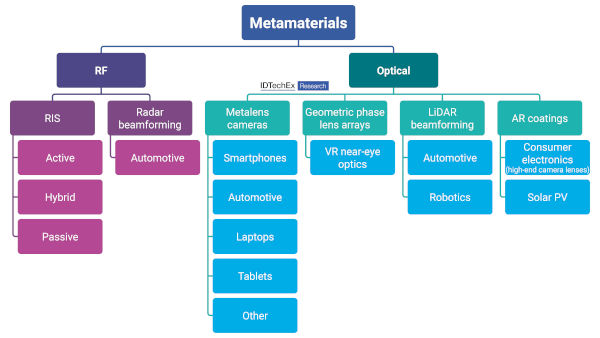
IDTechEx's 10-year forecast breaks down the EM metamaterials space into the following key market verticals, with many more analyzed in the report "Optical & Radio Frequency Metamaterials 2024-2034: Markets, Players, Technologies." Source: IDTechEx
RF (radio frequency) metamaterials market
Radiofrequency metamaterials have applications in multiple sectors, including telecommunications, automotive, aerospace, and security. They can be used in reconfigurable smart surfaces (RIS) to reflect, orient, and shield electromagnetic radiation, compensating for the shorter range associated with high-frequency signals. Furthermore, in radar beamforming, RF metamaterials allow for the active directing of electromagnetic radiation to improve angular resolution. This could be particularly beneficial for automotive radar systems. RF metamaterials can also be used to effectively shield against electromagnetic interference, improving security by preventing signal leakage, and can be frequency-selective to create transparent shielding. Radiofrequency metamaterials also have potential for medical applications, such as magnetic resonance imaging (MRI) and non-invasive glucose monitoring.
According to IDTechEx forecasts, the largest market for RF metamaterials will be reconfigurable smart surfaces (RIS) for 5G mmWave and future 6G communications. Both 5G mmWave and 6G offer significant advantages, such as the ability to leverage expansive bandwidth to support peak data rates ranging from gigabits to terabits per second while maintaining ultra-low latency.
However, the use of high-frequency spectrum presents challenges such as a very short signal propagation range (centimeters for frequencies above 100 GHz) and line-of-sight obstacles. Overcoming signal degradation and establishing reliable communication over reasonable distances is a priority for both technologies, especially in busy urban areas where constant connectivity is crucial despite these barriers.
Establishing numerous base stations is not cost-effective for providing adequate coverage in high-frequency spectrums such as 5G mmWave and 6G. In contrast, metamaterial SIFs can reflect and direct signals to end users, increasing signal range and strength while consuming minimal power. Furthermore, integrating metamaterial-based coatings with windows can enhance signal coverage by reflecting beams around obstacles in urban areas. These solutions provide broad coverage and offer significant opportunities for materials integration.
Optical metamaterials market
Relatively simple optical metamaterials based on the biomimicry of moth-eye structures have a relatively long history of use as antireflective (AR) coatings on high-end camera lenses. However, metalents manufactured using semiconductor industry processes are expected to have a huge impact, initially driven by their ability to improve the performance of computer vision systems.
In 2022, Metalenz's metalenses were commercially available in STMicro's time-of-flight (ToF) sensors, marking the first commercial use of this technology. In this case, the metalenses improved light-gathering performance in a smaller package than the optics they replaced. The greatest value of metalenses lies in their ability to add additional optical functions, such as polarization imaging, in a very compact size. This has enormous potential for application in facial biometrics for smartphones and could bring facial recognition to smartphones beyond Apple's range in the near future, with Metalenz announcing sensor modules designed for this application in late 2023.
Liquid crystal-based metalenses are expected to have a significant impact on virtual reality headsets, where they could be used to resolve the vergence-accommodation conflict and help these devices pass the "visual Turing test." Furthermore, active optical metalenses could contribute to making LiDAR more compact and expanding the markets in which these sensors can be used.
The biggest limiting factor for metalenses is their broad-spectrum performance, but significant innovations in the design of the metasurfaces themselves and software compensation are expected to make them a more compact and cheaper replacement for smartphone camera lenses within the next ten years. Ultimately, metalenses have the potential to disrupt many corners of the optics industry in the near future.
Author: Sam Dale, technology analyst at IDTechEx