“Internal combustion engine vehicles will likely remain with us for much longer. But by 2030, 120 million new vehicles will have been registered worldwide, and electric vehicles will account for approximately one-fifth of the total. Laser technology plays a key role in the manufacture of the most important vehicle components,” says Gerhard Hein, Managing Director of the VDMA Working Group on Lasers and Laser Systems for Materials Processing.
With the entry of electric mobility into the market, major production challenges are on the horizon. The international trade fair LASYS 2020 will address these changes in production technology, focusing on the diverse applications of laser materials processing. LASYS will celebrate its seventh edition in 2020. It will be the meeting place for representatives from various sectors, including manufacturers, integrators, service providers, and users of laser systems.
New Challenges for Laser Systems
“Although electric mobility is still in its early stages,” notes Johannes Bührle, head of the automotive sector at Trumpf, “production technology is key to its future.
However, the race started a long time ago. From a production standpoint, the goal is to strike a balance between manufacturing and mass production.” According to Bührle, many product designs are still in the development and optimization phase:
“Manufacturing and production equipment, such as laser systems, must be flexible enough to react to radical changes in design and the use of new or different materials.”
Laser systems are involved in many processes in the manufacture of electric vehicles. On the one hand, it's about creating lightweight constructions and improving body structures through load-adapted component design. Affordable laser machining processes for steel, aluminum, fiber composites, and additive laser processes play a significant role in this regard.
However, on the other hand, the production of batteries, power electronics components, and the electric drives themselves require innovative laser systems for joining or cutting that can efficiently and reliably process non-ferrous metals such as copper and aluminum.
Weight optimization with versatile laser processes:
Lightweight construction means optimizing a vehicle's weight while maintaining greater stability. Experts have high expectations for additive laser processes.
"Drive shafts manufactured using these processes in the automotive sector allow for weight reductions of more than two-thirds. The same applies to battery cases designed with grid structures or high-performance heat exchangers whose new design structures reflect a significant increase in compactness and exceptional functional efficiency," explains Hein.
Regarding the design of flexible, load-bearing vehicle components, the Fraunhofer Institute for Materials and Steel Technology (IWS), for example, believes that body structures that play a significant role in collisions should be individually improved. “To achieve this, we focus on components such as the bumper, battery tray, chassis, and overall vehicle structures. We reinforce parts precisely where needed. To do this, we use local laser treatment of sheet metal structures and local additive manufacturing techniques to apply ribs, for example, to profiles to reinforce them. We have also achieved designs with individual strength by local laser hardening of carbon steels at selected points,” explains Dr. Jens Standfuß, Head of Joining at IWS. Another key focus of the Dresden institute is the direct thermal bonding of metal to fiber-reinforced thermoplastics. Brief laser and induction heating produces a combination of adhesive bonding and mechanical teething. “The important thing is the laser structuring of the metal surfaces used. The surface is cleaned, expanded, and chemically modified to create shape-conforming structures. Unlike conventional adhesive joints, no additional material is required, and the laser bonding process is quick and easy,” says Standfuß.
High-efficiency laser welding of non-ferrous metals.
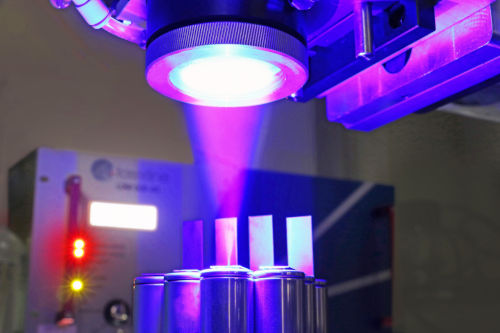
Electrically conductive materials, such as copper, are essential for battery cells, modules, packs, power electronics, and electric motors. Until now, their processing has been a challenge for laser systems. "We were the first company in the world to develop a blue diode laser with a wavelength of 450 nm and a power of more than 1 kW, which increases copper's light absorption to over 60%. Conventional infrared laser systems only achieve values of 2 to 5% due to strong light reflection," explains Dr. Simon Britten, Director of Innovation at Laserline's New Business Development department. Britten also points out: "This means that the energy input to the copper can be controlled so effectively that, for the first time, it is possible to achieve so-called heat conduction welding processes without evaporation or vapor capillaries. The result is processes that produce virtually no spatter. Furthermore, the precise remelting of the copper opens up new design possibilities for laser welding processes." Trumpf's laser systems operate in the green spectral range with a wavelength of 515 nm. "They utilize disk laser technology and, with an output power of 1 kW and a beam quality of 2 mm x mrad, enable unprecedented weld quality and energy efficiency, even with highly reflective materials such as copper," explains Bührle, a Trumpf expert.
Hairpin process: optimal interaction of various components.
The aforementioned new laser systems are used, for example, in the so-called Hairpin process: laser welding of stators. For Trumpf, the automated and cost-effective production of large quantities of electric motor stators is only possible with this process. In the Hairpin process, a compressed air gun fires a rectangular copper wire, similar to a hairpin, into the stator slot. "The hairpins are stripped by the laser, then twisted together and welded with a laser beam. It sounds simple enough, but it requires seamless interaction between the laser system, the optics, digital image processing, and process control," explains Bührle. Rainer Franke, Head of Laser Optics in the Laser Components department, agrees: "Laser optics also contribute significantly to the precision of laser welding and other manufacturing processes for electric mobility. We tailor the optics precisely to the intended use. Diffractive optical elements can be used to create a wide variety of beam shapes for specific requirements. Due to the high energy levels of industrial lasers, a high laser damage threshold in all optics is a critical factor."
Automated laser systems operate sustainably and with energy efficiency.
"To meet the growing demand from the automotive industry for installable electrical assemblies, turnkey automated production systems that integrate assembly, laser, and testing processes, as well as traceability systems for all product and machine data, are absolutely essential," says Dr. Jörg Lässig, Managing Director of SITEC Industrietechnologie. The Chemnitz-based company is responding with innovative, automated laser systems for welding power electronics components, stators, and bipolar plates for fuel cells. Lässig further emphasizes: "With our laser systems, we focus on both cost-effectiveness and environmentally sustainable production. We have achieved energy-efficient operation, for example, by integrating application-specific laser beam sources with high overall efficiency and optimal laser utilization through process-optimized system concepts."
Dr. Simon Britten of Laserline also considers establishing sustainable electric mobility in Europe a challenge. "With 'blue' laser light, we are facilitating this process by generating resource-efficient production methods. For the first time, this laser radiation can be generated directly without wavelength conversion. Combined with copper's high absorption, the overall efficiency of processes can be significantly increased in the future. Furthermore, we intend to develop
new applications beyond copper processing, because there is still much to discover about the interaction of many materials with this wavelength."
AI-powered laser methods and additive manufacturing are setting trends.
Individualization, improved cost structures, energy efficiency, optimized material use, process reliability, and quality will continue to be challenges in electric vehicle production in the future. Gerhard Hein of VDMA stated that: “When it comes to small batch sizes and true individualization requirements, the cost-effectiveness of tool-based technologies clearly reaches its limit. Laser-based additive manufacturing processes, such as laser metal deposition or laser metal fusion, offer a solution for the individualized series production of high-quality, weight-optimized vehicle components.” For Trumpf experts, artificial intelligence (AI) is a key solution. Bührle predicted: “AI is likely to greatly improve our production and quality control processes in the future if, for example, it can detect electric motors in the Hairpin process that do not meet predefined welding criteria. We are working on an AI that can do this independently.”




- Details
- Category: Events
LASYS, trade fair on flexible laser technology from June 16 to 18, 2020
Mobility is changing. And the focus is now on electric drives. One thing is certain: electric mobility will play a key role in the future, and it will encompass much more than just cars. Whether it's a tractor, a bus, a boat, a train, a motorcycle, a scooter, a bicycle, or even an airplane, the wave of electrification is gradually spreading.

Print Magazine

Annual subscription price:
You will receive all 10 editions that are published each year.
social networks
Popular News Electronics


Spanish electronics magazine. Printed for over 25 years.
Spain - Madrid - All rights reserved © Convertronic Professional Spanish Electronics Magazine.