
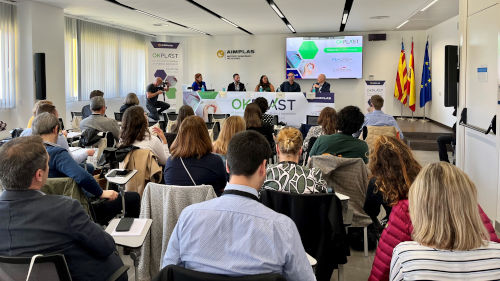
During the first presentation, Pierre Henry, from the European Commission's Directorate-General for the Environment, explained the status of the Draft Ecodesign Regulation for Products (ESPR) and how it will impact the way products are conceived and consumed today. These products will need to be durable, reusable, upgradeable, and repairable; free of substances of concern; and incorporate recycled materials. Efficient use of energy and raw materials in their manufacture will be considered, as well as their end-of-life recyclability. To this end, waste generation and its environmental impact will be taken into account, including through life cycle assessments and carbon footprint analyses.
Subsequently, Juan Ruiz, from Plastics Europe, addressed the issue of plastic pollution in the marine environment as a global problem and presented the regulatory actions underway by different countries within the framework of the UN, as well as industry initiatives such as OCS (Operation Clean Sweep) and the Reshaping Plastics report, which warns of the need to improve the circularity of plastics and promote actions to achieve net-zero emissions by 2050. For her part, Mariana Reina, from the Department of Competitive and Strategic Intelligence at AIMPLAS, reviewed the regulations concerning packaging and the objectives for reuse, recycled content, and compostability, and stressed the need for education on waste separation due to the risk posed by the introduction of bioplastics into the yellow recycling bin. José Guaita, from Heura, spoke about existing Extended Producer Responsibility (EPR) schemes and those currently being developed for commercial packaging in Spain. He emphasized the significant opportunity they represent for introducing post-consumer materials into the production chain of a country like Spain, which boasts the highest recycling capacity per capita in Europe. To conclude the first panel, Oscar Hernández, from ANARPLA, addressed the issue of end-of-waste status and its regulation in Spain and the rest of the European Union.
The second session of the day addressed the application of the Waste Law and the impact of the plastic tax. Angela Osma, from ANAIP, highlighted the significant effort companies are making to comply with this law and manage the tax, and reminded attendees that from 2024 onwards, it will be necessary to certify recycled content. Mar Guardiola, from Andersen, discussed the tax implications of the tax and emphasized the complexity posed by the lack of harmonization at the European level. Enrique Benavent, a Packaging researcher at AIMPLAS, focused his presentation on reuse as an alternative to reduce the impact of the tax and introduced AIMPLAS's Designed to be Reusable label. José Vicente Zaragozá, from KIWA, concluded the session along the same lines, focusing on the use of recycled material, the collaboration between KIWA and AIMPLAS to certify its traceability, and the certification of recycled content according to UNE-EN 15343:2008.
The first day concluded with a session dedicated to the REACH regulation, which governs the use of chemical substances. It began with a presentation on new developments in polymer registration and the restriction of fluorinated thermoplastics (PFAs) by Francisco Hernández of Chemservice. Following this, Eva Bonillo, also of Servireach, addressed the application of REACH to the mechanical recycling of plastics, while Elena Adán of BASF did the same for chemical recycling, a process she described as efficient but still facing challenges such as implementing these new technologies on an industrial scale and improving purification processes. Belén Monje, lead researcher in Mechanochemistry at AIMPLAS, reviewed the main international prohibitions and restrictions on monitored substances of concern, such as those contained in halogenated flame retardants.
Thursday's session began with a panel dedicated to product certification, emphasizing its importance in demonstrating sustainability and preventing greenwashing. Sonia Albein, lead researcher in Mechanical Recycling at AIMPLAS, discussed certifications that guarantee recyclability, such as RecyClass, and recycled content, such as EuCertPlast. Sara García, from TÜV Austria, addressed certifications related to compostability and biodegradability, while Anna Lisa Polimeni, from IPPR, presented the Plastica Seconda Vita certification. Pedro Fernandes, from APCER, discussed end-of-waste status and its regulation in Portugal. Finally, Rafael Postigo, from UNE, highlighted the importance of standards in legislation for building trust within the industry and in its relationship with consumers.
To close the day, the regulation of plastics in contact with food or cosmetics was addressed by Darío Dainelli of Darío Dainelli Policy & Regulatory Affairs, who explained the challenges and opportunities of the Regulation on Recycled Plastics for Food Contact, as well as the main questions its application raises for the industry. Hazel O'Keeffe of Keller & Heckman discussed the US case in her presentation on the FDA's role in the food contact recycling regulation. Raquel Requena, Head of Consumer Health and Safety and the Environment at AIMPLAS, spoke about the role of bioassays in advising on NIAS analysis, while Eva Martínez of AIDIMME addressed legislation for paper and cardboard in contact with food in different countries and emphasized the lack of regulation at the European level. She also discussed the use of plastics as a functional barrier in this type of packaging. Marta García, from Fakolith, spoke about innovation and sustainability in varnishes and coatings certified for contact with food and beverages, and reviewed the diversity of materials that can come into direct or indirect contact with food. Gerald Renner, from Cosmetics Europe, concluded with a presentation on plastic materials in the cosmetics sector, explaining how, in the absence of specific regulations, they are based on those for food contact.