
A fundamental component of humanoid hardware is the actuator, responsible for the physical movement of the humanoid robot, enabling these robots to walk, lift objects, handle tools, and interact with their environment. With a projected compound annual growth rate (CAGR) of 47% for humanoid unit sales over the next decade, new opportunities are emerging for material manufacturers and component suppliers to enter the supply chain of this rapidly growing market.
Current State of Humanoid Actuators:
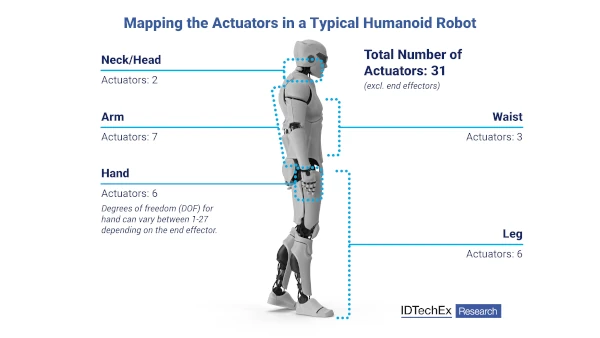
Actuators can be linear or rotary and use pneumatic, electric, or hydraulic power to generate movement, with electric actuators being the most popular among current humanoid robots. According to IDTechEx's analysis of more than 50 humanoid robots and prototypes, a humanoid robot typically has 31 actuators (excluding end effectors such as grippers or dexterous hands), resulting in the degrees of freedom (DOF) around the joints of the humanoid skeleton. Actuators also vary depending on the requirements of each joint. For example, wrists and ankles typically use smaller actuators, while weight-bearing joints, such as hips and knees, require larger, high-strength actuators.
IDTechEx analysis estimates that around 56% of a humanoid's weight comes solely from its actuators. These systems rely on rigid, high-strength materials, such as metal alloys (e.g., steel, aluminum, etc.), for key structural components. Furthermore, rare-earth permanent magnets (REPMs), such as NdFeB, are critical for humanoid robot actuator motors, as they provide high torque density, high power density, and smoother torque curves. The IDTechEx report, “Materials for Humanoid Robots: Technologies, Players, and Forecasts,” provides detailed information on material requirements and outlines the challenges facing actuators, with 10-year demand forecasts for key materials, including metals and rare-earth permanent magnets.
Is there a future for soft actuators?
Rigid actuators are particularly well-suited for high-force movements and loads requiring high precision, which is often the case for humanoid robot joints. However, they have limitations, including poor adaptability to unstructured environments, shock absorption that makes them vulnerable to impacts, mechanical wear, and fatigue. Furthermore, these systems use heavy materials such as steel (predominantly) and aluminum alloys, which increases the weight and bulk of the humanoid robot and ultimately reduces mobility and battery efficiency.
Compared to rigid actuators, the use of soft actuators based on "soft" materials—instead of metals—allows actuators to have biomimetic functions and behave like artificial muscles. Typical materials used for soft actuators include electroactive polymers, shape-memory alloys, and piezoelectric materials, among others. These materials respond to an external stimulus (e.g., current, voltage, temperature, pressure, magnetic field, etc.) to generate movement.
However, these technologies are still in the development stage and present several challenges that must be addressed.
Although the vast majority of current humanoid designs use rigid actuators—and IDTechEx believes these will remain the predominant option—soft actuators may play a role in the future (for example, in hybrid designs), being used in areas where human-like movement is a higher priority, while rigid actuators would be retained for areas subjected to high loads.
Outlook:
Overall, the current focus of the humanoid industry is on standardizing components, optimizing designs for ease of manufacturing, and establishing supply chains. This is also leading to the emergence of collaborations between humanoid original equipment manufacturers (OEMs) and actuator suppliers that traditionally serve the automotive industry, in order to leverage existing expertise and supply chains. Reducing weight without compromising structural integrity is also a key challenge for humanoid actuators. In the long term, materials innovations will be a cornerstone for supporting the development of next-generation humanoid hardware, capable of addressing the challenges faced by current cutting-edge technologies.
At this crucial stage for the humanoid robotics market, the IDTechEx report, "Materials for Humanoid Robots: Technologies, Players, and Forecasts," provides essential insights into the market and its trends, highlighting key emerging opportunities for material and component suppliers. The report offers an in-depth analysis of materials requirements and roadmaps, challenges and bottlenecks, as well as an overview of supply chains and industry players for key humanoid robot components, including actuators, structural elements (frames, housings and panels, and cladding), thermal management, and tactile sensors. The report also provides 10-year demand forecasts segmented by material type, including metal alloys (steel, aluminum and magnesium), rare earth permanent magnets, engineering plastics (e.g. PEEK, PC-ABS) and much more.
Fraunhofer IDMT develops smart acoustic sensors to detect drones
Drones can pose a risk to the security of airports, critical infrastructure, military installations, and large-scale events. However, they are difficult to detect when flying out of sight, for example, when visibility is reduced.