

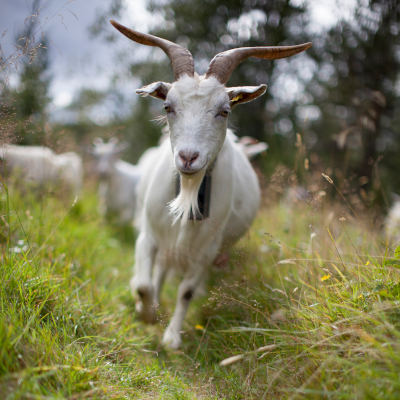
In 2016, a Nofence pilot project garnered significant attention when Norwegian TV viewers saw goats equipped with electronic collars grazing in the mountains surrounding the Fløibanen funicular in Bergen. The advantages of the first virtual fence were readily apparent: it allowed access to large areas of fresh pasture without the need for physical fencing.
Nofence's virtual fence makes it incredibly easy to keep livestock within a defined area. If an animal gets too close to a virtual boundary set via an app, the electronic collar around its neck emits a sound. The animal then receives a small electric shock if it crosses this boundary, quickly learning to stay within a predefined zone.
 Nofence's virtual "fence" keeps the animals in place.
Schive, the Norwegian battery specialist, quickly became involved as a battery pack supplier for Nofence, while Mascot later joined as the charger supplier. “These are products subjected to rough handling and temperature changes. As a battery supplier, we already had experience with tracking applications, but the Nofence project also required us to consider some unusual users: animals,” explains Odd-Leif Lien, Project Manager at Schive. Both the battery pack and the Mascot charger are specially adapted to the application's specific requirements, with particular attention paid to the animal's safety and comfort.
 Development of batteries and charging solutions for electronic collars: these products are exposed to rough handling and large temperature changes.
“For a price-sensitive product like this, it might seem obvious to opt for a cheap solution. But choosing the right charger is more complicated than it appears. You have to strike a good balance between price and performance without compromising on risk. Our chargers may seem expensive at first, especially in the early design phases. However, support, flexibility, and the ability to go back to the drawing board during the development process are important assets in a collaboration, and we were committed to providing all of that,” says Jan Fredrik Haugen, Head of R&D at Mascot.
 Schive battery pack (cattle version) with Nofence charging base and Mascot charger.
The quality of battery cells can also vary. “We only supply batteries from reputable suppliers and with built-in safety features,” Lien points out. “We have to minimize all risk factors. Among other things, all batteries are tested at our factory and delivered with full traceability. Quality has always been a key priority for us,” he says.
“Mascot develops high-quality, universal chargers, but no two applications are the same, and the chargers must be adapted to each need. For example, if charging will be frequent, it's best not to fully charge or completely discharge the battery. However, these collars, which are primarily intended to operate for months in the field, should be as fully charged as possible when shipped out,” explains Haugen. “Furthermore, these batteries can be deeply discharged. That's when it's important to charge the battery with a low current until it returns to its normal voltage level.”
“Products intended for certain sectors require special attention, and the medical sector is probably the most prominent. Devices used on living beings must meet the same standards, as is the case with our chargers, both in terms of product safety and electromagnetic compatibility (EMC),” emphasizes Haugen. “It is important to conduct extensive testing, both for use and abuse. Chargers and batteries can be exposed to large temperature fluctuations and intense wear and tear. Collars must remain outdoors and function under all kinds of weather conditions, as well as withstand shocks, water, sweat, heat, and cold. Even if the charger is indoors, the environment can be cold, dusty, and humid. Testing must guarantee a long service life despite the adverse environment. These requirements also include resistance testing against impacts, dust, and humidity, all of which are very important for Nofence.”
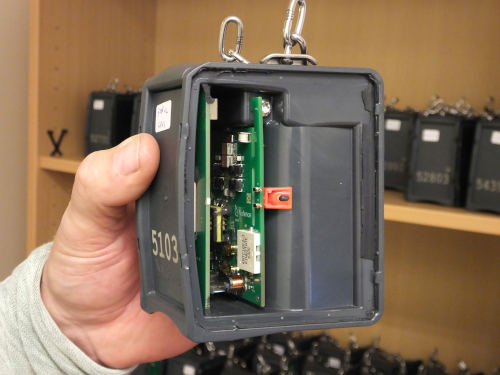 The inside of the animal's small collar, with the battery pack.
The concept has been well received by farmers and livestock breeders, who have been actively testing the Nofence concept, and their feedback has been invaluable. There have been some challenges along the way, but all have been overcome thanks to the skill of the engineers and the support of the suppliers. Nofence collars are available in two sizes, for sheep/goats and cattle, and with two different battery packs of 10 and 20 Ah, respectively.
Orders are now starting to come in, and the company has secured a production agreement with Inission Løkken worth 70 million Norwegian kroner (6.3 million euros) for a two-year period. Schive and Mascot formalized their collaboration last autumn with the intention of working more closely together on sales and marketing, as well as on development and projects like Nofence.