
At the same time, early-stage research into the next generation of semiconductor materials—ultra-wideband (UWBG) semiconductors—threatens to further revolutionize this sector. IDTechEx forecasts that the power electronics market will grow to US$65.2 billion by 2036, representing a compound annual growth rate (CAGR) of 10% over the forecast period. The IDTechEx report, "Power Electronics Market 2026-2036: Data Centers, Electric Vehicles, and Renewables," provides a detailed comparative analysis of silicon, broadband, and ultra-wideband semiconductors, as well as a supply chain analysis (including key insights from discussions with leading Chinese SiC manufacturers) and an assessment of each material in the data center, electric vehicle, and renewable energy sectors.
A difference in materials: key properties that differentiate Si, SiC, GaN and UWBG
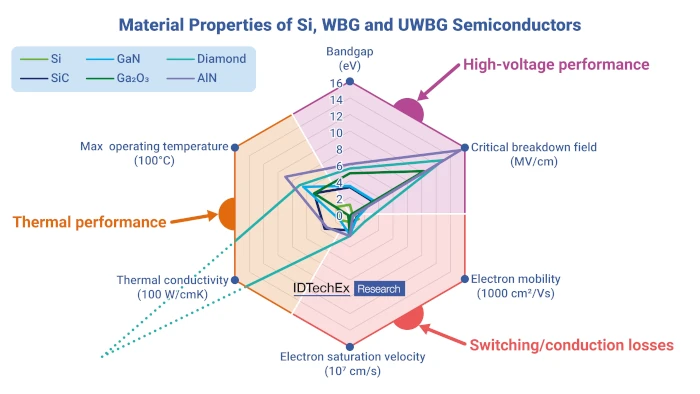
The most obvious difference between Si, SiC, GaN, and UWBG at the material level is their band gap. This directly influences critical material properties, such as their critical breakdown fields, which determine the maximum voltage at which power semiconductors can operate safely. A higher critical breakdown field allows for higher voltage operation or, alternatively, allows operation at the same voltage with a smaller drift layer, minimizing the form factor and on-state resistance. However, other parameters are also important when evaluating semiconductor materials. Electron mobility and drift velocity affect a device's switching performance, which in turn influences the switching frequencies a power transistor can achieve. It should be noted, however, that the device architecture also plays a key role in this regard. GaN high-electron-mobility transistors (HEMTs), for example, enable fast switching frequencies on the order of MHz.
Since thermal management plays a crucial role in system design, the thermal properties of semiconductor materials are also an essential factor to consider. Taking into account material and device considerations, SiC is well-positioned to complement silicon in high-voltage applications, while GaN is particularly well-suited for low-power, fast-switching applications. The properties of some ultra-wide-bandgap (UWBG) materials are very interesting. In particular, diamond, with its large band gap, high switching performance, and exceptional thermal conductivity, has the potential to function as the "ultimate" power semiconductor, at least in theory.
Data centers are driving innovations in broadband materials, while renewable energy is supporting the longevity of silicon
One of the most anticipated recent applications of power electronics is in data centers, particularly for AI training, where the next generation of servers requires a redesign of the power architecture. This involves moving from rack-level AC-to-DC conversion to a "sidecar" architecture that supplies 800 V DC to the rack. Eventually, this will be replaced by a "native" 800 V DC architecture, in which the mains voltage is reduced to 800 V DC using solid-state transformers and then distributed throughout the data center. While this is expected to bring significant efficiency improvements, the primary reason is practical: the current power architecture simply cannot provide the necessary power for Nvidia's Vera Rubin Ultra servers and later models. Detailed analysis of the transition to 800 V DC is included in the report "Power Electronics Market 2026-2036: Data Centers, Electric Vehicles, and Renewables."
In electric vehicles, the shift to an 800 V powertrain was a key driver of innovation in broadband materials, where the advantages of SiC over current silicon technology became clear and justified the higher cost in many high-performance models. In data centers, similar factors are driving innovation in broadband technology, particularly with GaN. In the low-voltage domain (reducing 800 V DC to 50 V, 12 V, or 6 V), efficiency and miniaturization are critical. GaN's ultrafast switching reduces the size of passive components (inductors, capacitors, etc.) and, therefore, the overall footprint of the device. With the goal of reserving as much space as possible for computing, device size is a vital parameter driving the commercialization of GaN. In the high-voltage field, solid-state transformers are likely to be based on SiC technology, where individual MOSFETs are already capable of operating at 10 kV.
Silicon carbon (SiC) and silicon nanomaterial (GaN) certainly grab the headlines, although they don't yet dominate the entire market (IDTechEx predicts that SiC will become the dominant material for power semiconductors by 2036). However, a solid and stable market for silicon power semiconductors remains. One example where industry players have been more hesitant to switch to broadband semiconductors is renewable energy, specifically wind turbines. This is especially true in the offshore sector, where repair costs would be very high if components failed. The advantages of miniaturization are also relatively less significant compared to other sectors. Finally, the wind energy sector is very cost-sensitive; in many cases, the additional costs associated with SiC are too high to bear. Overall, this has resulted in a much slower transition away from dominant silicon technology. However, the first collaborations are beginning to emerge, such as those established between Wolfspeed and Hopewind, suggesting that SiC technology has reached sufficient maturity for use even in these more cautious sectors. This maturity has been largely driven by R&D in the electric vehicle sector, highlighting the cross-cutting nature of the power electronics market.
Author: Matthew Fall - Technology Analyst, IDTechEx