Whether integrated into a smart home system or as discreet wearable devices, these new technologies aim to monitor health and well-being and improve quality of life. Against a backdrop of an aging population and rising healthcare costs, the project focuses on prevention to help people stay fit and independent for longer. Bosch Sensortec is coordinating the project, which has received €15 million in funding from national funding bodies within the EUREKA Xecs cluster.
For many people, smartphone apps or fitness trackers that help them monitor their goals—such as step counters or devices that track heart rate and sleep quality—have become part of everyday life. However, because this type of data is incomplete and lacks context, it is insufficient for consistently monitoring people's health and well-being. This is where SensorTech4Health comes in. This international project aims to develop preventative healthcare technology that will enable people to continue living independently in their own homes for longer.
“Our goal is to develop sensors that are more than just technical components: they will act as sensitive companions, helping people lead healthier lives,” explains Dr. Stefan Finkbeiner, Managing Director of Bosch Sensortec. “Our aim is to use smart sensor technology that seamlessly integrates into everyday life to improve people’s quality of life in the long term. By prioritizing prevention, we enable people to maintain their fitness and independence for longer. With this project, we are shaping the future of preventative healthcare,” Finkbeiner states.
The new assistance systems will be designed based on user needs, using smart technology to ensure the devices are easy and intuitive to operate. Eight international companies are collaborating with sleep research teams from the University of Freiburg Medical Center and the Czech National Institute of Mental Health, as well as with gas sensor experts from Saarland University. The project is coordinated by Bosch Sensortec and aims to develop market-ready products.
Smells, sounds and AI: assistance systems for a healthier society
Detecting health risks early is not only important for individuals. In an aging society with a healthcare shortage and expensive treatment and care options, missing the opportunity to stay healthy longer has significant consequences. Monitoring stress, sleep habits, and overall health can help people maintain a high quality of life for longer while preventing costly overburdening of the healthcare system. The SensorTech4Health project tackles these challenges head-on with plans to design intelligent assistance systems that promote healthier lifestyles, well-being, and safety.
New technologies will use information from the user's environment—such as their home or hospital room—or directly from the user's own body to monitor their health. Through machine learning, these innovative technologies will learn to "understand" this data and contextualize it within a given situation, allowing devices to take or suggest appropriate measures, even those as simple as opening windows in a stuffy room. "We are developing technical solutions for everyday people in their own homes, from young people who want to adopt a healthy lifestyle to the elderly, people with care needs, and people with chronic illnesses," explains Dr. Christian Bur, principal investigator of the project at Saarland University.
Academic and industrial partners are developing a range of diverse devices that automatically and discreetly monitor sleep quality, stress, and other health indicators. "These devices will have entirely new functions; for example, the ability to analyze body odors, breath, and volatile organic compounds." "The indicators measured by the various sensors will be analyzed together within their context using artificial intelligence and appropriate algorithms," explains the gas sensor expert.
Privacy by design
The partners are developing assistants that can be integrated into smart home systems, allowing people to continue living independently in their own homes. The team hopes to develop assistants capable of using machine learning methods to monitor users' well-being—for example, by detecting that someone is cooking at home, a sign that everything is alright. "This would be possible through a combination of microphones and gas sensors that detect certain substances in the air. The microphones don't record speech; instead, they transform sound into electrical signals through pressure changes on a microscopic membrane. Individual indicators and raw data alone aren't very revealing. But by combining indicators and data from various types of sensors and using artificial intelligence for analysis, we are able to create a novel assistance technology," explains Bur.
For the team, it is especially important that these systems do not violate user privacy and that data security is protected. "The systems are equipped with gas sensors and microphones that record sound exclusively, without any speech recognition technology." The systems will not have cameras and will not store or send data to the cloud. Signal processing will be carried out locally on the devices themselves,” Bur says. The technology is designed to operate discreetly, automatically, and securely in the background, without users having to press any buttons to control the devices.
New hearing loss assistance systems and much more
The group aims not only to design assistive technologies that integrate into smart homes, but also those so small that users can place them on their bedside tables. The consortium even plans to integrate gas sensor systems into smart textiles, such as bed sheets, allowing for constant, yet non-invasive, monitoring of health indicators for people with illnesses or those requiring care. Hearing loss increases the risk of dementia, a fact that underscores the importance of research into assistive systems that aid hearing. The consortium intends to develop cochlear implants with improved microphones, thereby enhancing their performance. It also plans to develop other electronic products that support hearing and improve the quality of life for people with hearing loss; for example, by suppressing distracting background noise, which would facilitate understanding conversations.
Gas sensors detect individual molecules among billions
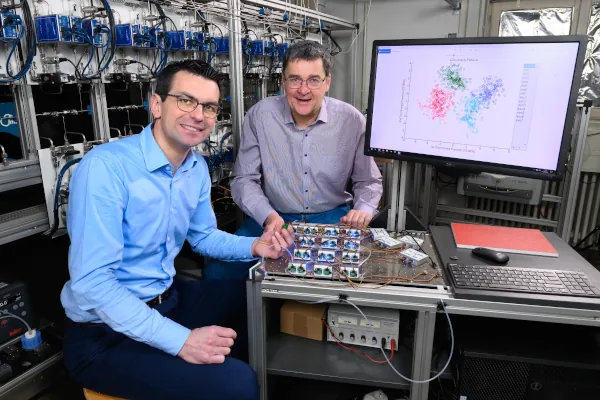
One of the project's main goals is to promote health and well-being through novel gas sensor technologies. To achieve this, researchers are harnessing a specific phenomenon that occurs within the body. "The body constantly produces metabolic byproducts that are released into the environment through the skin and respiration," explains Christian Bur, the postdoctoral researcher who leads the medical gas sensor research team in Andreas Schütze's Measurement Technologies research group at Saarland University. The molecular compounds that the body releases into the air have distinctive characteristics, although we are not normally able to smell them. Bur is developing gas sensor systems capable of accurately measuring these volatile organic compounds.
The systems collect the substances from the air and identify them using artificial intelligence. Filtering these substances is a significant feat, as they constitute a very small fraction of the air in a space, meaning they must be separated from a virtually infinite number of airborne particles. Christian Bur specializes in this type of gas sensor system and the related machine learning approaches. The systems being developed by Bur and his team function like high-tech sensory organs, isolating individual molecules among billions in a room and measuring their concentration. Using machine learning techniques and the data collected by the sensors, the systems are able to identify the compounds. “We are working with our industrial partners to develop systems with novel gas sensor layers that can continuously measure the concentration of specific substances with very high accuracy, using metal oxide semiconductor gas sensors,” explains Bur. Saarland University will receive €1.2 million to fund the project.
Project: SensorTech4Health
The SensorTech4Health project brings together partners from academia and industry in the field of digital health. This international collaboration has received €15 million in funding from national bodies within the EUREKA Xecs cluster. The German partners in the project received funding from the Federal Ministry for Research, Technology and Space through VDI/VDE Innovation + Technik GmbH.
The industrial partners participating in the project are Bosch Sensortec (Germany), Robert Bosch GmbH (Bosch Corporate Research, Germany), Robert Bosch Oy (Finland), Intervall Beratung GmbH (Germany), Cochlear Technology Center (Belgium), VS Particle (Netherlands), Sintex (Czech Republic), and PulseOn (Finland). The academic partners are the University Medical Center of Freiburg (Germany), Saarland University (Germany), and the National Institute of Mental Health (Czech Republic).