
The new IDTechEx report, "Redox Flow Batteries Market 2024-2034", shows that the RFB market will be valued at $2.8 billion in 2034. There are several factors that will determine how the RFB market will grow over the next decade.
Future market and advantages of RFBs
Redox flow batteries are well-suited for large-scale stationary energy storage applications. As larger volumes of VRE sources are integrated into power grids, there may be longer periods when these energy sources are unavailable. Therefore, energy storage technologies capable of providing longer-duration storage, such as RFBs, will be needed to dispatch power during these extended periods.
RFB manufacturers claim their systems have a long cycle life. In some cases, they exceed 20,000 cycles, a figure far superior to that of lithium-ion batteries. This means RFBs can supply more energy over their lifetime, resulting in a lower levelized cost of storage (LCOS) compared to lithium-ion batteries. This gives RFBs an advantage as an energy storage technology over Li-ion.
Some RFB technologies, such as vanadium-based RFBs (VRFBs), can decouple power output and energy capacity. To increase energy capacity, it is necessary to increase the size of the electrolyte storage tanks as well as the electrolyte volume. Changes to the cell assembly are only necessary when increasing the RFB's power output is desired.
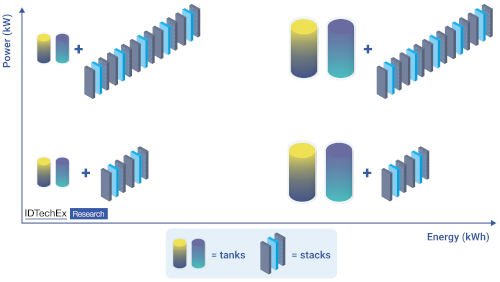
Decoupled scaling of RFB power and energy capacity. Source: IDTechEx.
This means that as storage duration increases, the CAPEX of these systems only increases in proportion to the size of the storage tank or the number of cells. In the case of lithium-ion batteries, as storage duration increases, the increase in the unit cost of the system is proportional, since all components must be scaled accordingly. This translates into greater LCOS reductions with increased storage duration for RFBs compared to Li-ion batteries. Thus, RFBs present a strong case for becoming a competitive long-duration energy storage technology in the future. The IDTechEx report presents, explains, and analyzes the LCOS calculations for lithium-ion RFBs versus vanadium RFBs.
current market
Despite these advantages, the CAPEX per kWh of VRFBs is currently higher than that of Li-ion batteries, and cost reductions are limited by the cost of the vanadium electrolyte. Furthermore, as there is currently no significant demand for LDES technologies, VRFBs will compete with Li-ion batteries for grid ancillary and utility services in the current stationary energy storage market. These applications will typically be for four hours or less, for which Li-ion is already a more widely deployed, well-understood, and commercially viable technology. Therefore, growth in VRFBs over the next few years is expected to be steady and consist of pilot and demonstration projects.
RFB manufacturers will try to reduce the cost of their systems by improving manufacturing processes or developing cheaper alternative chemicals. They will also try to increase the size of their systems to demonstrate their ability to store large amounts of energy for longer periods. For example, ESS Inc. plans to install a 500 MWh iron RFB for 10 hours in Germany in 2027. The success of these projects will be important for driving growth in the RFB market.
Emerging LDES signals and outlook
Although increased VRE penetration will drive long-term demand for LDES technologies, it is expected that demand for these technologies will be greater in some countries sooner than in others. These include Australia, South Korea, and the United States. Key factors in these regions include historical energy security and the risk of blackouts, previously announced tenders for LDES projects, government announcements of LDES deployment targets, and LDES technology financing.
In general, in other regions, demand for LDES technologies will be higher in the early 2030s, driven by increased VRE penetration and the associated challenges of uncertainty and variability in electricity supply. RFBs will be well-suited for LDES applications, given their lower LCOS and simpler, cheaper scaling of storage duration compared to Li-ion. Meanwhile, RFB growth is expected to be steady in the coming years, with deployments primarily consisting of demonstration projects and competition with Li-ion in other ancillary and grid supply services. Supply constraints on lithium-ion battery materials, such as lithium and cobalt, in the late 2020s may also be a driving factor increasing demand for other energy storage technologies in general, including RFBs.
Author: Conrad Nichols, Technology Analyst at IDTechEx