As lithium-ion batteries continue to expand beyond electric vehicles into industrial equipment, construction machinery, data centers, uninterruptible power supplies, and stationary energy storage systems, battery management systems (BMS) face increasingly demanding requirements. In all these applications, three objectives must be achieved simultaneously: continuous operation, safety, and long service life.
At the same time, battery packs are becoming increasingly larger and more complex. As the number of cells in series and parallel increases, any variation or anomaly in a single cell can have a greater and greater impact on the performance, lifespan, and safety of the entire system. Once installed in the field, battery packs cannot be disassembled for inspection, making the BMS the only practical means of monitoring battery health throughout its lifespan.
Under these conditions, conventional battery diagnostics based on voltage, current, and temperature measurements are reaching their limits. While estimating state of charge (SOC) and state of health (SOH) remains important, next-generation battery systems increasingly require a deep understanding of degradation mechanisms and emerging safety risks before failures occur.
Electrochemical impedance spectroscopy (EIS) offers a fundamentally different approach to examining battery behavior in the frequency domain. Rather than relying solely on aggregated electrical measurements, EIS allows observation of the electrochemical processes taking place within the cell, providing a more comprehensive and detailed view of battery health.
Limitations of Conventional Diagnostic Methods
Many BMS implementations rely on pulse resistance measurements using the ΔV/ΔI method. By applying a current pulse and measuring the resulting voltage response, resistance can be estimated with minimal hardware requirements.
However, the resulting resistance value is a composite quantity that includes contributions from multiple physical phenomena, including ohmic resistance, charge transfer resistance, double-layer capacitance effects, diffusion-related overpotential, and temperature- and state-of-charge (SOC)-dependent behavior. While convenient, a single resistance value provides little information about the underlying cause of battery degradation.

Figure 1. Equivalent circuit representation of a lithium-ion battery.
Similarly, state of charge (SOC) estimation based on open-circuit voltage performs well under stable operating conditions but becomes increasingly difficult in the presence of dynamic loads, temperature variations, and fast-charging conditions. Safety-critical degradation mechanisms, such as lithium plating, can develop long before a noticeable loss of capacity or an increase in resistance becomes apparent.
This poses a significant challenge for next-generation battery systems. In many cases, the risk may be increasing while traditional indicators still appear normal.
Although temperature compensation, model-based estimation, and machine learning techniques can improve performance, they remain fundamentally limited by the physical quantities available as inputs. If the measured quantities do not contain sufficient causal information, further processing alone cannot fully recover it.
Understanding EIS
Electrochemical impedance spectroscopy (EIS) addresses this limitation by separating battery processes according to their characteristic time constants.
Within a battery, electronic conduction, ion transport, interfacial charge transfer reactions, and diffusion processes occur simultaneously. In time-domain measurements, these effects overlap and are difficult to separate. EIS applies a small sinusoidal excitation and measures the resulting voltage and current response at multiple frequencies, allowing individual electrochemical processes to be observed independently.
The resulting impedance contains both magnitude and phase information, providing insights into the resistive and reactive behavior throughout the battery.
The impedance of a lithium-ion battery is typically represented by equivalent circuit models consisting of:
Ohmic resistance (Rs)
Charge transfer resistance (Rct)
Double layer capacitance (Cdl)
Diffusion-related elements
Different frequency regions highlight distinct electrochemical phenomena. High-frequency measurements are dominated by ohmic resistance and interconnection effects. Mid-frequency measurements reveal interfacial reactions and the behavior of the solid-electrolyte interface (SEI). Low-frequency measurements capture diffusion processes and concentration polarization.
Since impedance characteristics vary with the state of charge, EIS can also provide complementary information to traditional SOC estimation methods, especially under dynamic operating conditions where OCV-based approaches lose reliability.
This separation of electrochemical phenomena is one of the main advantages of EIS compared to conventional resistance measurements.
Visualizing Battery Behavior with Cole-Cole Plots:
EIS results are often visualized using Nyquist or Cole-Cole plots, which graphically represent the imaginary component of impedance as a function of the real component.
Changes in the shape of the plot can reveal valuable information about the battery's condition. The diameter of a semicircular arc is usually associated with charge transfer resistance, while shifts in the intersection with the real axis can indicate changes in ohmic resistance. Distortions or movement of these features may indicate the onset of degradation mechanisms.
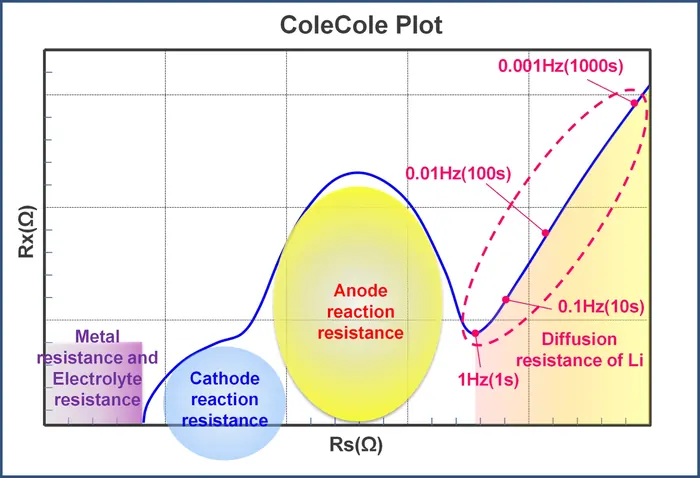
Figure 2. Cole-Cole plot showing the relationship between impedance characteristics and internal battery processes.
Instead of treating battery degradation as a single numerical value, EIS transforms impedance into a structured representation that can provide information about interfacial reactions, diffusion behavior, and evolving degradation pathways.
Lithium Deposition and Safety Diagnostics:
One of the most important applications of EIS is the detection of precursors to lithium deposition. Lithium deposition occurs when the insertion of lithium into the negative electrode becomes rate-limited, and metallic lithium begins to deposit on the electrode surface. Conditions that increase the risk of deposition include low temperature, high state of charge (SOC) charging, aggressive fast-charging profiles, and cell aging.
The challenge is that lithium deposition often develops before obvious voltage anomalies or measurable capacity loss become apparent. Once established, it can lead to irreversible lithium loss, accelerated degradation, dendrite formation, localized heating, and ultimately, an increased risk of thermal runaway.
Since conventional BMS indicators may not detect these early-stage changes, EIS offers a potentially valuable diagnostic tool. Changes in phase behavior, imaginary impedance components, and load transfer characteristics can reveal evolving interfacial conditions before more visible symptoms appear.
Especially in the mid- and high-frequency regions, EIS measurements can provide valuable information while maintaining practical measurement times suitable for field applications.
Implementation Challenges:
Although the advantages of EIS are well known in laboratory environments, its implementation in production BMS hardware presents significant challenges.
The impedance of battery cells is extremely small, often on the order of one milliohm. With typical excitation currents, the resulting voltage changes can be as small as a few hundred microvolts. These signals must be measured accurately in environments containing switching noise, electromagnetic interference, temperature variations, and other disturbances.
Phase accuracy is also critical. Measurement performance depends not only on amplitude resolution but also on timing synchronization, sampling accuracy, filtering characteristics, and signal path adaptation. Therefore, its practical implementation requires a thorough analysis of measurement bandwidth, noise performance, implementation cost, and operating conditions.
Practical Approaches to Implementing EIS in Battery Management Systems:
Instead of attempting to miniaturize laboratory EIS instruments, Renesas focuses on extracting useful impedance information using resources already available in BMS architectures.
The company's approach emphasizes low power consumption, minimal use of external components, and compatibility with high-voltage multi-cell battery systems.
Two complementary techniques are employed.
Approach 1: AC Superposition with Lock-In Equivalent Synchronization.
The first approach introduces a small AC component into the battery current and extracts impedance information using synchronized measurement techniques.
Traditional laboratory instruments typically rely on multiple analog-to-digital converters (ADCs) and dedicated lock-in architectures. Renesas' approach seeks to achieve equivalent amplitude and phase extraction using practical BMS resources, including delta-sigma converters and digital processing.

Figure 3. Architecture of the "lock-in" amplifier used for AC-IMP measurement.
This method is particularly effective under standby conditions, where current flow is minimal and electrical noise is reduced. Controlled excitation and synchronized sensing enable stable extraction of impedance information while maintaining compatibility with the requirements of production battery management systems (BMS).
Approach 2: FFT-Based Estimation from Pulse Responses.
The second approach leverages the mathematical relationship between time-domain and frequency-domain behavior.
Instead of performing direct frequency sweeps, the stress relaxation waveforms generated during normal BMS operation can be analyzed using FFT-based techniques to estimate equivalent RC parameters.
These parameters are directly related to the relaxation behavior associated with diffusion and interfacial reactions, making them relevant for load control, thermal management, and degradation assessment.
Although challenges remain due to noise sensitivity and parameter correlation, this approach offers a practical way to extract EIS-related information from measurements already available in existing BMS workflows.
From Measurement to Automated Decision Making:
The fundamental value of EIS lies not only in measurement but also in transforming measurement results into actionable decisions.
In laboratory settings, qualified experts typically interpret Cole-Cole plots visually. Production BMS implementations require automated judgment, robustness to variation, and explainable diagnostic results.
Therefore, impedance data must be converted into quantitative characteristics suitable for automated analysis. Examples include changes in Rs, variations in arc diameter associated with load transfer resistance, and impedance peak displacement.

Figure 4. Feature extraction from Cole-Cole charts for automated diagnosis.
Renesas focuses on extracting stable diagnostic features using a limited number of frequency points, enabling practical implementation without the need for full-spectrum measurements. This approach allows for rapid safety assessment while integrating measurement, analysis, and decision-making directly into the BMS.
Conclusion:
As battery systems continue to increase in scale, complexity, and performance requirements, conventional diagnostic approaches based solely on voltage, current, and temperature measurements are becoming increasingly limited. Electrochemical impedance spectroscopy offers a more comprehensive view of battery behavior by separating electrochemical processes according to their characteristic time constants, enabling a deeper understanding of degradation mechanisms and emerging safety risks.
By combining practical impedance measurement techniques, feature extraction, and automated decision-making, Renesas' EIS technologies pave the way for field-applicable diagnostics capable of supporting the next generation of battery management systems.
Authors: John Carpenter and Masaki Hogari, Renesas https://www.renesas.com
About the authors:
John Carpenter is a director at Renesas Electronics, where he is responsible for systems and applications engineering for the battery management group. He has extensive experience focused on systems solutions for battery and energy management technologies and has led complex product development programs and cross-functional teams. He specializes in project execution, stakeholder management, systems development, and strategic market planning, and has a strong track record of delivering innovative solutions and driving organizational success through collaboration and operational excellence.

Masaki Hogari is a senior applications engineer at Renesas Electronics and a member of the Algorithm Firmware Technology (AFT) team. He has extensive experience in lithium-ion battery technologies and battery management system (BMS) solutions. His technical expertise encompasses battery management algorithms for state-of-charge estimation, battery health diagnostics, impedance-based analysis, battery safety, and battery swelling detection. His work has contributed to the adoption of lithium-ion battery technologies in a wide range of industrial applications, including power tools and e-bikes, and he has led the development and commercialization of charge indicator integrated circuit solutions for various battery systems. He currently specializes in battery characterization and algorithm development, and has a strong track record of driving innovation through proprietary technologies and facilitating the successful implementation of battery systems, including training and capacity-building activities worldwide.