Depending on the recycling technique used, the products of these processes may require further refining or processing to allow their reintroduction into the manufacture of new batteries. In its latest report, "Li-ion Battery Recycling Market 2023-2043," IDTechEx discusses and analyzes three key recycling technologies being used by commercial players, including mechanical, hydrometallurgical, and pyrometallurgical recycling.
Mechanical Recycling
: Mechanical processing is the simplest technique, employed by many players worldwide, and is often the initial step in lithium-ion battery recycling. It typically begins with a dismantling phase, which is carried out manually due to differences in the design of electric vehicle batteries and requires skilled labor. Typical subsequent steps include shredding, grinding, and crushing. This breaks down the high-value materials, separates them from the foils and casing, and is performed in an inert atmosphere. Screening is often used to separate larger fragments of current collectors, casings, and separators from the electrode materials, which are composed of very fine powders. This results in the production of black mass, which requires further refining through hydrometallurgical or pyrometallurgical processing to produce battery-suitable metal salts. Currently, most operators in Europe and North America only have mechanical recycling capacity. Therefore, most of these recyclers currently lack the capacity to produce battery-ready materials ready for use in the manufacture of new batteries. This black metal is typically transported to recyclers in the Asia-Pacific region who possess these capabilities.
Pyrometallurgical Recycling:
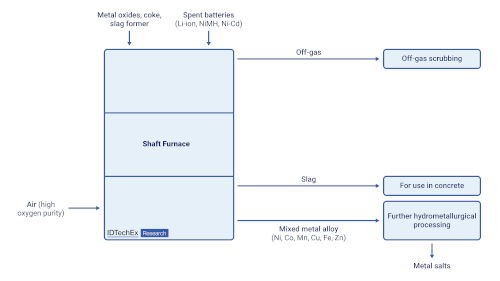
Pyrometallurgy refers to the use of heat to extract materials from batteries, typically carried out at high efficiency in an electric arc or blast furnace. Advantages of this process include minimal pretreatment requirements and its independence from the chemical composition of the batteries, allowing it to process various waste streams containing metals, such as NiMH, Ni-Cd, and Li-ion batteries. However, the process is capital- and energy-intensive, requiring significant gas purification. Pyrometallurgy produces a mixed metal alloy and a slag stream containing lithium, manganese, and aluminum. Therefore, further hydrometallurgical processing is still necessary to recover all the valuable metals to battery grade.
 Example of a pyrometallurgical process for recycling used batteries. Source: IDTechEx
Hydrometallurgical recycling:
Hydrometallurgical techniques can be used to directly recycle black mass or refine alloys produced from pyrometallurgy to form battery-grade metal salts. These salts can be reintroduced into the manufacture of new cathode precursors and are therefore more valuable than black mass produced from mechanical recycling. In hydrometallurgical recycling, leaching, solvent extraction, or precipitation steps can be used to selectively extract metals such as nickel and cobalt from the black mass produced by mechanical recycling in the form of battery-grade salts. The main advantages of hydrometallurgical recycling are that more valuable metals can be recovered and that it requires less energy than pyrometallurgical recycling. However, the cost of reagents and high water consumption pose some drawbacks. However, in interviews with IDTechEx, some recyclers have commented that they are able to cycle water several times through the recycling process to maximize their efficiency.
Currently, most hydrometallurgical recycling capacity is located in the Asia-Pacific region, with key players such as Sungeel HiTech, Exigo Recycling, and ACE Green Recycling. However, companies in Europe and the US recognize the advantages of hydrometallurgical processing and are expanding their capacity. Fortum recently began commercial operations at its hydrometallurgical plant in Harjavalta, Finland. This is the first commercial-scale hydrometallurgical recycling facility in Europe. In the United States, Li-Cycle also plans to establish its own commercial-scale hydrometallurgical plant.
Other Techniques
Although these are generally the three most developed processes used by lithium-ion battery recycling companies, other approaches are being explored. Specifically, direct recycling is a technique that involves mechanical preprocessing and component separation steps, followed by reactivation of the battery material to recover the capacity lost during cycles, but without breaking the crystalline structure of the cathode material. However, this is a pre-commercial technology that is being investigated by research institutions at a laboratory scale.
Conclusions
Battery manufacturers are keen to source recycled materials to mitigate metal price fluctuations and stabilize material supply. As the volume of end-of-life lithium-ion batteries continues to grow, recyclers will expand their recycling capacity by building new plants to meet the demand. By recycling lithium-ion batteries through hydrometallurgical processes, recyclers can produce battery-grade metal salts, which can then be used in the manufacture of new batteries. Hydrometallurgical and mechanical recycling capacities will expand in North America, Europe, and Asia-Pacific. Recyclers in Europe and North America will begin establishing commercial-scale hydrometallurgical recycling facilities to produce higher-value battery metal salts, rather than the black metal they have traditionally produced. This will give battery manufacturers in these regions the opportunity to begin to domesticate their supply of materials for the manufacture of new batteries, while reducing the risks associated with raw material supply and fluctuating costs.
New EU Battery Regulation for Cell-to-Pack and Cell-to-Body:
The sustainability, design, and recovery of electric vehicle (EV) batteries are about to be overhauled thanks to the approval of new EU regulations governing the battery market. In June 2023, Parliament approved new legislation establishing battery requirements, including a "battery passport" and the recovery of certain materials. In recent years, the EV market has moved towards greater system integration, with technologies such as cell-to-pack and cell-to-body designs, which can be more difficult to disassemble and/or remove from vehicles. Will this change with the adoption of these new regulations?
The new EU regulations cover the entire lifecycle of a battery, from material extraction to end-of-life recycling. To reduce the impact of initial manufacturing, higher recycled content is required in batteries, and targets are also set for the amount of lithium (50% by 2027, 80% by 2031) and cobalt, copper, lead, and nickel (90% by 2027 and 95% by 2031) that must be recovered from used batteries. An IDTechEx study on the lithium-ion battery recycling market has revealed that 23.8 million tons of lithium-ion batteries will be recycled by 2043. Facilitating battery removal from vehicles and disassembly into parts could benefit recyclers in the long run.
Cell-to-cell batteries are designed so that a battery pack is no longer segmented into multiple modules. Instead, all the cells are stacked directly to reduce unnecessary materials and weight, improve energy density, simplify manufacturing, and lower costs. According to research by IDTechEx, the average cell-to-cell battery shows a 20% increase in its gravimetric cell-to-cell ratio (the proportion of the pack's weight made up of the cells). Cell-to-body or cell-to-chassis technology takes this a step further, making the battery a structural component of the vehicle's frame, resulting in greater integration and a reduction in overall vehicle weight. The market is moving in this direction, with manufacturers like BYD already installing cell-to-pack systems in large quantities and cell-to-chassis designs becoming increasingly common, such as Tesla's 4680 battery pack.
 Cell-by-cell batteries significantly reduce the packaging material around the cells. Source: IDTechEx
Initially, one might expect that a cell-to-cell design would be easier to disassemble at the cell level, given that there are fewer parts in the pack. However, cell-to-cell designs typically make much greater use of structural adhesives or encapsulating foams, which can often make disassembly of a pack very difficult, and the standard approach in the event of a failure would be to replace the entire battery pack. If the adhesives or encapsulants used can be dissolved with a solvent without significantly damaging the cells, this could greatly simplify recycling and be a viable point of differentiation for material suppliers. In the case of cell-to-chassis batteries, removing the pack from the vehicle can become a more arduous task, making the recycler's job much more difficult.
For battery designers, EU regulations say nothing about the internal structure of the battery (module structure, cell separators, adhesives, etc.). One recycling method involves shredding the battery. It is then sieved to separate the larger particles from the smaller ones, the latter containing the valuable electrode materials. The resulting black mass is then processed using hydrometallurgy to recover lithium, cobalt, nickel, etc., in the form of battery-grade metal salts. Ideally, this process would start with just the cells so that the resulting black mass would have a higher percentage of the critical metals. Some have placed entire modules in the shredder; an entire pack could also be processed, in which case the battery design matters little at the end of its useful life, and the designer could take advantage of the short-term benefits of a cheaper and easier-to-manufacture battery pack. However, this will complicate the subsequent extraction stages.
In addition to recycling, there is also the possibility of using EV batteries in second-life applications, such as stationary energy storage. The IDTechEx report on second-life EV batteries has revealed that the market will reach $7 billion by 2033. This eliminates the immediate need to recycle a battery, and most second-life battery manufacturers currently opt for pack-level integration to avoid complex and time-consuming cell-level disassembly procedures. Even so, the pack would still need to be removed from the vehicle. If the pack is part of the vehicle's structure, the disassembly time would increase, making the reuse process more expensive. However, if a remanufacturer were to hypothetically disassemble at the cell level to use the best-performing cells in their second-life battery, a cell-to-pack (rather than cell-to-chassis) design could decrease disassembly times and reduce remanufacturing costs, resulting in a better-performing second-life system.
In summary, cell-to-pack designs are unlikely to disappear. If anything, the trend toward greater vehicle integration is likely to continue, thanks to reduced manufacturing costs and increased energy density. EV battery packs generally last longer than many initially expected, but in the future, as more EV packs reach the end of their lifespan, the difficulty and effort of recycling large quantities of highly integrated battery packs may become apparent, and designers may need to consider this aspect more carefully going forward, especially as critical material recovery targets become more stringent.
IDTechEx has investigated the impact of cell-to-pack/cell-to-chassis bonding on various battery materials, including fire protection and thermal interface materials. The IDTechEx report, "Materials for Electric Vehicle Battery Cells and Packs 2023-2033," covers deployed and announced cell-to-pack and cell-to-chassis designs, along with how this will affect the strength of various materials and components, including steel, aluminum, copper, composites, thermal interface materials, fire protection materials, electrical insulation, cold plates, and coolant hoses. The report also delves into the materials used with batteries, such as lithium, cobalt, nickel, manganese, electrolyte, iron, phosphorus, binders, casings, carbon black, silicon, and separators. These materials are analyzed with demand forecasts for the period 2023-2033.