

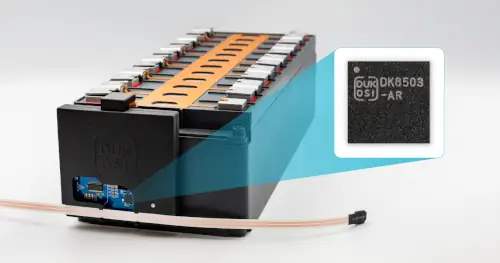
The technology allows communication between the AFEs distributed by the battery and the main processor of the BMS through a contactless network, replacing part of the wiring and connectors traditionally used to transmit this data.
DK-NFLNK is independent of the AFE manufacturer or model and uses the C-SynQ communication protocol developed by Dukosi.
The solution is available for evaluation and development in batteries intended for electric vehicles, industrial and marine applications, robotics, energy storage systems, telecommunications infrastructure, and data centers for artificial intelligence.
Communication between the AFE and the BMS
The DK-NFLNK is designed to act as a communication link within the battery pack itself. Its architecture consists primarily of the DK8503 Node chip, the DK8203 System Hub, a software API, and the C-SynQ-based contactless communication protocol. The DK8503 connects directly to the analog front panel (AFE) via a standard SPI interface. Being independent of the AFE, it can be integrated with various designs based on multi-channel analog front panels without the system being dependent on a specific model of this component. Data obtained from the AFEs is transmitted to the main processor of the battery management system (BMS) via the DK8203 System Hub.
A single bus antenna
Instead of using individual wired connections between the different modules and the main controller, DK-NFLNK employs a single bus antenna for communication. The system uses near-field communication within the battery pack.
According to the architecture described by Dukosi, this implementation allows for operation at reduced radio frequency power levels, simplifying certain considerations related to mechanical and electromagnetic integration within the battery. Eliminating some of the wiring and physical connectors also reduces the number of connection points between modules.
Synchronized measurements at the module level
DK-NFLNK enables the transmission of synchronized measurements from various AFEs to the main processor of the BMS. Measurement synchronization is crucial for determining the status of different battery components and coordinating decisions made by the management system. Communication is organized using a star topology, with the DK8203 System Hub acting as the central element for information exchange with the various nodes. The contactless network itself provides electrical isolation between communicating elements, eliminating the need for a conductive connection to transmit data.
Reusability between different battery designs
The architecture is designed to reuse certain components across battery packs with different configurations. The same main processor in the BMS and the DK8203 System Hub can be used in various battery pack designs. Dukosi also provides a common library and API for the different DK-NFLNK configurations. This approach allows for maintaining a common software base when developing different battery packs, reducing the modifications required at the communication layer.
AEC-Q100 certification and design for ASIL C
The DK8503 and DK8203 circuits are AEC-Q100 certified. AEC-Q100 establishes various qualification requirements for integrated circuits used in automotive applications, including tests related to temperature, electrical stress, and reliability. Dukosi also indicates that both components have been designed to meet the requirements associated with ASIL C.
ASIL (*Automotive Safety Integrity Level*) is part of the ISO 26262 standard for functional safety for road vehicles and establishes different levels of safety integrity based on the risk associated with the system.
Electric vehicles, storage and data centers
DK-NFLNK is designed for high-power battery systems used in various sectors. Intended applications include electric vehicles and other xEV platforms, industrial systems, vessels and marine equipment, and robotics applications. The technology can also be used in battery energy storage systems (BESS), including grid-connected projects and large-scale storage systems. Other areas under consideration include telecommunications infrastructure and energy storage systems used as backup power in data centers, including facilities supporting artificial intelligence workloads.
Migration to Smart Cell batteries
DK-NFLNK shares the C-SynQ protocol with Dukosi's DKCMS system. This common foundation allows for a transition from conventional multi-channel AFE-based architectures to designs where monitoring is performed at the cell level using the company's Smart Cell architecture. DK-NFLNK thus functions as a communication layer that can be integrated into existing designs without initially replacing the AFE-based monitoring architecture.
DK-NFLNK Assessment Kit
Dukosi has also made available to developers a DK-NFLNK EVK evaluation kit for testing and initial prototype implementation. The kit is aimed at battery pack developers and BMS designers who want to evaluate the integration of the technology with different mainframes and AFE devices. The DK-NFLNK EVK includes a DK-NFLNK Node board and a Dukosi System Hub unit.
A DK-NFLNK resistive splitter board is also available as an option. The kit includes the necessary cables for USB and SPI connections, as well as a bus antenna and a coaxial cable. The evaluation environment is completed with a graphical interface for Microsoft Windows, a DK-NFLNK user guide, software documentation, and a printed circuit board design guide.
Evaluation kits and samples of DK-NFLNK are now available for development and initial integration testing in battery systems.