And in that cycle, after-sales service is the point where the technological promise is validated under real conditions.
Speed, service and results: the new standard in technical support
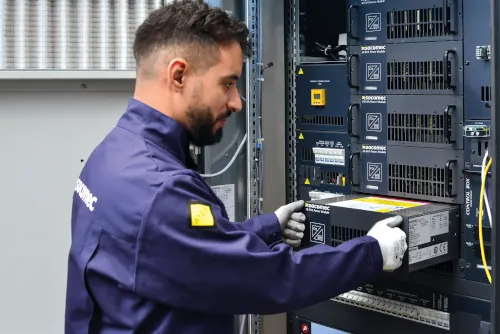
A paradigm shift has redefined what is expected of specialized technical service. Speed is no longer measured solely by contractual response times, but by the actual ability to minimize the impact of an incident. Every minute counts when a critical load is at stake. The difference between an effective intervention and a delayed response translates into financial losses, contractual penalties, or unacceptable service interruptions. Human interaction has also become crucial. In high-critical environments, the client is not just looking for a technician; they need a contact person who understands the gravity of the situation, knows their installation, and is committed to resolving it. In the opinion of Santiago Macías, After Sales Project Manager at Socomec, trust is built when the client perceives that “they are not talking to a ticket number, but to an expert who understands the real impact of an outage on their business and is committed to the solution until the very end.”
The immediate results complete this equation.
Excellent technical service goes beyond simply following a standard protocol; it provides expert judgment, accurate diagnosis, and definitive solutions. In an increasingly digital market, the combination of remote support, data analysis, and on-site presence has become essential. Customers expect technical expertise, but also close operational support.
As a manufacturer specializing in electrification solutions for critical applications, Socomec understands that the value of its technology lies in its service. This philosophy is evident in its figures from last year, during which it carried out 4,851 technical visits, with preventive maintenance accounting for a significant 46% of these interventions. This is not a minor figure, but rather demonstrates a strategy focused on anticipation, detecting deviations before they become failures.
Special mention should be made of the activity related to the commissioning of critical infrastructure. In 2025, 378 interventions related to this process were carried out, including commissioning visits, additional actions, and pre-commissioning work.
• Pre-commissioning is not a mere formality; it is a critical phase where the electrical infrastructure, installation, and environment are validated to ensure they meet the necessary conditions for safe and compliant commissioning. Reviews of wiring, protection devices, ventilation, electrical parameters, and system consistency allow for the detection of deviations that, if left uncorrected, would compromise the equipment's future reliability. This approach drastically reduces subsequent incidents and shortens time to service.
• Commissioning (PEM) is the moment when the solution ceases to be a blueprint and becomes an operational asset. Here, the manufacturer's experience makes all the difference. In-depth knowledge of the equipment allows for adjusting parameters, validating behavior under real-world loads, and ensuring that the system responds correctly to failure scenarios. It's not just about turning on the equipment, but about certifying that the infrastructure is ready to operate under real-world criticality conditions. The result is a high volume of technical service activity that covers more than 5,850 UPS systems and 1,900 locations with daily contractual reviews; this translates to an average of two technical interventions per day per specialist, 90 search incidents handled throughout the year, and nearly 1,500 cases managed by the call center. Because behind these figures lies organization, methodology, and, above all, a service culture closely aligned with customer needs. This has allowed them to maintain a failure rate of 14%, an indicator consistent with well-monitored and properly maintained installations. As Macías himself points out, the market has evolved from corrective maintenance to a model that demands speed, expert advice, and optimization capabilities. Socomec responds to this demand by combining its status as a manufacturer with a readily available technical service, capable of performing under pressure and providing definitive solutions when they are most needed.