


The data confirms it. According to the Industry and Energy Forum (FIE) and Opina 360, 85.7% of substations in Spain are already saturated, and the capacity available for new connections has fallen from over 10 GW to 7,363 MW, after losing almost 2.8 GW in just two months. In total, more than 5,200 substations can no longer absorb new loads, with saturation particularly pronounced in the north and center of the country.
Far from being an isolated case, this situation reinforces the urgent need to strengthen, digitize, and better manage the grid to avoid bottlenecks that hinder electrification. The question is clear: is the current electrical infrastructure prepared to simultaneously handle the electrification of transport, buildings, and industry?
The problem: more load, more variability, more electrical risks.
Mass electrification implies a significant increase in connected power and greater load variability. Electric vehicles introduce concentrated peak demand, especially in urban environments. Electrified buildings with advanced HVAC systems add significant seasonal and daily fluctuations. Meanwhile, electrified industry incorporates continuous and, in many cases, nonlinear loads—such as variable frequency drives or DC/AC processes—that affect grid stability.
This combination of factors creates three key challenges:
1. Progressive overloading of the grid, with increasingly saturated substations and less capacity for new connections.
2. More variable and difficult-to-predict loads, with simultaneous peaks during peak hours, such as the charging of electric vehicle fleets.
3. Deterioration of the quality and reliability of supply, with harmonics, voltage dips, and fluctuations affecting sensitive equipment and critical processes.
The Essential Need for Measurement to Control
As may be obvious, the first step to achieving efficient and optimized management of an electrified network is to obtain the greatest possible real-time visibility of what is happening at each node, branch, and consumer. Without accurate data, any control strategy is reactive, inefficient, and risky.
Advanced measurement of consumption, power quality, and imbalances becomes an essential starting point for:
• Detecting phase imbalances that can cause conductor overheating or premature equipment failure.
• Analyzing consumption patterns associated with electric vehicle fleets, building HVAC systems, and industrial processes.
• Integrating AC and DC data, crucial when load sources include both traditional loads and fast DC charging systems.
Without granular and continuous measurement, electrification is managed blindly, which can lead to inefficiencies, unnecessary oversizing, and even failures at critical points in the network. In this context, Socomec, with over 100 years of experience in the energy sector, provides solutions designed to address the current challenges of electrification.
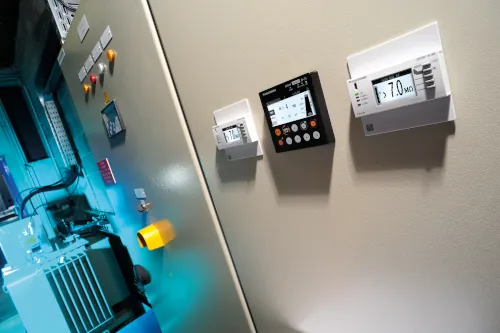
For advanced monitoring, the DIRIS Digiware multipoint system allows for real-time measurement, analysis, and management of electricity consumption and power quality. Thanks to its modular and scalable architecture, DIRIS Digiware facilitates the rapid identification of inefficiencies, the application of corrective measures, and compliance with regulatory requirements in industrial, commercial, and critical infrastructure environments.
Stabilizing and Ensuring Continuity:
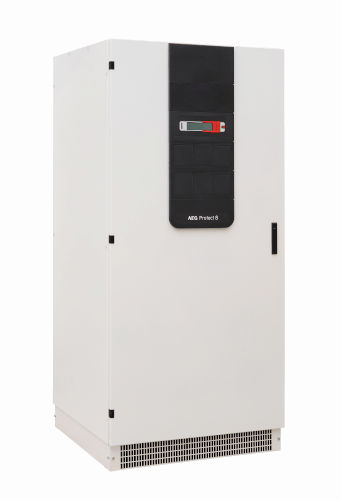
As dependence on electricity increases, continuity of supply ceases to be a temporary backup and becomes a constant operational requirement. In this context, Socomec's modular UPS systems (Modulys XM, XS, and GP) not only respond to outages but also:
- Filter disturbances
- Stabilize voltage
- Protect critical processes
In industry, smart buildings, and data centers.
Thanks to their modular architecture, these systems provide scalability and redundancy, allowing them to accommodate load growth without compromising electrical continuity.
The ultimate challenge: safety and availability.
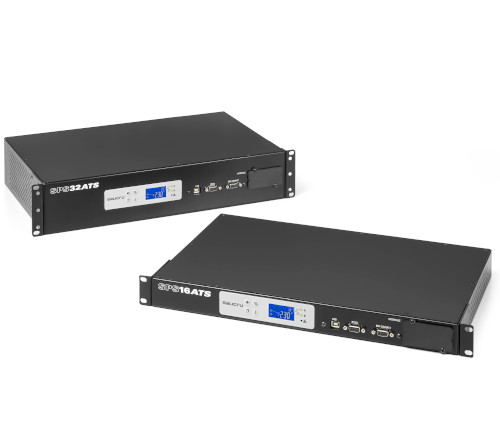
Electrification means working with multiple power sources—grid, generators, or storage—and in environments where even millisecond downtime is unacceptable, ultra-fast switching between sources is critical. In applications such as data centers, hospitals, or continuous industrial processes, STATYS ensures continuity of supply through immediate transfers, preventing operational disruptions.
At the same time, the increasing complexity of installations—with electric vehicle chargers, renewable generation, and batteries—demands electrical safety and reliable switching. In this context, SIRCO disconnect switches, designed for low-voltage AC and DC circuits (up to 415 V), allow for safe opening and closing under load, facilitating maintenance, protecting personnel and equipment, and adapting infrastructure to grid changes.