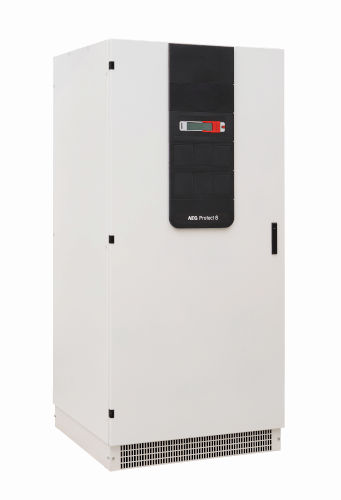
Power demand can fluctuate from 0% to 100% in milliseconds, generating erratic on/off cycles that place a high level of stress on the electrical infrastructure. Uninterruptible power supplies (UPS) must now also function as dynamic power conditioners, capable of reacting in real time to these load variations. Failure to do so can cause these pulses to be reflected back into the electrical grid or backup generators, compromising the overall stability of the system or even causing failures.
Vertiv provides critical infrastructure technologies, including high-capacity power converters. Its Power Center in Bologna needed to validate new input power smoothing algorithms for its Vertiv™ Trinergy™ UPS systems. These systems intelligently draw power from the UPS batteries during peak loads, protecting upstream generators from erratic AI load behavior.
The units feature an advanced topology, with two three-phase AC mains inputs, one DC battery input, and one three-phase output. Each of these signals needed to be monitored simultaneously. The teams needed to capture long-duration thermal data and high-time-resolution measurements to analyze waveform distortion, noise, and total harmonic distortion (THD) during fast switching events. Active, reactive, and apparent power also needed to be characterized to fully understand power quality under stress conditions. With a high number of channels, currents up to 5000 A requiring stringent safety controls, as well as the need for 24/7 reliability, intermittent anomaly capture, and long-term thermal logging, the instrumentation challenge was considerable. Vertiv implemented a fully integrated measurement ecosystem from Yokogawa, based on the WT5000 precision power analyzer, the DL950 ScopeCorder, the GM10 data acquisition system, and the IS8000 software platform. The WT5000 power analyzer provides the core power analysis. With an accuracy class of 0.03% and compatibility with up to seven input modules, it allows Vertiv engineers to simultaneously measure AC and DC power. The instrument offers harmonic analysis up to the 500th order, essential for assessing power quality and validating efficiency even under dynamic load conditions.
The ScopeCorder DL950 captures the transient behavior of pulsed loads. Configured with 16 channels, it combines the capabilities of a high-speed oscilloscope with those of a long-term data logger. It accurately captures voltage and current waveforms during rapid switching events, facilitating the identification of high-frequency noise and verification of the system's dynamic response time without losing critical information. Yokogawa's IS8000 software connects and synchronizes these domains using the IEEE 1588 Precision Time Protocol (PTP). This platform integrates data from the WT5000, DL950, and GM10, which monitors the system's thermal points. This configuration generates a single, time-synchronized dataset where thermal stress, energy efficiency, and waveform distortion can be analyzed together.
Luigi Balma, from Vertiv's R&D team, explained: “The Yokogawa ecosystem is the best solution for us, as it allows us to simultaneously visualize many variables—voltage, current, AC and DC—on a single screen, with time coherence.” In addition to directly enabling the validation of its patented input power smoothing technology, the integrated solution has transformed the workflow in the Bologna laboratory. The ability to visualize thermal, electrical, and waveform data on a single IS8000 interface has significantly reduced testing complexity and debugging time. Thanks to Yokogawa's high-precision validation, Vertiv continues to develop next-generation data center technologies.