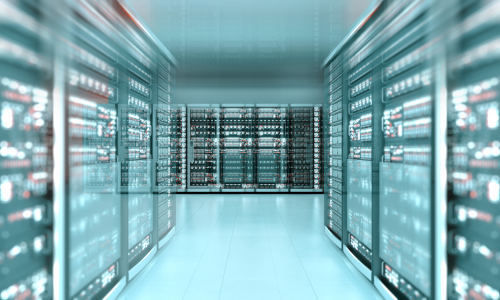
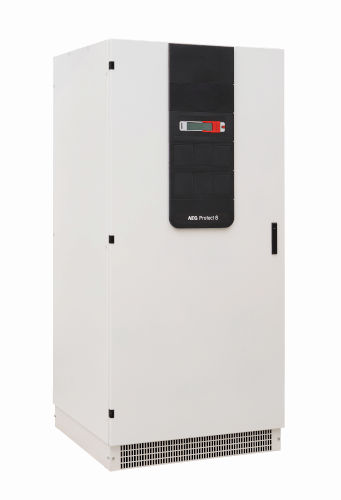
In recent years, the growth of communications and data networks, further driven by the expansion of artificial intelligence (AI), has multiplied the need for advanced electrical protection systems. This scenario has fostered the construction of large data centers and the deployment of edge infrastructures equipped with thousands of electronic devices that require a stable and secure power supply.
Cloud and edge: two models with different energy needs.
The architecture used to process the enormous volume of data generated by today's networks can be centralized or distributed. This leads us to talk about cloud and edge computing environments.
The choice between these two models depends on factors such as:
the location where the data is generated,
the required response speed
, the scalability of the infrastructure
, operational resilience,
and information security.
Both cloud and edge infrastructures share a fundamental aspect: they originate from an alternating current (AC) electrical grid, while telecommunications equipment and data centers operate on direct current (DC). Therefore, AC/DC conversion is essential to ensure the operation of these critical infrastructures.
UPS Systems: Continuous Power Protection Against Outages.
One of the most widely used solutions to guarantee power continuity is the Uninterruptible Power Supply (UPS). These systems store energy in batteries and perform the AC/DC conversion necessary to provide a stable, clean, and continuous power supply.
The main function of a UPS is to protect equipment against electrical incidents such as:
Power outages,
Overvoltages,
Voltage fluctuations
, Harmonics and electrical disturbances
In the event of a total power grid failure, the UPS continues to supply power to critical equipment, preventing service interruptions and potential data loss.
DC power systems for telecommunications and edge data centers
Pure DC power architectures are also commonly used in telecommunications and edge data center environments. These DC power systems are specifically designed to ensure maximum availability and protection of critical infrastructure.
Its main advantages include:
High reliability and redundancy,
Modular and scalable design,
Greater energy efficiency,
Reduced electricity consumption,
Compact size for local installations
The most common applications of DC power systems include fixed and mobile communication networks, railway infrastructure, electrical substations, and edge data centers.
In the railway sector, for example, DC power systems offer high immunity to electrical disturbances and robust operational reliability, essential factors for signaling and control equipment, where failure is unacceptable.
The growth of edge computing is driving new electrical protection needs.
Edge computing solutions are deployed locally and require compact and efficient infrastructures, very different from large cloud data centers. However, both models will continue to coexist in a rapidly expanding market driven by digitalization and artificial intelligence.
In this context, both UPS systems and DC power solutions play a key role in ensuring operational continuity, energy efficiency, and electrical protection for data centers, telecommunications networks, and critical infrastructure.