

The grid, conceived over decades under assumptions of stability, predictability, and centralized generation, now operates in a radically different context: massive penetration of renewables, accelerated electrification of end uses, industrial digitalization, and a critical dependence on processes that cannot tolerate interruptions, not even for milliseconds.
Thus, the uncertainty surrounding a potential new blackout stems not only from recent memory but also from the technical analysis of current operating conditions. Grids are operating closer to their thermal and dynamic limits, with narrower safety margins. Furthermore, the inherent variability of photovoltaic and wind power generation introduces fluctuations in active and reactive power that directly affect voltage and frequency stability. These factors are compounded by the aging of key infrastructure, increasing exposure to extreme weather events, and the operational complexity resulting from an increasingly interconnected and bidirectional grid.
From an electrical perspective, a power outage is rarely a sudden, isolated event. On the contrary, it is usually the end result of a series of imbalances, such as out-of-band frequency oscillations, voltage collapses at weak nodes, cascading trips of poorly coordinated protective devices, or saturation of power components. Even without reaching a total blackout, companies deal with the daily reality of micro-outages, voltage dips, transient overvoltages, and harmonics that degrade equipment, corrupt data, and reduce the lifespan of assets.
In this scenario, energy resilience ceases to be a theoretical concept and becomes a strategic priority. It's not just about restoring power after a failure, but about anticipating, absorbing, and isolating disturbances before they result in an operational interruption.
From Fragility to Continuity: How Risk Accelerates Demand for Backup Systems.
After the blackout, many organizations discovered that their true weakness wasn't the duration of the event, but their inability to manage it. A mere second of voltage drop was enough to halt production lines, corrupt databases, or force costly and slow-to-reverse emergency shutdowns. This lesson is driving a clear and sustained demand for backup and power quality solutions.
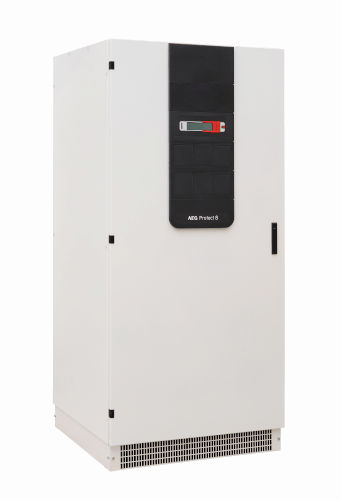
Uninterruptible power supply (UPS) systems have evolved from a defensive element to an active component of the electrical architecture. Online double-conversion topologies, with continuous regulation capabilities, allow critical loads to be completely decoupled from grid disturbances. They are no longer sized solely to cover a prolonged blackout, but to manage repetitive micro-outages, frequent switching, and environments with high harmonic distortion.
At the same time, energy storage is acquiring a structural role. Batteries—increasingly integrated into hybrid systems—allow for the absorption of peak demand, smoothing of power ramps, and the provision of synthetic inertia to internal networks. In industrial and commercial environments, storage ceases to be a passive backup and becomes a resource that optimizes daily operations and reinforces stability in the face of external events.
Finally, AC and DC protection completes this ecosystem. The growth of electronic loads, variable frequency drives, data centers, and photovoltaic systems introduces new fault currents and risk profiles. Proper selectivity, rapid tripping, and adaptation to mixed architectures are critical to preventing cascading failures. Added to this is power quality management: harmonic filtering, reactive power compensation, and phase imbalance control—aspects that directly influence overall reliability.
It is at this point that resilience ceases to be an abstract concept and materializes into concrete engineering decisions. Decisions that require experience, a systems perspective, and proven solutions.
Socomec: Resilience Engineering Applied to Operational Reality.
Discussing energy resilience without acknowledging the role of leading specialized manufacturers would be incomplete. In this new paradigm, Socomec has established itself as a key player in the development of energy management, protection, and storage solutions focused on service continuity.
Its approach stems from a deep understanding of the grid and its loads. In the UPS field, the company offers highly efficient, scalable systems designed for integration with advanced storage, capable of operating as a true energy buffer against grid fluctuations. These solutions go beyond simply supplying power during an outage; they stabilize voltage, filter disturbances, and ensure clean power in highly sensitive environments.
Regarding energy storage, Socomec has developed platforms that allow batteries to be managed as a dynamic asset. Integration with monitoring and control systems facilitates peak shaving strategies, selective backup, and support for the internal network, reinforcing energy autonomy without compromising the safety or lifespan of the equipment.
AC/DC protection and isolation is another key pillar. In installations where traditional networks coexist with distributed generation and electronic loads, the ability to accurately isolate faults makes the difference between a localized incident and a general outage. Socomec's solutions are designed to respond quickly and reliably, maintaining selectivity even in complex scenarios.
Finally, power quality management acts as the invisible thread connecting the entire system. Advanced measurement, critical parameter analysis, and active correction allow for anticipating problems before they occur. In an uncertain environment, visibility is a form of control.