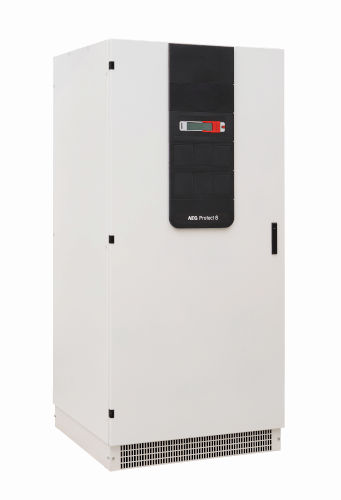
In this context, uninterruptible power supply (UPS) systems have become central components of any electrical infrastructure. They are responsible for absorbing disturbances, filtering harmonics, maintaining power to sensitive loads during micro-outages, protecting against catastrophic failures, and sustaining operations when the grid goes down. They guarantee operational resilience and provide stability to structures where every millisecond matters.
Two Architectural Approaches: Modular and Monolithic.
After years of evolution in these types of solutions, two predominant types coexist in the market: modular UPS and monolithic UPS. Both fulfill the same mission, although their philosophy and structure are different. This difference gives rise to very particular behaviors in terms of maintenance, availability, scalability, and total cost of ownership.
• Modular UPS: Building Blocks for Resilience: The modular UPS is composed of interchangeable power modules, each with its own control and capacity. This segmentation is the key point: the total power is obtained by adding modules, which allows for scalable and redundant configurations. In many critical architectures, it is already common to see solutions such as MODULYS XM or MODULYS XL, from Socomec, in next-generation data centers, or MODULYS GP in hospitals and industrial processes that require absolute continuity. Even in smaller IT environments, it is practical to work with compact and scalable solutions like MODULYS XS.
• Monolithic UPSs: consolidated power in a single unit: At the opposite end of the spectrum, we find the monolithic UPS. All the power is concentrated in a single chassis and a single conversion system. This simplicity is one of its greatest advantages. When an environment has very stable loads and legacy rooms where the infrastructure is not designed for distributed configurations, a monolithic model like the DELPHYS XM is usually a natural fit.

Advantages and Considerations of Different UPS Architectures
To make an informed decision, it's advisable to delve into the strengths and limitations of each approach.
Advantages of Modular UPS: Modular architecture was developed for environments where continuity is non-negotiable, with strengths such as:
• High availability: Each module operates in parallel, preventing a single point of failure. If one module fails, the others maintain the load. This raises a key question: What is the value of this level of fault tolerance when a single minute of downtime can cost millions?
• N+1 redundancy: Redundancy is implemented naturally. Simply integrating an additional module ensures sufficient power even if one module fails.
• Hot-swap maintenance: Modules are replaced under load. There's no need to divert power or shut down systems. This feature completely changes operational management and reduces human risk.
• Scalability: Increasing power is a matter of adding modules. This approach allows for growth at a realistic pace, aligned with the installation's evolution. Do you recall any projects where the final capacity far exceeded the initial forecast? In these cases, a modular system prevents over-sizing from day one.
• Lower MTTR: the average repair time is minimal. In many cases, simply replacing the affected module is sufficient, reducing both risks and costs.
• Extended lifespan: the modular architecture allows for the replacement of critical components without compromising the rest of the system. This prolongs the operational lifecycle and delays complete overhauls.
Challenges of Modular UPS Systems: However, modular UPS systems are not the perfect solution for all types of electrical environments, presenting certain challenges that must be considered from the design phase:
• Higher initial cost: The modular approach requires a larger initial investment. Although the ROI is often offset by increased availability and reduced downtime, this is a factor that must be evaluated.
• Integration complexity: The system requires a more sophisticated architecture in both design and commissioning. This implies technical expertise and a clear vision of the growth roadmap.
• Dependence on the control system: Each module needs coordination. The system's central processing unit is critical, and managing multiple elements requires robust and fully reliable control.
Advantages of the Monolithic UPS. The monolithic UPS is based on a clear premise: a single unit that directly handles power supply. Its strengths include:
• Simplicity: the topology is more straightforward. Fewer components mean fewer internal interactions and less operational complexity.
• Unified power: all capacity is contained in a single chassis. This feature is well-suited for rooms with limited space or where a compact installation is desired.
• Lower initial cost: the initial investment is usually lower compared to an equivalent modular system.
• Suitable for stable environments: this architecture is a perfect fit for predictable loads without significant growth. In fact, in legacy buildings where the electrical infrastructure is already established, it is common to see solutions like the DELPHYS XM operating for years with excellent reliability.
Problems with monolithic UPS systems: While their simplicity is appealing, they present significant challenges:
• A single point of failure: If the system fails, the entire load goes down. Can you imagine this scenario in an operating room or a production AI cluster?
• Invasive maintenance: Many interventions require shutting down or bypassing the system, forcing planned maintenance windows and entailing operational risks.
• Limited scalability: Capacity is restricted to the size of the chassis. If the installation grows, the only solution is usually to replace the entire UPS.
A decision that must be based on criticality, growth, and redundancy.
Field experience shows a recurring pattern: UPS systems fail due to poor architecture, insufficient maintenance, and operational errors. This analysis aligns with the technical perspective of specialist manufacturers like Socomec. What does this mean in practice? That choosing between modular and monolithic solutions is not an academic exercise; it directly impacts operational risk throughout the system's lifecycle.
If you require absolute continuity, constant evolution, or near-100% availability, the modular approach, with product families like MODULYS XM, MODULYS XL, MODULYS GP, or MODULYS XS, is usually the natural choice. If the environment is stable, the load will not increase, and the installation is constrained by legacy architecture, a monolithic system like DELPHYS XM can offer a reliable and cost-effective solution.
Article provided by Socomec