

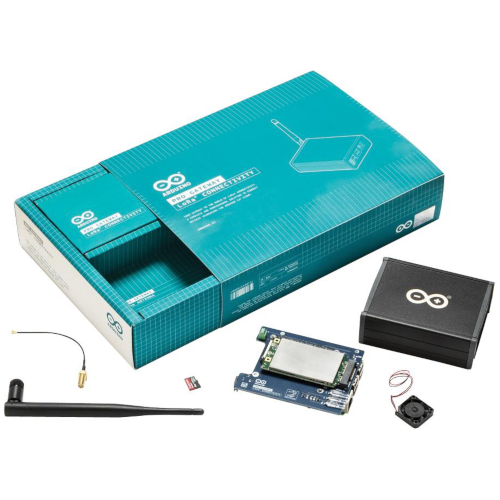
The Arduino Pro Gateway Kit seamlessly integrates with the Arduino MKR WAN 1300 development board, enabling existing Arduino users to design and prototype long-range, low-power Internet of Things devices within a familiar Arduino environment without switching platforms. Gateway setup, provisioning, and remote management are greatly simplified through the Arduino Create platform, allowing users to leverage LoRa connectivity in numerous potential applications, such as:
• Automated meter reading
• Environmental monitoring
• Smart cities
• Home automation
• Security and alarm systems
• Industrial control
• Irrigation systems
• Agricultural monitoring
The new Gateway is built around Semtech's SX1301 digital baseband chip: a powerful digital signal processing engine that enables stable connections between the Gateway and a large number of wireless endpoints deployed over a wide range of distances. The Arduino Pro Gateway offers up to eight LoRa channels in the 868 MHz frequency band, allowing it to receive up to eight LoRa packets simultaneously, making it ideal for LoRaWAN gateway applications.
The Gateway includes a "Listen Before Talk" (LBT) anti-collision feature, allowing users to transmit at a higher power on the first available channel, thus achieving greater range than conventional LoRa gateways. It also comes pre-installed with an optimized transporter and a highly reliable LoRaWAN network server, running on the Arduino cloud provided by A2A.
In addition to the Gateway with LoRa connectivity and the SX1301 baseband chip, the kit includes:
• A Raspberry Pi adapter
• An aluminum case
• The Raspberry Pi 3 Model B+
• A 5V power supply
• An Ethernet cable
• An external antenna
Hari Kalyanaraman, Global Head of Emerging Businesses and Single Board Computers at Premier Farnell and Farnell element14, comments, “The Arduino Pro Gateway kit, in combination with the Arduino Create platform, offers an easy-to-deploy gateway solution that enables LoRa connectivity in a wide variety of applications, including environmental monitoring, industrial control and automation, smart cities, and more. This allows engineers to develop LoRa applications and bring them to market quickly.”.
.