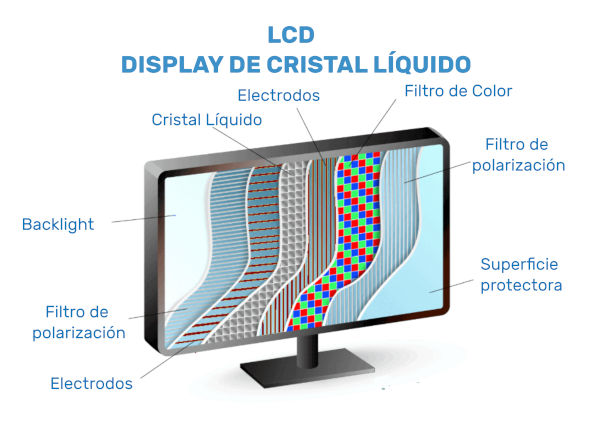
LCD screens are composed of several layers:
• Two transparent glass plates: These contain and protect the liquid crystals.
• Liquid crystals: A substance that can change its optical properties under the influence of an electric field.
• Polarizing filters: These allow light to pass through only in a specific direction.
• Electrodes or alignment layer: These are transparent layers placed on the inside of each glass plate.
• Backlight: This illuminates the screen from behind, usually using LEDs.
• Color filters: Composed of pixels, each made up of three subpixels: red, green, and blue (RGB).
At the heart of an LCD screen are the liquid crystal molecules, unique for their ability to align in a specific direction when subjected to an electric field. These molecules are formed by long, rod-shaped structures that have both liquid and solid properties. In their natural state, liquid crystal molecules are randomly oriented, resulting in a dark appearance when light passes through them.
To understand how LCD molecules work, let's take a closer look at the basic structure of an LCD panel. The two glass plates serve to contain a thin layer of liquid crystal material. The inner surface of each glass plate is coated with a transparent electrode that allows an electric field to be applied through the liquid crystal layer.
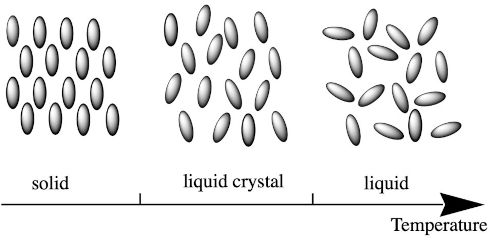
The liquid crystal molecules in an LCD screen are typically of two types: twisted nematic (TN) and vertically aligned (VA). In a TN LCD, the molecules align at a specific angle, usually 90 degrees, between the two crystal plates when no electric field is applied. This twisted arrangement allows light to pass through the liquid crystal layer and reach the viewer.
When an electric field is applied to a TN LCD, the liquid crystal molecules begin to unwind, aligning themselves parallel to the electric field. This realignment changes the polarization of the light passing through the liquid crystal layer, preventing it from reaching the viewer. By controlling the electric field, the amount of light passing through the LCD screen can be precisely regulated, resulting in different brightness levels.
On the other hand, VA LCD screens work differently. In a VA LCD screen, the liquid crystal molecules are initially aligned vertically, perpendicular to the glass plates. When an electric field is applied, the molecules tilt, allowing light to pass through the liquid crystal layer. As with TN LCDs, the degree of tilt can be controlled by adjusting the voltage, thus controlling the brightness.
Although LCD molecules ultimately function by manipulating the alignment of the liquid crystal structures through the application of an electric field, and this controlled realignment allows the LCD to regulate the passage of light, it is not the only fundamental component of an LCD. For it to work, we need the backlight to generate enough illumination for proper viewing.
The light generated by the backlight must pass through a polarizing filter that directs the light in a single direction, so that when it passes through the liquid crystal layer it is homogeneous. This polarized light interacts with the liquid crystal molecules, changing its polarization direction, so the second polarizing filter only allows light that has been polarized in the correct direction to pass through.
As we've discussed, the amount of light passing through each pixel is controlled by the voltage applied to the electrodes. Pixels with higher voltage appear brighter, while pixels with lower voltage appear darker.
Color production takes place in the color filter layer, which is located between the second glass and the second polarizing filter. Since each pixel is composed of red, green, and blue subpixels, the combination of these primary colors creates a wide range of colors. Currently, millions of colors can be reproduced with this system, under the control of the electrodes that regulate the amount of light passing through each subpixel.
To achieve high resolutions, such as 8K or 4K, an LCD screen must have a large number of pixels. This is achieved by reducing the size of the individual pixels and increasing the number of electrodes in the electrode layer. However, as the number of pixels increases, so does the complexity of the screen and the need for greater precision in controlling the orientation of the liquid crystal molecules.
This whole set allows us to enjoy viewing images and videos with incredible resolutions and vibrant colors.
For more information Or to choose an LCD with special features for your project, Steliau Technology Iberia: