This article analyzes the relationship between Time-of-Flight (TOF) MS parameters and ADC specifications. Mixed-front-signal (MxFE®) ADCs demonstrate that low-noise, high-speed ADCs can greatly improve TOF MS metrics, including mass accuracy, mass resolution, and sensitivity.
Introduction to Time-of-Flight
Mass Spectrometry (TSMS) is an analytical technique for quantifying known and unknown molecules within a sample based on molecular weight. By ionizing elements and/or molecules in the sample into gaseous ions, with or without fragmentation, and then separating them in a mass analyzer, the elements and/or molecules are characterized by their mass-to-charge ratio (m/z), or pulse location, and relative abundance, or pulse amplitudes, in mass spectra.
A mass spectrometer consists of three main components: the ion source to produce gaseous ions from the sample under test, the mass analyzer to separate the ions according to their m/z ratios, and the ion detector to detect the ions and the relative abundance of each ionic species. The detector output is conditioned and digitized to produce a mass spectrum. Several mass analyzers exist with fundamentally different strategies for separating ions of different m/z values. Figure 1 shows the main building blocks of quadruple MS and time-of-flight (TOF) spectroscopy.
In TOF MS, ions formed by a short ionization event are accelerated by an electrostatic field such that ions of different m/z values have the same kinetic energy but different velocities. The ions then travel along a field-free drift path and arrive at the detector with different times of flight: lighter ions arrive before heavier ones, as illustrated in Figure 2. In practice, the time of flight of a packet of ions of the same m/z is distributed to form a pulse that can be as narrow as a few hundred picoseconds (ps) due to differences in the initial spatial distributions and energy (or velocity) in the acceleration region. Each pulse is the sum of signals corresponding to multiple independent ion arrival events and is often characterized by the full-width-to-half-maximum (FWHM) parameter.
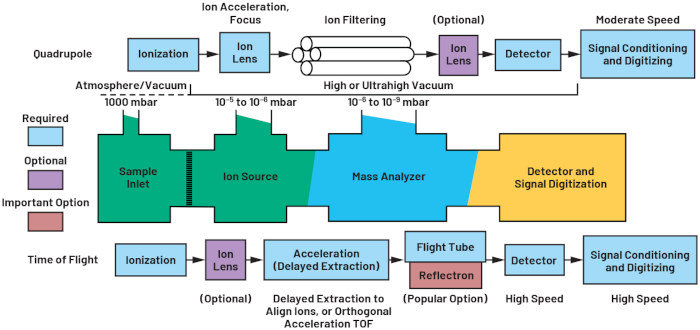
Figure 1. Main blocks of quadruple MS and TOF.
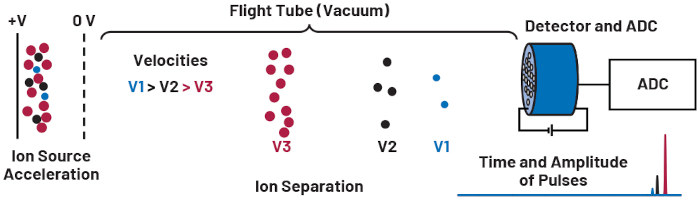
Figure 2: Illustration of a time-of-flight mass analyzer.
A detector, such as a microchannel plate (MCP) detector, detects incoming ions and produces a pulsed electrical current. This electrical current is recorded using a time-to-digital converter (TDC) or a high-speed digital-to-analog converter (DAC). While the TDC can be extremely fast, up to a few ps, it has a limited dynamic range for recording pulse amplitude. High-speed ADCs can achieve 2 or more gigasamples per second (GSPS) with a bit resolution of 10 bits, 12 bits, or even higher, enabling accurate recording of both pulse timing and amplitude. We will discuss important specifications of high-speed ADCs that influence the performance of time-of-flight mass spectrometry (TOF) scanning.
Applications of TOF MS:
MALDI technology ionizes matrix molecules, typically organic acids, and simultaneously vaporizes sample molecules with ultraviolet (UV) laser pulses ranging from hundreds of ps to a few nanoseconds (ns). In the gas phase, matrix molecules transfer protons to sample molecules, thus protonating them and turning them into charged ions. Because the matrix absorbs most of the laser energy, the sample molecules retain their integrity without fragmentation or decomposition, making MALDI the most compelling ionization method for analyzing biological macromolecules. Thanks to the easy coupling between MALDI and TOF MS, the unlimited mass range, high sensitivity, and high throughput, TOF MS has become an essential tool for biomedical research, drug discovery, and clinical applications where the analytes are often macromolecules.
In particular, MALDI-TOF MS plays an irreplaceable role in the clinical identification of bacteria thanks to its faster turnaround time of 4 hours, compared to over 72 hours for conventional or other novel technologies.<sup>3</sup> A short turnaround time is critical for the care and outcomes of patients suffering from bacterial infections. Other advantages of MALDI-TOF MS include ease of sample preparation, low operating costs, and the ability to identify some rare bacteria. Given that antimicrobial resistance poses a serious threat to human health worldwide, there is a growing trend toward using MALDI-TOF MS as a point-of-care device.<sup>4</sup>
Key TOF MS Parameters:
The ability of TOF MS to quantify different analytes in assay samples depends on many factors, including the choice of sample ionization method, the configuration and timing characteristics of the electric fields used to accelerate and guide ions toward the ion detector, detector efficiency, and signal digitization. We will limit our discussion to the key TOF MS specifications related to signal digitization, including mass range, mass accuracy, mass resolution, repetition rate, and sensitivity.
The mass range is the range of molecular weights of the sample molecules and is related to several factors, such as the accelerating voltage, the length of the flight tube, the sampling frequency, and the repetition rate. Mass range requirements vary depending on the application. For example, bacterial identification using MALDI TOF MS measures ribosomal markers in the mass range of 2,000 Da to 20,000 Da.
Since mass is calculated from time of flight, the mass accuracy of Time-of-Flight Mass Spectrometry (TOF) is primarily determined by the accuracy of the pulse timing measurements. In practice, the arrival time of each pulse is calculated by fitting the pulse to a Gaussian function and finding the peak. The ADC sampling rate determines the number of samples for an individual pulse and is critical for pulse fitting.
Mass resolution is a measure of the closest distinguishable separation between two neighboring pulses in the spectrum. It is often defined as the ratio of the ion mass to the width of the corresponding mass pulse. A typical definition of pulse width is the Full Weight Mass (FWHM). The narrower the pulse, the higher the mass resolution, meaning better differentiation between two ion packets with similar molecular weights. Although mass resolution can be significantly improved by orthogonal acceleration and reflectrons, the ADC sampling rate and noise performance also affect this key specification.
In time-of-flight mass spectrometry (TOF) mass spectrometry, the mass spectrum is the sum of signals from many repetitions rather than a single transient, encompassing a single ionization, acceleration and drift, and ion detection and digitization process. Crucially, for assay samples containing multiple molecules of varying molecular weights and concentrations, a single ionization event may not produce ions from all molecules of interest, nor in proportions commensurate with their concentrations. Summation is an effective and practical method for reducing this sampling error and improving the signal-to-noise ratio (SNR). Therefore, the repetition rate is an important and practical specification of TOF MS for SNR and throughput.
The latest TOF MS instruments can achieve a sweep speed of 1 kHz or faster, meaning each transient lasts 1 millisecond (ms) or less. Increasing the ADC sampling frequency shortens the duration of each transient for a faster replenishment rate.
The sensitivity of TOF MS is the ability to detect molecules with the lowest concentrations in the samples. It is collectively determined by many factors, such as background chemical noise, the concentration range of all molecules of interest, the noise figure and dynamic range of the detector and ADC, and the number of transients summed for the final mass spectrum. In practice, system sensitivity can be optimized by identifying the bottleneck factor and/or balancing these factors.
Desired ADC Specifications for TOF MS:
A low-noise, high-speed ADC is critical to the performance of a TOF MS system. As discussed earlier, timing accuracy and system noise level are two important specifications for a TOF MS instrument. While system noise can be mitigated by summing repeated measurements, timing accuracy is determined by the sampling rate and aperture jitter of the high-speed ADC. Considering that pulses can be as narrow as a few hundred ps in a TOF MS instrument with orthogonal acceleration and a reflectron, there are only a few samples for an individual pulse at a sampling rate of 5 GSPS.
Each sample is crucial for finding the pulse peak when the samples are fitted to a Gaussian function. Hence, sampling rate and aperture jitter are desirable ADC specifications.
Sensitivity is determined by the system noise level, which can be improved by summing repeated measurements. However, the number of repetitions limits the instrument's performance. The ADC's noise performance is important for achieving the desired sensitivity with fewer repetitions. There is often a misconception about ADC performance that its SNR is proportional to its bit resolution. ADCs with a sampling rate of 1 GSPS or higher typically use a pipeline architecture and have specifications that include an effective number of bits (ENOB) and noise density/noise figure/SNR/etc. However, daisy-chain ADCs cannot achieve bit resolution because they have several drawbacks that contribute to noise, such as the high-gain, high-bandwidth operational amplifiers needed to reduce errors, capacitor mismatch, and the power dissipation of the front-end operational and sample-and-hold (S/H) amplifiers.<sup>5</sup> The ENOB depends on the input frequency and sampling rate and is calculated using the signal-to-noise ratio and distortion (SNDR). For example, the 12-bit AD9081 has an 8-bit ENOB at 4 GSPS with an input frequency of 4500 MHz. ENOB is not a good measure of the ADC's noise performance.
Noise density is a step closer to the practical noise level, but Gaussian pulse bench testing maintains the basic truth of the ADC's noise performance and, therefore, the sensitivity of the TOF MS instrument.
Bench Test of a Low-Noise, High-Speed ADC:
The MxFE offers intelligent integration of RF ADCs, digital-to-analog converters (DACs), on-chip digital signal processing, and a clock loop/phase-locked loop (PLL) for multi-chip synchronization. MxFE parts with only high-speed ADCs are also available. For simplicity, our bench test used the AD9082, which has integrated ADCs and DACs, as shown in Figure 3. The integrated DAC was used to generate the input signal. This DAC generated a narrow Gaussian pulse train with a full-wavelength half-time (FWHM) of 0.5 ns and amplitude controlled by a combination of digital scaling and external attenuators. Gaussian pulses are much closer to the mass spectrum signal than the typical single-tone signal used for ADC characterization. Two ADC channels are configured to digitize the signal: CH1 for various saturated or attenuated amplitudes by varying the external attenuators, and CH2 as a reference for signal strength above 90% full scale (FS) without saturation. The sampling frequency was 6 GSPS in our test to obtain sufficient samples for each pulse.
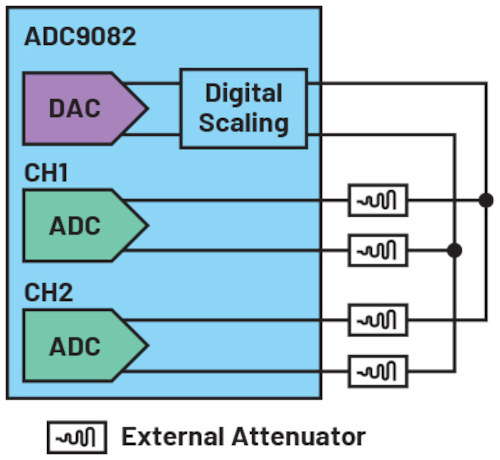
Figure 3. Block diagram for testing the high-speed ADC with the AD9082.
Three types of tests were performed:
Attenuation and saturation tests: CH2 with a pair of fixed 7 dB attenuators as a reference; CH1 with 8 dB, 9 dB, and 10 dB attenuators for attenuation tests and 3 dB and 1 dB attenuators for saturation tests.
Measurement of weak signals with up to 20 dB attenuation: CH2 connected directly to the DAC output as a reference with -16 dBFSC scaling; CH1 with a pair of 10 dB attenuators for the signal.
Noise measurement: CH2 with a pair of fixed 7 dB attenuators as a reference; CH1 with 50 Ω termination.
For each test, data >10 µs were acquired, and the data acquisition was repeated 10 times to verify reproducibility. The data were plotted and analyzed in MATLAB®. The 10 repetitions were aligned and plotted for each test case. Figure 4 shows a single pulse in the test where CH1 is 3 dB lower than CH2. The 10 repetitions were well overlapped for both channels, demonstrating the high reproducibility of the data acquisition.
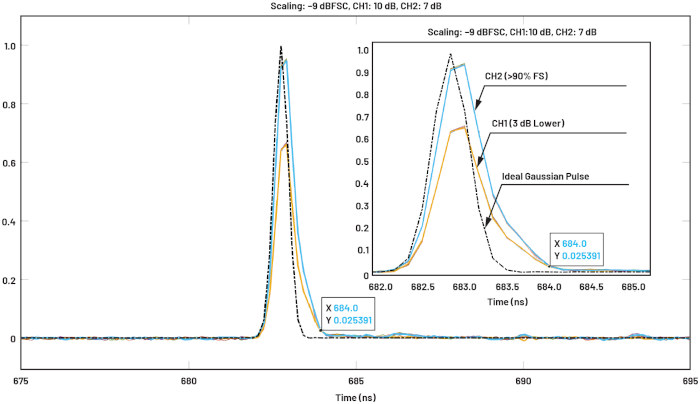
Figure 4. The overlap of the 10 repetitions demonstrated a high reproducibility of the data acquisition.
The AD9082 ADC has an overload protection circuit, which will activate if the input amplitude exceeds the upper limit. A recovery tail often occurs on the falling edge of the pulse if the protection circuit is activated, resulting in a clipped peak at FS and a recovery tail.
A shorter recovery tail is important for accurate time-of-flight (TOF) and mass measurements for time-of-flight mass (TOF) measurements. Figure 5 shows the graph of five cases with either saturation (up to 6 dB) or attenuation.
To test the ADC's performance with a weak input, we acquired the signal attenuated by 10 dB and 20 dB, as shown in Figure 6. The clean signal trace was at 10% of FS, or attenuated by 20 dB, suggesting minimal noise introduced by the ADC.
For the ADC background noise, CH1 was connected with a 50 Ω terminator, while CH2 remained at >90% FS, as shown in Figure 7.
We analyzed the noise data by plotting the histogram and calculating its standard deviation, as shown in Figure 8. The standard deviation in this case was 0.0025, suggesting an SNR of 52 dB at FS.
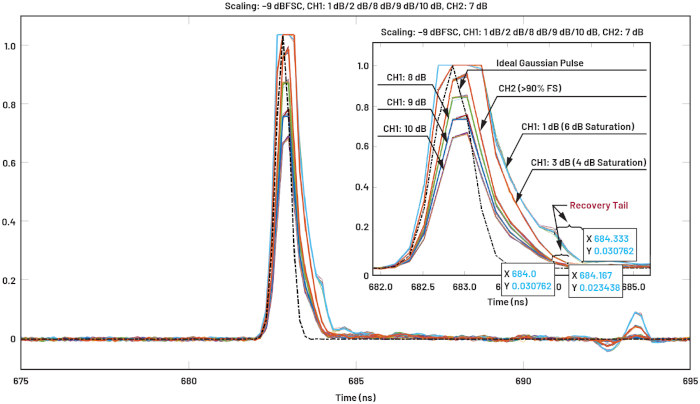
Figure 5. The overlap of the 5 test cases with saturation or over-attenuation.
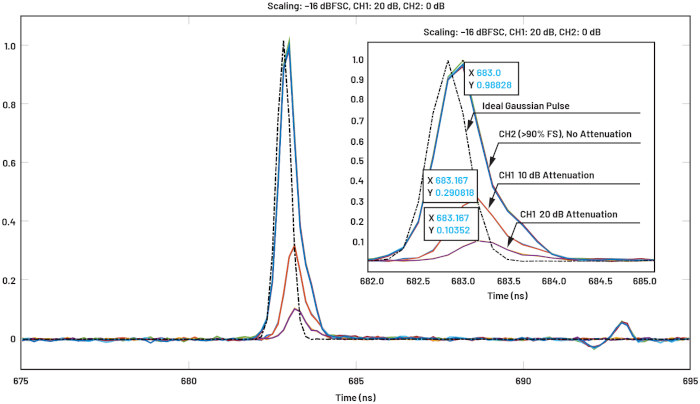
Figure 6. Test cases with input attenuated by 10 dB and 20 dB.
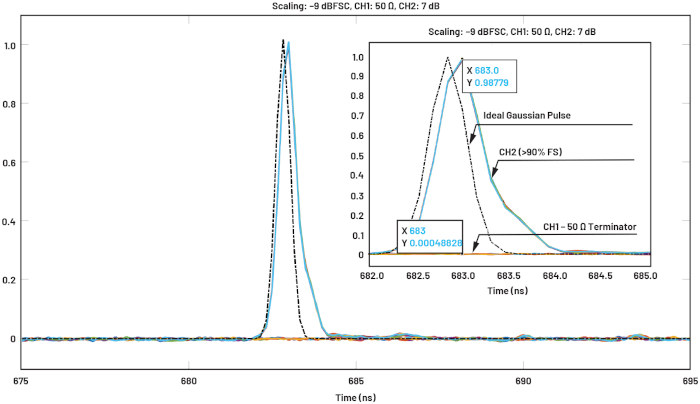
Figure 7. Measurement of background noise with CH1 connected with a 50 Ω terminator.
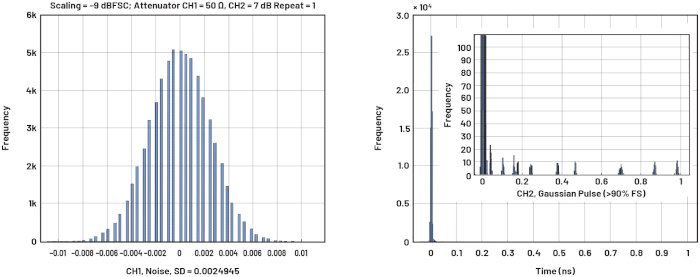
Figure 8. Histograms of the background noise measurement (CH1, left) and of the FS signal (CH2, right).
To further quantify the timing accuracy and noise performance, we segmented each pulse with its peak centered within a 30 ns window. We then fitted each pulse with a Gaussian model to measure its full-wavelength (FWHM). We used 12 ns data on either side, or 24 ns total, of the 30 ns window as the baseline for noise calculation.
Figure 9 shows the complete acquisition plot for the single-pulse, 10% FS input, zoom-in test case with Gaussian fitting and segmented baseline. Table 1 shows the mean and measured FWHM and the calculated signal-to-noise ratio (SNR).
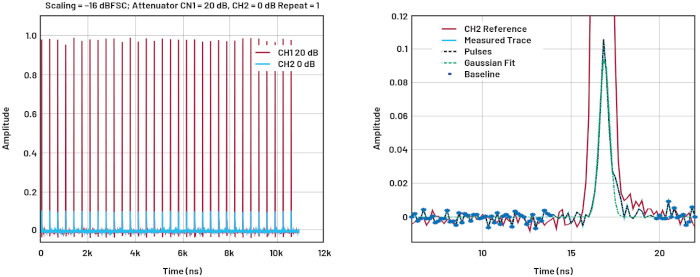
Figure 9. Pulse segmentation and baseline for FWHM and SNR measurement for the 10% FS input test case.
Table 1. FWHM and SNR measurement for the 10% FS input test case
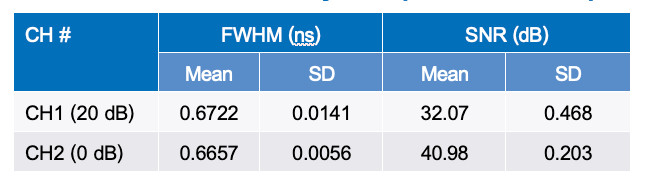
Table 2. Measured FWHM and SNR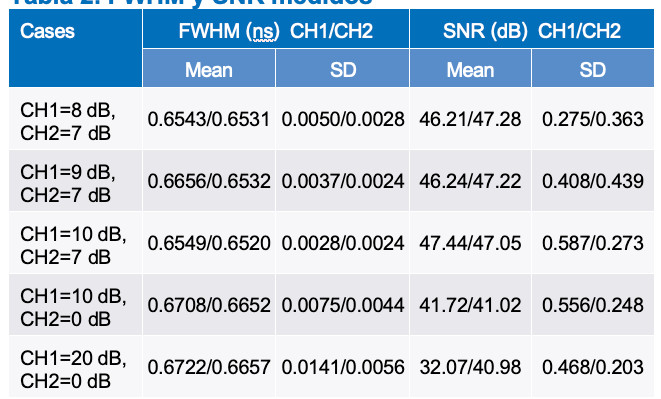
Discussion and Conclusion:
With the establishment of MALDI-TOF MS as the standard for bacterial identification in clinical microbiology laboratories and the growing interest in proteomics for personalized medicine, MALDI-TOF MS is expected to continue its growth momentum in healthcare in the coming decades. TOF MS also has broad applications in biomedical research and drug discovery, food safety, and environmental monitoring due to its advantage for intact molecules with a wide range of molecular weights. With superior noise performance and a sampling rate 3× to 6× faster than the ADCs of the current generation of TOF MS instruments, the low-noise, high-speed ADC is a critical component of the next generation of high-performance TOF MS instruments. The high sampling rate allows for a smaller footprint of the TOF MS instrument without sacrificing performance, as it can reduce the length of the flight tube and, therefore, the load on the vacuum system. A smaller footprint is important for point-of-care applications and various TOF MS field applications.
There are limitations to our AD9082 bench test, including the limited availability of external attenuators for creating test cases with low-amplitude inputs (such as 1% FS, or 40 dB attenuation), impedance mismatch causing data reflection, and open space without electromagnetic interference shielding. The reported SNR of the test cases was lower than the actual value because baseline reflection caused by impedance mismatch was not removed in the noise calculation. MxFE test boards along with graphical user interface (GUI) software are available for more intensive testing. Detailed instructions with the aid of a live demonstration can facilitate the setup of the customer's evaluation system. Prototyping with MxFE samples is easy with guidance from an experienced application team.
The measured FWHM and SNR demonstrate the superior time accuracy and noise performance of the MxFE ADCs. The MxFE's commercially available sampling rate of up to 10 GSPS provides the flexibility needed to design next-generation MS TOF sensors with improved mass accuracy and resolution, increased sensitivity, and an even smaller footprint. Furthermore, MxFE ADCs are supported by power supplies, synchronization products, and controllers that help ensure seamless system integration and optimization.
References
1 Jurgen H. Gross. Mass Spectrometry: A Textbook, 3rd Edition. Springer, 2017.
2 Eva Torres-Sangiao, Cristina Leal Rodriguez, and Carlos Garcia-Riestra. “Application and Perspectives of MALDI–TOF Mass Spectrometry in Clinical Microbiology Laboratories.” Microorganisms, Vol. 9, 2021.
3 Mohammad Y. Ashfaq, Dana A. Da'na, and Mohammad A. Al-Ghouti. “Application of MALDI-TOF MS for Identification of Environmental Bacteria: A Review.” Journal of Environmental Management, Vol. 305, 2022.
4 E. Chabriere, H. Bassène, M. Drancourt, and C. Sokhna. “MALDI-TOF MS and Point of Care Are Disruptive Diagnostic Tools in Africa.” New Microbes and New Infections, Vol. 26, 2018.
5 Chun C. Lee. Dissertation: Improving Accuracy and Energy Efficiency of Pipeline Analog to Digital Converters. The University of Michigan, 2010.
About the author:
Guixue (Glen) Bu is a systems design/architecture engineer in the Instrumentation System Solutions Group, focusing on R&D in the development and applications of scientific instrumentation. He joined Analog Devices in September 2018. He received his bachelor's degree in engineering from Tsinghua University and his master's and doctoral degrees from Purdue University, all in biomedical engineering.
Author: Guixue (Glen) Bu, Systems Design Engineer at ADI