The high-frequency requirement and the need for the smallest possible size mean that power converters must incorporate smaller passive components to offer advantages in terms of size and weight reduction. The trend away from pure silicon and toward high-frequency silicon carbide (SiC) MOSFETs in high-voltage pulsed power circuits has reduced the required space and costs, while increasing efficiency and improving performance.
Thanks to their faster switching speeds, SiC-based devices can operate at frequencies with bandwidths well above 100 kHz. This has opened up possibilities for their use in applications such as uninterruptible power supplies (UPS), solar inverters, AC variable speed drives and servomotors, power factor correction, and computer-controlled welding machines.
However, there has always been a trade-off between performance and response time, and users in various market sectors have strived to find a solution that can meet their increasingly demanding requirements. Although classic transducers in open-loop and closed-loop versions achieve responses up to 300kHz, in the current market they are still not sufficient for the detection needs of a high bandwidth due to the adoption of SiC IGBT (insulated-gate bipolar transistors).
Bandwidth exceeding 1MHz:
A customer in the welding industry contacted LEM, the market leader in providing innovative, high-quality solutions for measuring electrical parameters, because the response times and frequency responses of their existing power converters were inadequate. In response, LEM developed a hybrid transducer that far surpassed the performance levels of any other company on the market.
This hybrid device is a combination of an application-specific integrated circuit (ASIC) and a DC-based transducer with a pure inductive coil to accelerate the signal. Thanks to the pickup coil integrated into LEM's ASIC, the transducer is able to react like a current transformer. While existing AC transducers based on a pure coil can achieve higher levels, no DC transducer incorporating open-loop technology and a pickup coil can operate with bandwidths exceeding 1MHz—until now.
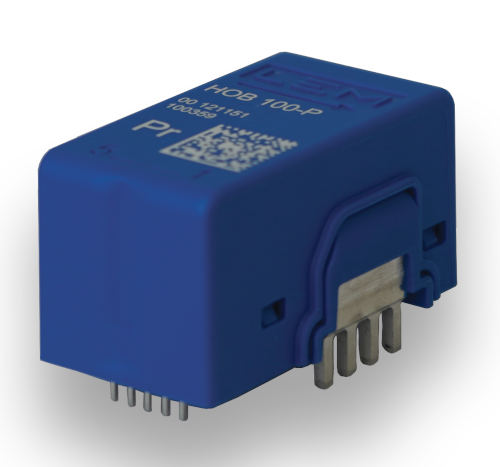
LEM's solution – the HOB family, consisting of approximately 20 low-power, multi-range current sensors capable of measuring AC, DC, or pulse currents up to 250A – was developed to meet high-bandwidth detection requirements when using fast-switching SiC MOSFETs in high-voltage pulsed power circuits where fast, flexible high-voltage pulses are critical. The customer specifically sought a high-performance solution that would provide fast response times and increased bandwidth, all in a smaller footprint.
A Completely Different Semiconductor Technology:
While a closed-loop sensor has typically been a high-cost option for any industry seeking to achieve these goals, LEM expects its hybrid transducer will soon be attractive to various markets looking to adopt any type of switched-mode converter based on SiC and GaN (gallium nitride) power modules with a wide bandwidth. The growing trend toward switched-mode converters is driven by the need for devices and equipment that are as small as possible and have a better power-to-weight ratio.
Thanks to what LEM calls “a completely different semiconductor technology,” the very high-speed SiC or GaN transistors not only guarantee faster switching times but can also operate at higher frequencies and withstand higher voltages. The company expects this transistor technology to be the norm in just five years.
However, in the HOB family, far more important than bandwidth frequency is response time—the time between the primary current and the transducer output. This factor has been key for LEM's customer, who realized that transistors switching at ever-increasing speeds must have a current transducer capable of tracking di/dt (the rate of change of current) as closely as possible.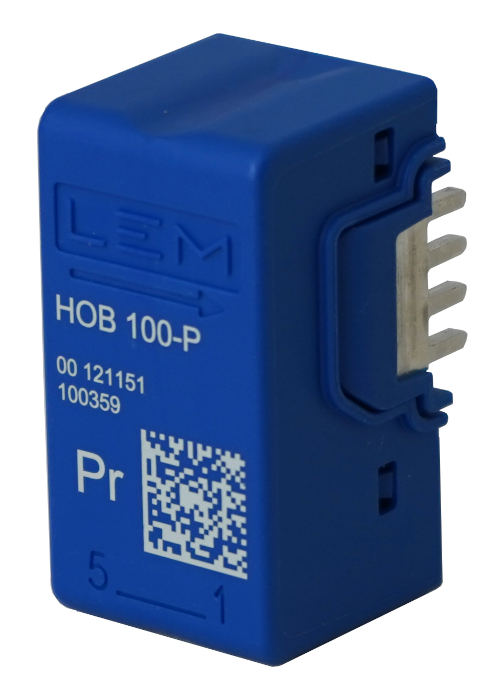
Response times starting at 100ns.
Traditionally, while di/dt could reach up to 500A per microsecond (possibly even 1kA/µs) with this technology, the response time in other transducers was around 1.5 microseconds. LEM committed to providing its customer with a response time of up to 200 nanoseconds. And not only did they meet this target, but they improved upon it with the new HOB family and its pickup coil, which offers a response time of 150ns (10 times faster than anything else on the market). In some cases, the response time was as low as 100ns.
Models belonging to the HOB family offer nominal currents of 50A, 75A, 100A, and 130A, while the currents for peak power (Ipm) are 2.5 times these figures. The special (SP) models within the range are custom-designed to meet specific user requirements, but all have a cutoff frequency (at -3dB) above 1MHz. The standard HOB transducer family uses a 5V power supply (with a 2.5V reference voltage), while other models have 3.3V, 3.4V, and 3.5V power supplies. All models can operate at temperatures from -40°C to +105°C.
Other features that set the HOB sensor apart from its competitors include galvanic isolation between the primary and secondary circuits, an integrated bus bar, and an innovative, space-saving design achieved through-hole (THT) mounting on the printed circuit board.
The Future of Hybrid Technology:
The hybrid transducer, which occupies the same footprint as previously available transducers, is based on technology that LEM has successfully supplied to the automotive industry. However, thanks to its smaller size and superior performance, LEM expects this technology to expand into other domains as transistor manufacturing costs decrease, automation increases, and production rises.
The future of this new hybrid technology is expected to be secure as the market grows for applications requiring very low cost, excellent performance, and high response time. Among the extremely demanding applications that are a perfect fit for LEM's new device are portable plasma cutters, welders, and DC/DC converters, as well as the aforementioned UPS market, switched-mode power supplies, AC and servo motor variable speed drives, and static converters for DC motor drives.
LEM is already receiving customer requests for a PCB-mounted transducer offering current ratings of 300A, 600A, and above. While it is difficult to predict exactly how quickly demand will evolve, LEM is positioned to supply an open-loop multi-range current sensor to a wide range of markets. This sensor features unprecedented response times and frequency bandwidth, as well as reliability, low power consumption, low noise, and improved immunity to dv/dt (acceleration) to which SiC power modules can be subjected.
LEM – Life Energy Motion.
LEM, a leading electrical measurement company, develops best-in-class energy and mobility solutions to ensure customers' systems are optimized, reliable, and safe. Our team of 1,500 people in more than 15 countries transforms technological potential into powerful solutions. LEM develops and employs the world's best talent working at the forefront of major trends such as renewable energy, mobility, automation, and digitalization.
Thanks to its innovative electrical solutions, LEM helps its customers and society accelerate the transition to a sustainable future. LEM has been listed on the Swiss Stock Exchange (SIX Swiss Exchange) since 1986 under the symbol LEHN.
www.lem.com