BGA packages have better electrical performance and I/O density, making them ideal for space-constrained and high-volume applications.
Therefore, choosing between LGA and BGA is crucial, as it will directly affect the performance of your boards and assembly costs. This guide breaks down the key differences between them and offers information on when to use each in your projects. Let's read on.
What is LGA (Land Grid Array)?
LGA stands for Land Grid Array. It is an integrated circuit packaging technology that, instead of pins, features an array of contacts on its underside. These contacts connect to a socket on the circuit board. It offers high pin density, excellent thermal performance, and a compact size, and is commonly used in industrial controllers, server processors, and embedded electronics.
What is BGA (Ball Grid Array)?
BGA (Ball Grid Array) is an integrated circuit (IC) package characterized by an array of solder balls on its underside, which serve as interconnection points and are soldered directly to the PCB. This design allows for shorter electrical connections, reduces signal loss, and improves performance in high-speed applications.
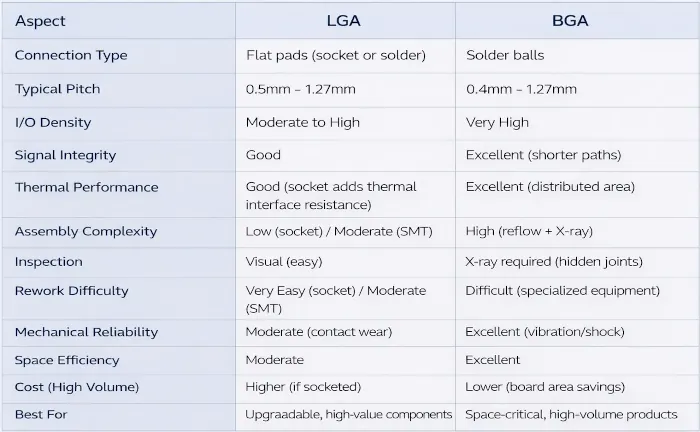
LGA vs BGA Comparison Table
LGA vs BGA: 5 Key Differences Explained
LGA and BGA differ significantly in structure, performance, and suitability for applications; here we list the 5 key differences:
Connection Methods and Structure:
The BGA connects to the PCB by reflow soldering its solder balls to form permanent connections. The LGA, on the other hand, uses flat metal traces that can be pressed against the socket contacts or soldered directly to the board.
Electrical Performance:
The BGA offers superior electrical performance compared to the LGA because its signal paths are shorter and its inductance is lower. The LGA has socket contacts, which add extra resistance and cause signal degradation, especially at high frequencies.
Thermal performance:
BGA offers a firm, discreet connection that allows heat to be dissipated through the PCB itself, but heat can accumulate between the component and the PCB. In contrast, LGA with a socket provides better airflow around the component and facilitates heatsink mounting for improved thermal management.
Inspection Method:
BGA assemblies require X-ray inspection because their solder joints are hidden under the packages. However, socketed LGAs can be visually inspected because they use mechanical contacts instead of soldering.
Rework and Replaceability:
Because BGAs are permanently soldered to the PCB, their removal and replacement is difficult and requires specialized rework equipment. LGA packages can be easily removed and replaced if sockets are used.
LGA vs BGA_ Key Differences
How to choose between BGA and LGA packages?
Choosing an integrated circuit package isn't about finding the best one, but rather about ensuring its attributes meet your project's needs. Below is a practical framework you can use to make your decision:
Use LGA when:
Component replaceability is essential. If your board requires field upgrades or component replacement, an LGA socket configuration is the ideal choice. It allows for easy replacements and repairs.
It works with components that have fewer pins. LGA provides solid mechanical support and facilitates visual inspection of integrated circuits with fewer pins.
Your application faces mechanical stresses. LGA offers greater physical stability than BGA in environments with vibration, shock, or jolt.
Budget is a key concern. LGA manufacturing is less expensive than BGA, making it ideal for projects with tight budgets.
Use BGA when:
Pin density is important. BGAs have a matrix-based connection structure used to support complex integrated circuits with extensive I/O requirements.
Thermal management is a priority. BGA packages offer excellent heat transfer, making them ideal for high-power processors and high-performance chips.
Electrical performance is crucial. BGAs offer shorter signal paths, reducing interference and protecting signal integrity in high-speed circuits.
A compact design is required. BGA packages occupy less PCB space than LGAs and are therefore widely used in portable and space-constrained devices.
Conclusion
LGA and BGA are two common packages widely used in electronics, each with its own advantages and disadvantages. Neither is inherently better than the other. When choosing between them, it's crucial to determine your project's specific requirements, such as: Will this project require upgrades or rework? If so, you should choose LGA with a socket. What is the end application? If the board size is small, you should choose BGA, as it takes up less space. If your project will be used in a harsh environment, you should also choose BGA or surface-mount LGA, which offer greater mechanical strength.
In short, between LGA and BGA, there's no better or worse option, just the one that best suits your needs. Evaluate your requirements and choose the right one.
Frequently Asked Questions
What is the difference between BGA and LGA?
BGA uses solder balls to connect to the circuit board permanently, while LGA uses flat contact pads that connect via sockets or by direct soldering to the board.
What are the disadvantages of BGA?
To check the quality of the BGA assembly, an X-ray inspection is necessary, and reworking is also difficult since the components are difficult to replace once soldered.
Is it possible to solder LGA packages directly to PCBs?
Yes, in addition to using sockets, LGA packages can also be soldered directly to the board as surface mount components.
LGA vs BGA: Is BGA more reliable in the long run?
Compared to a socketed LGA, then yes. BGA packages are soldered to the circuit board, providing greater mechanical strength and increased resistance to vibration and impact.
Author: shenjie, UNITYPCB