

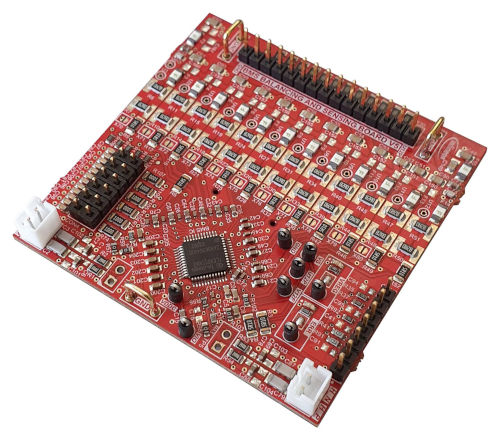
Although lithium-ion and other widely used technologies have greatly increased battery energy density and made these types of products possible, they require significantly more care than older chemistries to maximize the time between charges and the product's lifespan. Simply connecting a power source to the terminals and disconnecting it once the internal voltage has reached a sufficient level is not enough.
Battery Technology Challenges:
Lithium-ion batteries, in particular, are vulnerable to factors such as overcharging. This not only damages the cells but can also be dangerous. Overcharging increases the pressure inside the cells and can cause a thermal runaway, which can lead to the battery catching fire. That's why all charge controllers on the market incorporate overcharge protection.
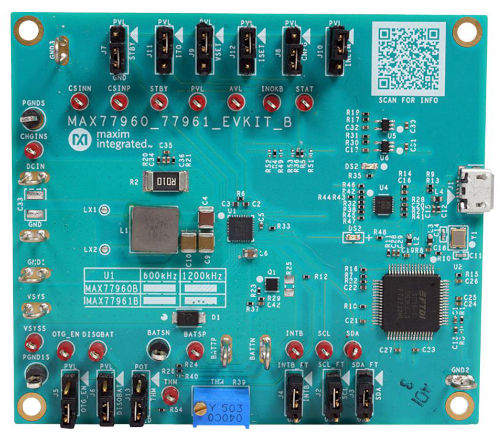 Maintaining high levels of battery life and maximum charge requires a high degree of control over the process from start to finish. The MAX77960B and MAX77961B, designed by Maxim Integrated, are two examples of how this can be achieved in portable systems. Such a device charges the battery in three successive phases: pre-charge, constant current, and constant voltage. The pre-charge phase is used to properly prepare the battery for full charge, which is important to prevent damage if the cells have been almost completely discharged. The process involves supplying a small current initially. The charger uses both measurements and a safety timer to verify that this phase is completed successfully and, if not, reports an error to the main microcontroller.
The other two modes require a compromise. Constant current charging is the fastest method, but it risks damaging the battery because it involves higher current levels that can cause overheating. That's why battery charge controllers include temperature sensor inputs to restrict power if the battery gets too hot. Typically, when the battery is nearing full charge, the charge controller will switch to constant voltage mode. This prevents overheating and helps improve battery life, but it significantly slows down the charging process.
Improved charge control offers other advantages. It allows for optimizing the overall system size and weight, not only of the battery itself but also of the power supply circuitry. Some charge controllers are highly integrated. For example, the MC34674 from NXP Semiconductors is a fully integrated charger for single-cell lithium-ion and lithium-polymer batteries, optimized for travel applications, requiring only an external LED to indicate the charging status, two decoupling capacitors, and a thermistor circuit with a connection to detect the battery temperature.
Chargers and Voltage Conversion for Power Supply:
The same need for high integration with few passive components applies to DC/DC converters used to condition and deliver power to the various devices in the system, with their specific voltage and current requirements. The large number of power rails required, even in relatively small portable devices, ranging from 1 V for a digital system-on-a-chip (SoC) to 12 V or more for analog I/O, makes compact solutions even more valuable. By using fewer external passive components and reducing conversion losses, the charger and regulator circuitry can be smaller and operate without bulky heatsinks on the power transistors, thus enabling compact and efficient system designs. One way the MAX77960B and MAX77961B help improve density is by acting as both buck converters and chargers: supplying power to the portable system whenever the battery supply voltage is higher than the desired output voltage.
Whether based on rechargeable or non-rechargeable chemistries, battery voltage will decrease as the cells discharge. If this voltage falls below the converter's operating range, the remaining charge in the battery will be wasted, resulting in shorter-than-expected battery runtimes. Using DC/DC conversion with both buck and boost operation allows for the extraction of the maximum possible charge.
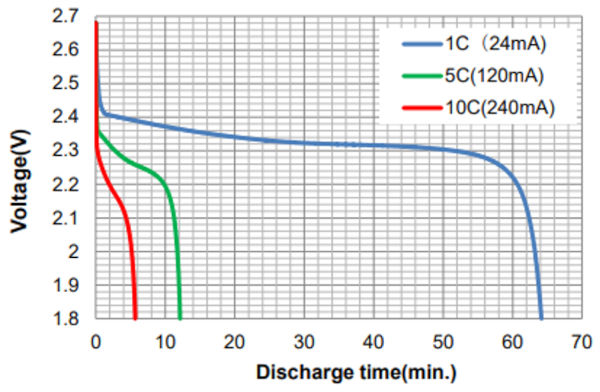 Figure 1. Discharge current characteristics: The graph shows the output voltage as a function of time when a battery is being discharged. Source: https://www.farnell.com/datasheets/2305652.pdf
The ability to support low-power shutdown modes is vital for Internet of Things (IoT) devices, such as environmental sensors and wearables designed to monitor health and well-being. These devices sleep for extended periods and wake up for a fraction of a second before returning to sleep mode. With such short duty cycles, low quiescent current is crucial throughout the system, including in the power management circuitry. The MAX710ESE+ buck-boost converter developed by Maxim, for example, allows the linear regulator subsystem to be used exclusively during these sleep modes to limit current consumption and prevent battery drain during prolonged periods of inactivity.
Battery Monitoring and Management:
In many applications, it is equally important to know how much charge remains and to monitor the current flow to each cell in a battery pack. The combination of these two elements can be crucial for automotive systems, as drivers will not want to be far from a charging point if the estimate is incorrect or if an imbalance results in insufficient voltage being supplied because several cells have become excessively discharged. In all systems, accurate charge estimation helps optimize charging time and capacity management. Currently, some systems leverage these measurements to slow charging and improve battery lifespan by comparing the current charge to the expected usage. In many cases, dedicated products are available for battery management and monitoring.
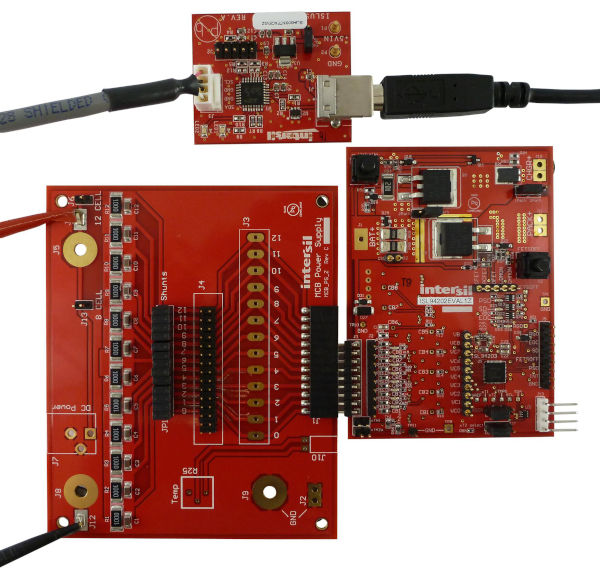 The Renesas ISL94202 is designed for batteries containing up to eight cells and provides autonomous pack control without the need for a supervisory microcontroller. The device automatically manages cell balance within the pack and has several protection features to prevent overcurrents and other problems. Another example is the Infineon Technologies TLE9012AQU, which performs four main functions: measuring cell voltage, measuring temperature, balancing cells, and providing isolated communication to a central battery controller. This combination of functions makes the device well-suited for larger automotive and communications systems where multiple battery packs are required in parallel. To ensure accuracy when measuring cell status, a 16-bit resolution A/D converter monitors each cell.
Modern vehicle designs may incorporate several different battery subsystems to power various parts of the vehicle, from the drivetrain to the infotainment system. Many manufacturers are now planning to eliminate the low-voltage battery used to power auxiliary circuitry and instead use the higher-voltage transmission battery to power in-cabin equipment as well. This requires not only DC/DC converters optimized for maximum power reduction but also battery management systems capable of handling a complex power topology. NXP's range of battery management and support integrated circuits, such as the MC33771C, is designed to meet a wide range of requirements. These devices support isolated daisy-chain communication to transmit information to a central microcontroller and can measure current synchronously across the various battery packs.
At the other end of the spectrum, and to support the growing use of Internet of Things (IoT) sensors, energy harvesting is becoming an important method for supplementing the power available to wearable and battery-powered devices. Energy harvesting enables security sensors and other low-power devices to operate for many years without battery replacement or connecting the device to the electrical grid.
A common configuration is to combine a disposable battery, such as a lithium coin cell, with a rechargeable device, either a supercapacitor or a small lithium-ion battery. Energy harvesting technologies do not always deliver the charge efficiently, and the sources often operate at high impedance. Therefore, careful circuit design is necessary to minimize losses. Maxim's MAX20361 offers designers an integrated solution capable of harnessing energy from solar cells and supplying a useful charge to downstream circuitry. The integrated boost converter can operate from input voltages as low as 225 mV.
integration
into systems as straightforward as possible. Design support from experienced engineers at distributors like Farnell ensures that teams receive the best advice on which devices to use for each application.
Author: Cliff Ortmeyer, Global Head of Technical Marketing at Farnell