Image 1: Some of the applications for which NCAB produces printed circuits in the railway sector are PCBs for control centers and trains.
However, given the criticality of many railway applications, another fundamental standard to consider would be IEC 61508.
Standards – IEC 61508
This is the reference standard for functional safety in E/E/PE
(Electrical/Electronic/Programmable Electronics) systems.
- Specific architecture to meet a SIL (Safety Integrity Level).
- Methodology for obtaining FCC (Federal Communications Commission) approval. It does not consider the concept of Fail Safe.
The standard establishes three fundamental principles
: - Zero risk "can never be achieved"
- Intolerable risks must be reduced
- Safety management must be considered from the outset
This regulation is, in turn, the basis for other standards that apply to the railway sector, such as CENELEC.
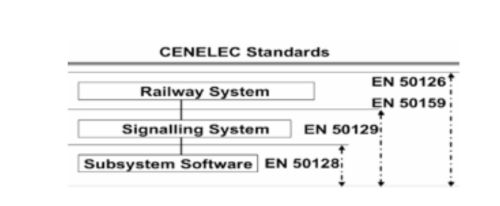
CENELEC Standards:
CENELEC (European Committee for Electrotechnical Standardization) is responsible for
European standardization in the areas of electrical engineering. Along with ETSI (telecommunications) and CEN (other technical areas), it forms part of the European system of technical standards. Although it works actively for the European Union, it is not an EEC institution.
CENELEC's work is primarily based on IEC (International Electrotechnical Commission) publications, although its own standards are also developed by CENELEC's technical staff.
The CENELEC standard is divided into three standards:
- 50126 (IEC 62278)_Generic standard for a system: Life cycle and its phases
(requirements, design, manufacturing, validation, etc.), organization and roles necessary to ensure safety, RAMS concept (Reliability, Availability, Maintenance and Safety) of a railway system, Command, Control and Signaling (safety management).
- 50128 (IEC 62279)_Software standard: Equivalent to the generic standard, but for software (it does not cover RAMS, which is more hardware-related). Railway applications, Railway Control and Protection Systems.
- 50129 (IEC 62425)_Complements 50126 and covers more aspects related to hardware and programmable logic such as FPGAs. For example, identifying and ensuring that a system is (more or less) safe and justifying this.
Within the CENELEC standard, another important standard to consider (besides those for electromagnetic compatibility testing and environmental tests such as temperature and vibration) is the insulation coordination standard (50124-1). This standard applies specifically to the design of PCBs regarding insulation between conductors of different shields and between metallic surfaces, and includes tests to verify compliance.
How do CENELEC 50126/28/29 differ?
50126 applies to all railway systems, 50129 is specific to signaling systems, and finally, 50128 is the standard to consider for programming software subsystems.
Therefore, it's clear that as PCB designers, we can say that the specific reference standard for designing printed circuit boards for railway applications would be EN 50129.
EN 50129 standard.
This specification includes the following aspects:
Technical Safety
- Design Description
- Technical Safety Principles
Guarantee of correct operation
- System architecture and definition of interfaces
- Compliance with system requirements and security requirements
- Guarantee of correct HW and SW operation
Effect of failures
- System behavior under failures
Operation under external influences
- Climatic, mechanical, electrical and more severe conditions
Application conditions related to safety
- System configuration and manufacturing, operation and maintenance
- Safety monitoring during maintenance, system removal, disposal and results reporting.
FMEA (Failure Mode and Effect Analysis) - Systematic evaluation of failure
models.
Inductive method: bottom-up, HW systems (processes for failure modes (understanding "failure" as a loss of functionality), causes, and effects), identifies the "single-point" of failure.
FMEA results contribute to design improvements, testing, and risk analysis
.
Why is it important to apply CENELEC standards correctly?
Applying these standards facilitates access to international markets,
leading to greater competitiveness and savings in both time and money by
identifying errors before PCB manufacturing.
The key is to apply the standard from the very beginning of the design process.
The fact is that to facilitate the implementation of a PCB in a railway application,
the CENELEC standard must be considered from the outset
of any new design.
Some common best practices to keep in mind from the beginning are:
- Structuring the schematic appropriately by grouping logic blocks and inputs and outputs to minimize connection traces, thus largely avoiding parasitic resistive and capacitive effects.
- Subsequently applying the standard to the PCB layout, selecting a trace width sufficient to allow the maximum current to flow through them. The minimum spacing between traces will depend on the voltage they must withstand.
NCAB's local offices have a technical team of engineers capable of providing advice on PCB design, covering aspects such as efficiency, manufacturing technology, and sustainability, as well as regulatory compliance in demanding sectors and applications like rail and similar industries.
This expertise stems from 30 years of experience, a presence in over 15 countries, and an annual production volume of more than 350 million PCBs for high-performance applications.
Please feel free to contact NCAB Group Iberia at +34 915 398 877 with any PCB-related inquiries.
Author: CELIA FERNANDEZ, FIELD APPLICATION ENGINEER NCAB